
Almost Seven Years Later and It's Still All About Central Bank Liquidity
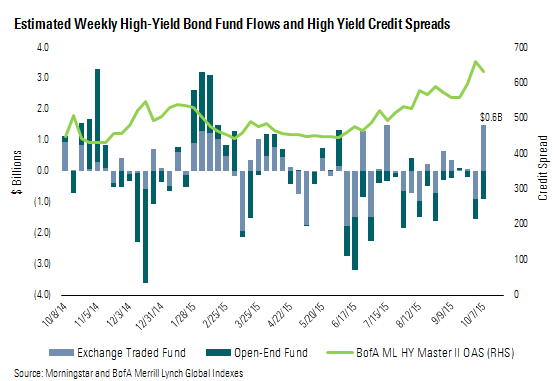
Indicative of the demand for corporate bonds, fund flows in the high-yield sector increased $0.6 billion.

The buy-the-dip crowd came out in force last week, and traders were stunned by the pace of the snapback. The turnaround was driven by a combination of bad-news-is-good-news logic (weak economic metrics will force central banks to keep the liquidity spigot open) and a good-news-is-good-news theme as commodity prices stabilized and then rose higher, driving a V-shaped rebound in bond prices in the energy and metals and mining sectors. For example, in the United States, the employment report the prior week dramatically missed expectations and the prior month was revised sharply downward. Although there are two more payroll reports before the December Federal Open Market Committee meeting, the market is pricing in a higher probability that the Fed won't begin to raise the federal funds rate until well into 2016, based on the poor showing in employment data. Considering that the FOMC does not have a press conference scheduled for the January meeting, if it does not raise rates in December, then the next most likely action would not be until March.
In the eurozone, headline inflation dipped into deflationary territory, which prompted reports that the European Central Bank may need to increase the size and duration of its quantitative easing program. The Bank of Japan held off on expanding its monetary easing program in early October but is widely believed to be considering additional monetary stimulus at its next meeting. Expectations are that the BoJ will cut its long-term economic forecasts. In an attempt to stem the decline in property prices, China's regulators reduced the minimum down payment required by first-time homebuyers. Property prices in China have continued to decline over the past year despite several interest rate cuts and decreases in reserve requirements.
Early indications suggest that the pace of economic expansion in China may be much slower than generally believed. As a result, for companies with significant exposure to China, third-quarter earnings releases may be especially volatile over the next few weeks. For example, at the end of September, Caterpillar CAT (rating: A-, wide moat) reduced its revenue forecast and earnings guidance based on softness in its mining, oil and gas, construction, and rail business lines, which we attribute to slowing emerging-markets infrastructure spending. Also, Yum Brands YUM (rating: BBB, wide moat) reported earnings that missed expectations. Management attributed the miss to its China division and reduced its same-store sales guidance in the region. Alcoa AA (rating: BB+/UR+, no moat) missed analysts' estimates as well. Management lowered its estimates in China for automotive and heavy-truck production and commercial and construction sales.
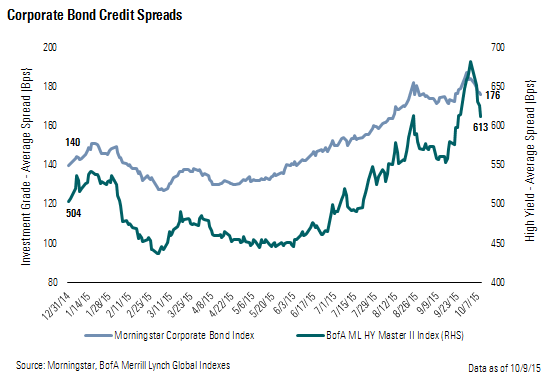
Over the course of the week, the average spread of the Morningstar Corporate Bond Index tightened 8 basis points to +176 bps over Treasuries and the Bank of America Merrill Lynch High Yield Master Index tightened an astounding 70 basis points to end the week at +613. Institutional investors returned to the investment-grade market as they put new cash to work and exchange-traded fund unit creation drove up bond prices in the high-yield market as OWIC (offer wanted in competition) lists dominated trading desks. Investors were comforted by the stabilization and subsequent rebound in commodity prices and attracted to the wide credit spreads caused by the weakness over the past few months. In the commodity markets, oil rose to over $50 a barrel for the first time since July and copper rose more than 3% last week. In the Morningstar Corporate Bond Index, the energy sector tightened 15 basis points to +218 and the metals and mining sector tightened 41 basis points to +377. In the Bank of America Merrill Lynch High Yield Master Index, the energy sector tightened 118 basis points to +1,019 and the metals and mining sector tightened 97 basis points to +1,250.
As one of the most volatile fixed-income asset classes, emerging-markets fixed-income indexes were decimated in the third quarter; however, since the beginning of October, emerging-markets bonds have soared higher. Month to date, the Morningstar Emerging Market Composite Bond, Emerging Market Sovereign Bond, Emerging Market Corporate Bond, and Emerging Market Corporate High Yield Bond indexes rose by 2.31%, 2.62%, 2.32%, and 3.48%. As risk assets moved higher, the demand for safe-haven assets such as U.S. Treasuries subsided. The entire yield curve shifted higher as the 5-year, 10-year, and 30-year rose by 12, 11, and 10 basis points, respectively, to 1.41%, 2.10%, and 2.93%.
Part of the reason credit spreads were driven tighter as much as they were last week is the dearth of new issue activity over the past month. Dealers' inventory levels diminished quickly in the face of demand, and with very few new bonds to go around, traders had to bid prices up to tempt other investors to sell. The new issue market should pick back up as third-quarter earnings begin in earnest this week with a number of the large banks, then shift over to corporates the week thereafter. As earnings are released and issuers exit their self-imposed quiet periods, we expect the new issue market will spring back to life and help to satisfy investor demand.
Indicative of the demand for corporate bonds, fund flows in the high-yield sector increased $0.6 billion. ETF unit creation grew by $1.5 billion, but was offset by $0.9 billion of redemptions out of open-end mutual funds. If the rebound in high yield continues early this week, fund outflows in the open-end funds should abate and likely turn positive. This in turn should help keep the momentum going forward and bid bond prices up further in the near term.

 United States