
US Bank Deregulation Lifts Risk for Bank Stocks but Creates Opportunity, Too
A closer look at risks and opportunities, plus our picks for stocks best positioned within this new environment.

President Donald Trump’s administration’s deregulatory agenda has included cuts to environmental rules and a reduction in bank oversight. This will likely raise risk for banks, in part by affecting how banks integrate environmental, social, and governance themes into their business activities. Here, we delve into what these changes might mean for large US banks, including the risks and opportunities they face, and our stock picks for those best positioned within this new environment.
Since the new administration’s arrival, a wave of change has rippled through federal banking regulators, including leadership changes, a pivot in ESG agendas, and the suspension of investigations. In recent months, US financial institutions appeared to echo this regulatory shift with their exit from climate pledges, namely Climate Action 100+, the Equator Principles, and the Net-Zero Banking Alliance.
At the same time, these changes may raise risks for banks, including exposure to financial crime, as opportunities emerge to engage in new areas like cryptocurrency and as the enforcement of certain practices may be downscaled. Based on our research combining Morningstar Sustainalytics’ ESG Risk Rating and Morningstar Equity Research, Bank of America BAC stands out as a potential top choice among large US banks, with a 3-star Morningstar Rating and strong management of key ESG issues in the current climate.
Opportunities for US Banks
In the short to medium term, deregulation may bring upsides for banks, such as lower capital requirements, and improved cost/income ratios by reducing expensive remediation measures and fines. These could, in turn, increase a bank’s return on tangible equity and capital returns.
In addition, the potential deregulation of digital assets like cryptocurrencies could benefit US banks by diversifying revenue streams, particularly after the US Securities and Exchange Commission’s previous enforcement actions limited crypto activities. The Federal Deposit Insurance Corporation, meanwhile, announced in February that it is reevaluating its supervisory approach to crypto activities, aiming to allow institutions to engage in crypto while maintaining safety standards. However, leniency could also increase exposure to risks such as money laundering, sanctions, and terrorism financing.
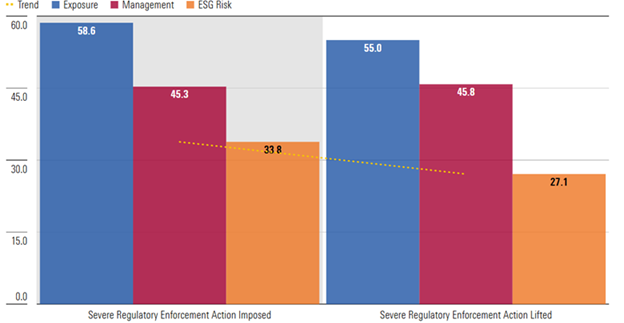
The chart below highlights Wells Fargo WFC as an example of how the regulatory shift could positively affect its risk profile and growth potential. An asset cap imposed on Wells Fargo by the Federal Reserve in 2018 has stunted the bank’s growth, effectively preventing it from growing its balance sheet. (Regulators imposed a series of enforcement actions on the bank following a fake accounts scandal in 2016.) If the regulatory punishment is lifted, however, Wells Fargo could see a 20% reduction in overall ESG risk, lowering its risk from high to medium and boosting its ranking among Sustainalytics’ banks universe from the bottom quartile to the lower second quartile. The removal of the asset cap is eagerly awaited by investors, with an anticipated tailwind for Wells Fargo‘s earnings growth once it occurs.
An ESG Risk Scenario Analysis on Wells Fargo: The Impact of Lifting Severe Regulatory Enforcement Actions
Using the ESG Risk Rating to Screen US Banks
Which US banks are best positioned to balance the risks and opportunities of the new environment? Morningstar Sustainalytics offers insights into companies’ exposure to material ESG issues and evaluates their strategies to address such risks. This information can be combined with Morningstar Equity Research’s fair value estimate, which compares a company’s current market price against its estimated intrinsic value to help investors identify opportunities aligned with both financial and ESG objectives.
In this case, investors can look at the material ESG issue for financial companies that we refer to as “ESG Integration.” Using this metric, we assess how well financial institutions integrate ESG themes into their lending and investment portfolios. Business Ethics is a key material ESG issue for banks and signals the strength of a bank’s governance structure for critical themes such as money laundering, which will be key in the wave of deregulation on the horizon.
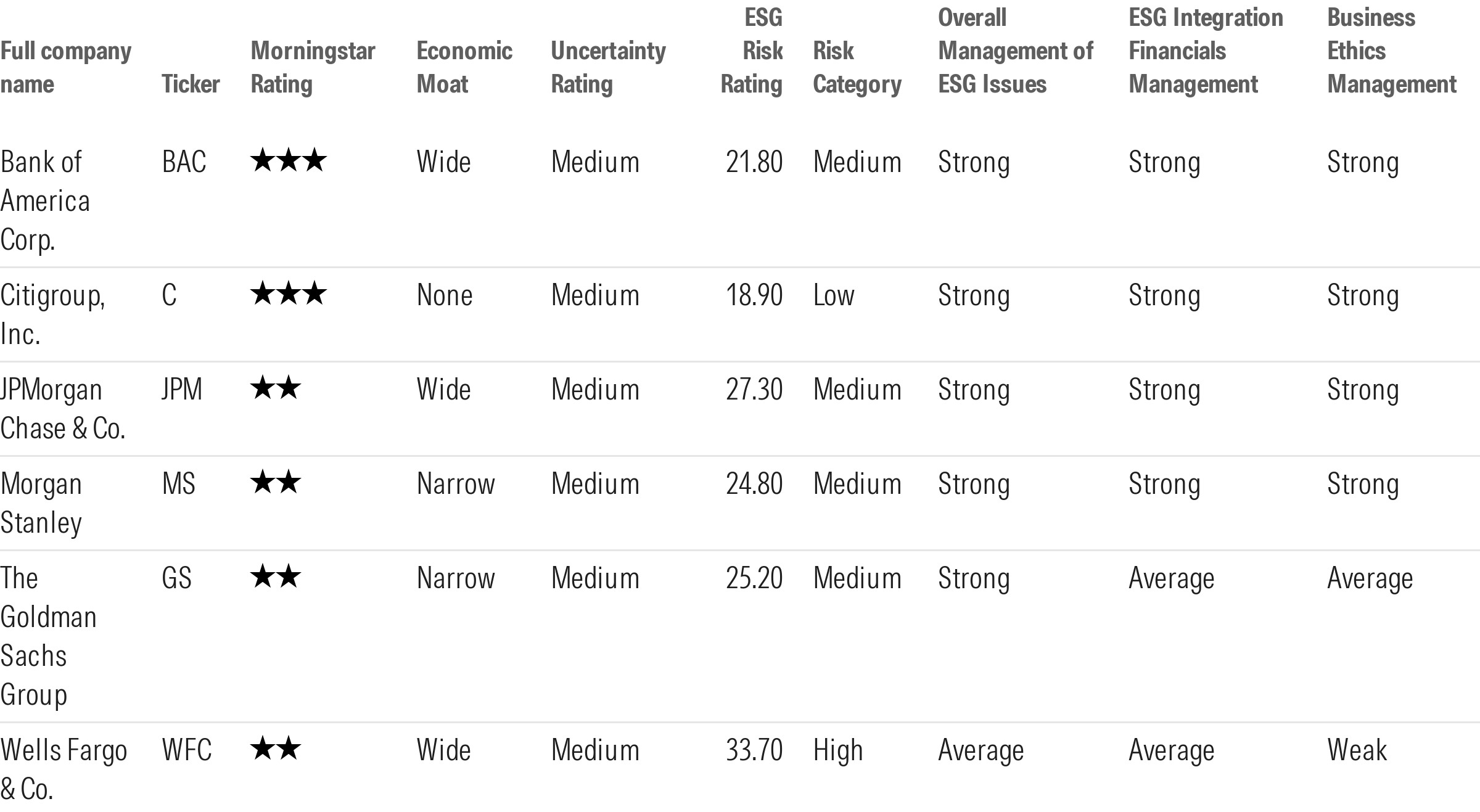
ESG Risk Rating and Morningstar Equity Research Valuation for Large US Banks
Top Stock Pick: Bank of America
Combining insights from the ESG Risk Rating and Morningstar Equity Research (depicted in the table above, Bank of America stands out as a potential top choice among large US banks, with a 3-star rating by Morningstar Equity Research and strong management of key ESG issues in the current climate, namely ESG Integration into lending and investment decision-making, and Business Ethics.
With a strong retail presence, a Tier 1 investment bank, and as one of the leading US credit card issuers, Bank of America has emerged as one of the preeminent US banking franchises. As the second-largest US money-center bank by assets, with a leading share and operations in many of the areas it competes, the bank possesses a wide economic moat.
While US banking stocks face some turbulence, predominantly due to tariff-related disruptions, Bank of America is well positioned to navigate choppier waters as its underlying business is now inherently more resilient. The bank kept its allowance for loan losses as a percentage of loans roughly flat on a sequential basis, at 1.20%. The possibility of economic dislocation emanating from US trade and tariff policies and the potential hit to consumer and business sentiment means banks will have to build loan-loss reserves in anticipation of higher losses in upcoming quarters.
Overall, Bank of America is a high-quality bank and is arguably the closest competitor to JPMorgan Chase JPM in terms of its scale, the breadth of its product offerings, and its long-term profitability potential.
The bank also manages its ESG risks well, especially compared with most of its US and global competitors with higher ESG risk. The bank is topped only by Citigroup C in our US banks’ selection in this regard.
We consider Bank of America to be about 12% undervalued and a relatively better option for investors in the money-center bank space from a risk/return perspective.
Citigroup’s attractive 3-star Morningstar Rating and its stellar ESG risk profile are also noteworthy. Its multiyear overhaul is set to structurally refocus and simplify its operations, which should help free up extra capital and derisk its business. We note tangible improvements in its management of business ethics risk, owing partly to its commitment to derisking and refocusing its business. This has helped the bank achieve its low ESG risk profile, which sets it apart from peers in this regard. However, the lack of an economic moat and the uncertainty stemming from its overhaul signal some unpredictability for investors in the medium to long term.
Editor’s Note: A version of this article was originally published on Sustainalytics.com
The author or authors do not own shares in any securities mentioned in this article. Find out about Morningstar’s editorial policies.

 United States