
Sustainalytics: Anthropic’s High ESG Risk Brings AI Governance Concerns Into Focus
Complex business ethics issues weigh heavily alongside product governance and cybersecurity risks.

As Anthropic’s IPO comes to market, investors must consider questions beyond valuation. For instance: How effectively are AI companies managing the risks of developing and deploying increasingly powerful AI systems?
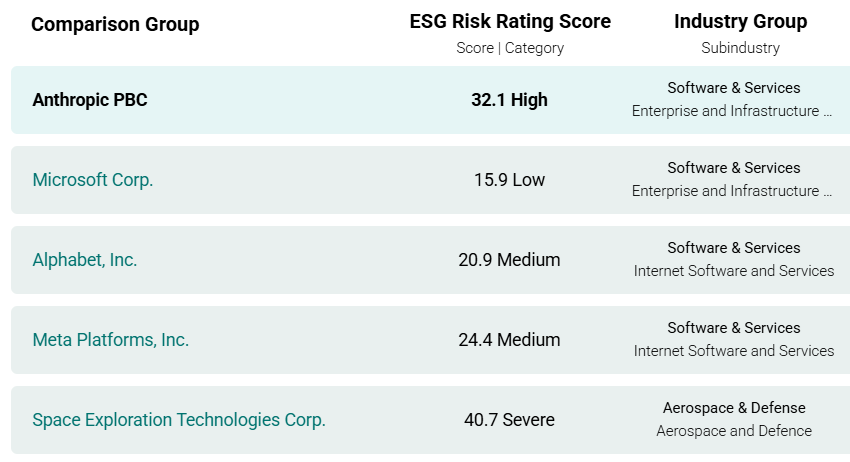
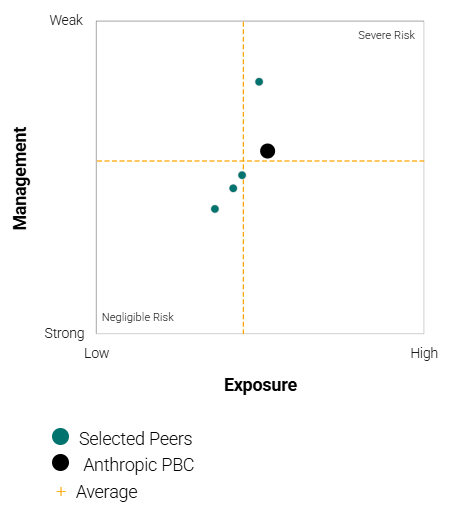
Morningstar Sustainalytics recently assigned Anthropic a High ESG Risk Rating. The assessment is driven primarily by exposure to product governance, data privacy and cybersecurity, and business ethics risks.
Business ethics may prove to be Anthropic’s most important ESG issue in the long term, weighing heavily in our rating. Developing frontier AI models requires enormous computing resources, creating dependence on a small group of infrastructure providers. Several companies in this space occupy multiple roles in the AI ecosystem as investors, suppliers, partners, and in some cases, competitors. Such arrangements can create potential conflicts of interest and governance concerns.
In Anthropic’s case, Morningstar estimates nearly $500 billion of the company’s $819 billion compute commitments involve providers also pursuing AI ambitions, such as Alphabet, Amazon, Microsoft, and SpaceX. This supplier/competitor dynamic is not unusual in the industry. With Anthropic, some competitors are also investors and business partners, adding another layer of governance complexity.
Anthropic’s Disclosure Gap for Managing Risks
Anthropic was founded with an explicit focus on developing AI responsibly. It is registered as a Delaware public benefit corporation, with an innovative governance structure combining a long-term benefit trust and founder-concentrated control. As AI advances, that mission will be tested not only by technical and commercial challenges, but also by questions of governance, transparency, and business ethics put in practice.
A significant finding in our assessment is the gap between Anthropic’s exposure to ESG risks and its disclosure about how it manages some of them. The company provides meaningful disclosures on safety, privacy, and cybersecurity. Less information is available regarding conflicts of interest management, intellectual property governance, compliance controls, and other business ethics issues. Anthropic also does not publish comprehensive ESG reporting.
This matters because investors need more than statements of intent. Effective governance depends on clear accountability, oversight, disclosure, and evidence that controls are working as intended.
Peer Comparison
Why Anthropic Has a High ESG Risk Rating
Anthropic’s high risk rating is not surprising. The company develops frontier AI models that businesses, governments, and individuals are still learning to use. In some cases, AI models have created harmful, biased, and misleading outputs affecting those same stakeholders. By nature, AI companies have far more complex risk profiles than traditional enterprise and infrastructure software companies. What stands out is not simply these issues, but the degree to which governance and transparency have become central factors in evaluating them.
Product governance is the most obvious example. AI developers face growing scrutiny over harmful outputs, misuse of models, and the consequences of increasingly autonomous systems. Anthropic has several safeguards in place, including a Responsible Scaling Policy, a board-level Safety and Risk Committee, and ISO 42001 certification for AI governance. These measures suggest the company has developed a formal framework for managing AI-related risks.
Yet incidents involving misuse of AI systems continue to occur throughout the industry, and regulators are paying closer attention. In September 2026, the US Federal Trade Commission opened an investigation into Anthropic to assess potential dangers associated with Claude. California’s recent lawsuit against OpenAI over the company’s autonomous AI agents’ hack of the Hugging Face platform is another example. In addition, four nonprofit organizations recently filed suit in California, asking a court to bar Anthropic and other AI software companies from developing or deploying new AI models.
A negative result in this kind of case could have significant consequences for the company’s pace of product innovation. For investors, this illustrates a broader point: model safety is more than just preventing a technical glitch. It has become a governance and risk management issue with potential regulatory and financial consequences.
Anthropic’s S-1 describes several ways its products could act in an unintended manner, causing harm to clients, governments, and even “catastrophic or existential risks to humanity.” As unusual as such a warning may be, the underlying reality is that users, investors, and AI companies accept that, as of late 2026, AI models may and do hallucinate, make mistakes, and sometimes go rogue.
Anthropic’s Data Privacy and Cybersecurity Risks
Companies like Anthropic process vast amounts of information and rely on highly valuable intellectual property. This makes them attractive targets for cyberattacks, espionage, and other malicious activity. In addition to traditional cyber threats, AI systems introduce novel attack vectors, such as prompt injection, which may be difficult to detect and often require specialized controls to mitigate effectively.
Anthropic has adopted several recognized controls here, including security-by-design practices and certifications such as ISO 27001, SOC 2, FedRAMP High, HIPAA, and CSA Star. These measures compare favorably with industry standards. At the same time, the combination of sensitive data, advanced AI capabilities, and increasing geopolitical competition means that privacy and cybersecurity concerns are unlikely to diminish.
Intellectual property presents another area of uncertainty. Like many AI developers, some of Anthropic’s existing and potential legal challenges relate to the use of copyrighted material in model training. One recent case involving AI training data resulted in a settlement worth $1.5 billion, but other cases remain unresolved. The eventual legal and financial implications are still unclear, though they could become material.
For investors, the key lesson extends beyond Anthropic. As AI becomes increasingly embedded in the economy and in portfolios, understanding how these companies manage governance, privacy, cybersecurity, and business ethics challenges may become just as important as assessing how powerful their models are.
The author or authors do not own shares in any securities mentioned in this article. Find out about Morningstar’s editorial policies.

 United States