
For Pension Funds and Other Asset Owners, Trade Wars, AI, and Sustainability Are Financially Relevant
The latest perspectives from institutional investors in Morningstar’s Voice of the Asset Owner Survey.


In my more than three decades working with the institutional investor community—is it really that long?!—I’ve learned that setting up consistent listening points is a good way to better understand what causes people pain. This is particularly true with the asset owner community, an influential and powerful group of investors whose opinions are sometimes held close but always insightful.
These are the investment professionals who oversee significant pools of capital for the largest global public and corporate pension plans. They are fiduciaries, meaning they take their jobs very seriously and answer to a very demanding set of board members and other key stakeholders. Their decisions also affect the retirement security of everyday people who are the ultimate end-investors: Think firefighters, teachers, and construction workers, for example. These large pension funds and other asset owners have a lot on their plates, and for that reason, it is sometimes difficult to get their ear and gauge their opinion on global investment issues.
That’s why I am so excited about our annual conversation with asset owners—the Morningstar Voice of the Asset Owner Survey. We’ve just completed the fourth year of our global survey, which blends qualitative and quantitative survey formats to better understand what’s on the minds of asset owners and the key issues on their radar.
What did we learn by reaching out to more than 500 asset owners around the world with combined assets under management north of $19 trillion? Quite a bit.
Trade Wars Top Global Asset Owners’ Worry Lists
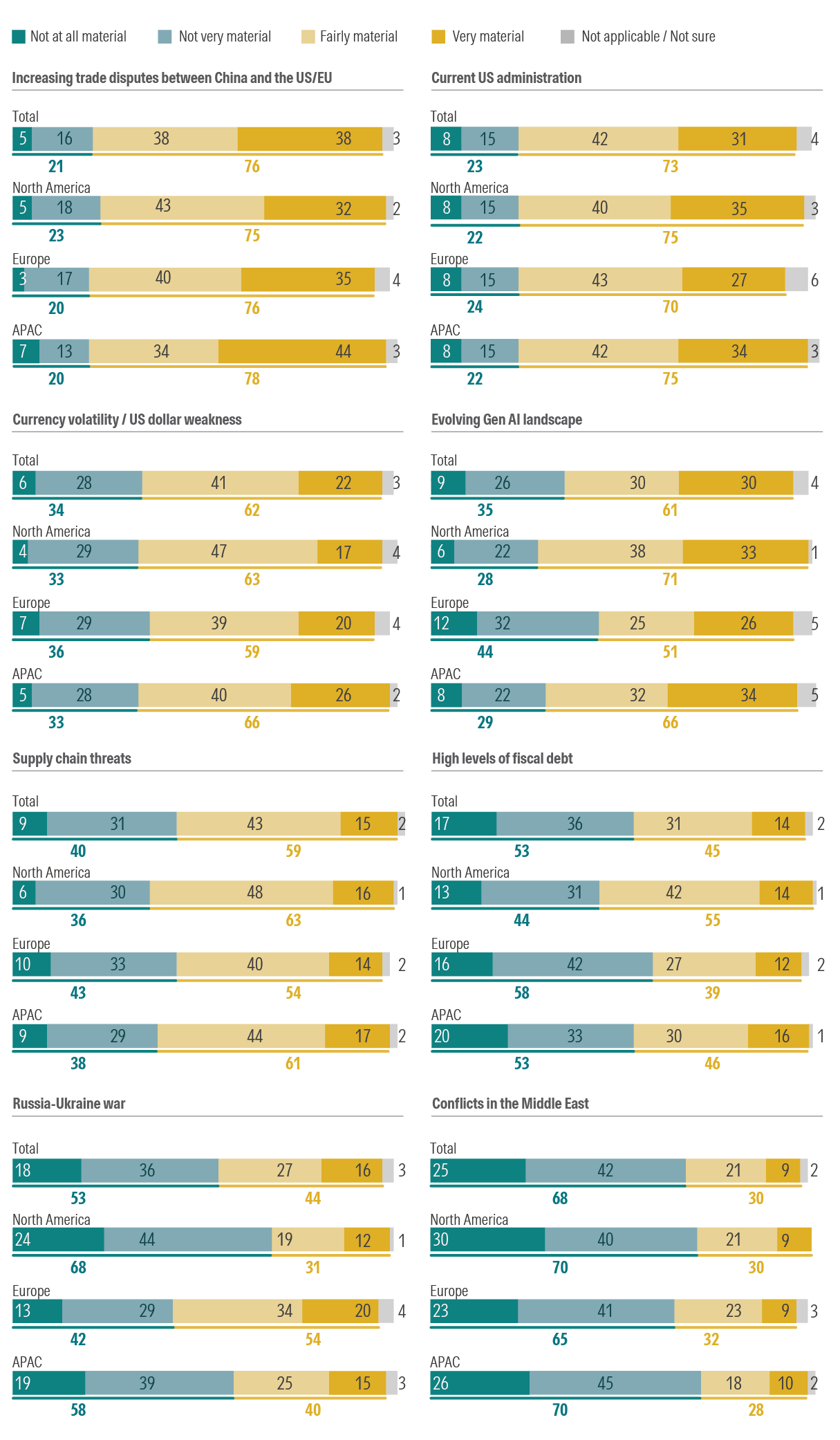
Asset owners were asked about the materiality, or financial relevance, of a range of geopolitical issues to their investment strategies. This year, global trade issues outweighed geopolitical conflicts as a major concern. In fact, global trade disputes, a new US administration, and currency volatility far outweighed ongoing global conflicts such as those in Russia-Ukraine and the Middle East.
Notably, the rising influence of generative artificial intelligence is becoming a significant factor in the institutional investment decision-making process, another issue related to trade and commerce that is driving rapid change in the global market ecosystem.
Here’s what keeps asset owners up at night:
Issues Most Material to Asset Owners’ Investment Decisions (%)
ESG Materiality Is Growing, Depending on Where You Sit
Sustainable investing is still a very important and material part of asset owners’ approaches. Of course, that means they need our help! But we definitely see solid evidence that there is a growing divide between the US and the rest of the world when it comes to ESG investment matters.
The proportion of asset owners reporting applying ESG considerations to more than 75% of their assets under management has increased by 8 percentage points since last year to 20%. And, notably, those reporting that 100% of their AUM is invested through an ESG lens has reached 10%, up 233% since we began our survey in 2022.
Percentage of Total AUM With ESG Considerations Applied (%)
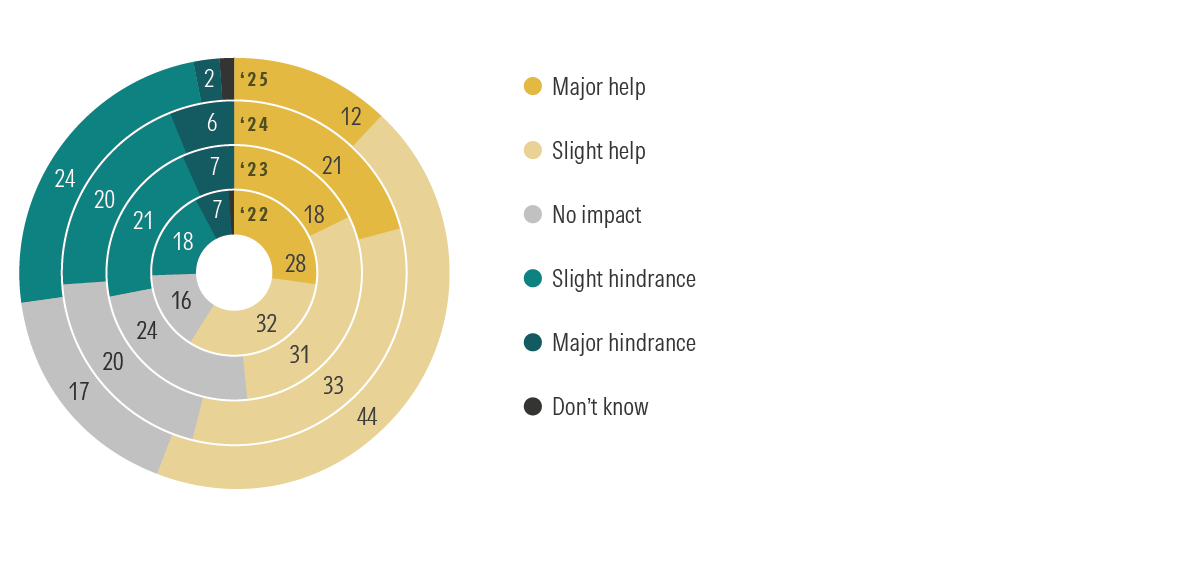
Yet average AUM assets invested with ESG considerations were clearly lower in the US this year. Further, when we asked about materiality of ESG, comparing responses across the 11 countries surveyed by number of “net more material” to “net less material,” responses, the US was the only country in which a greater portion of respondents (34%) perceived ESG as having become less material in the last five years as compared with those who felt it has become more material (30%). This reflects a clear divide that we’ve seeing in the US on ESG.
Institutional Investors Are Pushing for More Rigor on Climate Investing
One of the most exciting parts for me in our survey this year is when we asked asset owners what they need in terms of investment data, tools, and support. Asset owners clearly want more support in climate-related investing, specifically climate transition readiness and energy management. In fact, these were the top two environmental issues cited by asset owners as most material this year.
Yes, it is important to identify top issues, but it is even more important to understand what asset owners are doing about it. This year, we drilled deeper, asking asset owners what methods and measures they are employing to promote climate transition readiness in their investments. Carbon footprinting, investing in climate solutions, and measuring progress on net zero pathways for their portfolio holdings were at the top of the list. This is my favorite kind of insight: the kind we can use to develop and improve solutions for our clients.
These high-level takeaways barely scratch the surface of our annual survey results. I encourage you to visit the full report and experience the results that come from our asset owner listening post.
The author or authors do not own shares in any securities mentioned in this article. Find out about Morningstar’s editorial policies.
Morningstar, Inc., licenses indexes to financial institutions as the tracking indexes for investable products, such as exchange-traded funds, sponsored by the financial institution. The license fee for such use is paid by the sponsoring financial institution based mainly on the total assets of the investable product. A list of ETFs that track a Morningstar index is available via the Capabilities section at indexes.morningstar.com. A list of other investable products linked to a Morningstar index is available upon request. Morningstar, Inc., does not market, sell, or make any representations regarding the advisability of investing in any investable product that tracks a Morningstar index.

 United States