
It’s Time to Think About Renewables Again
Data center demand, electrification, and the budget bill have stoked enthusiasm


It’s time to think about renewable energy stocks again. After years of combating high valuations, rising interest rates, and fears that tax incentives would be taken away, renewable stocks are reviving. You can thank demand from data centers and electrification.
Consider that Invesco Solar Energy ETF TAN is up 14.34% in the year to date. The First Trust Global Wind Energy ETF FAN is up 26.2%. Impax Global Environmental Markets Fund PGINX, an open-end fund, is up 11.24%. At the same time, the Morningstar US Market Index is up 7.05%.
“The market has focused on resurgent baseload technologies in natural gas and nuclear,” write Morningstar analysts Brett Castelli and Tancrede Fulop. “However, we also recognize wind and solar as essential to meet this growing demand. We see few opportunities in baseload energy stocks, such as natural gas turbine suppliers. However, we remain optimistic about select renewable energy shares that are currently trading at discounted valuations.”
Why Renewable Energy Stocks Bounced Back
The recent tax and spending bill reverses many of the climate solutions passed under the Biden administration. So why the outperformance of renewables? Gitterman Wealth Management analyst Adam Bernstein calls the event “a risk-on signal.”
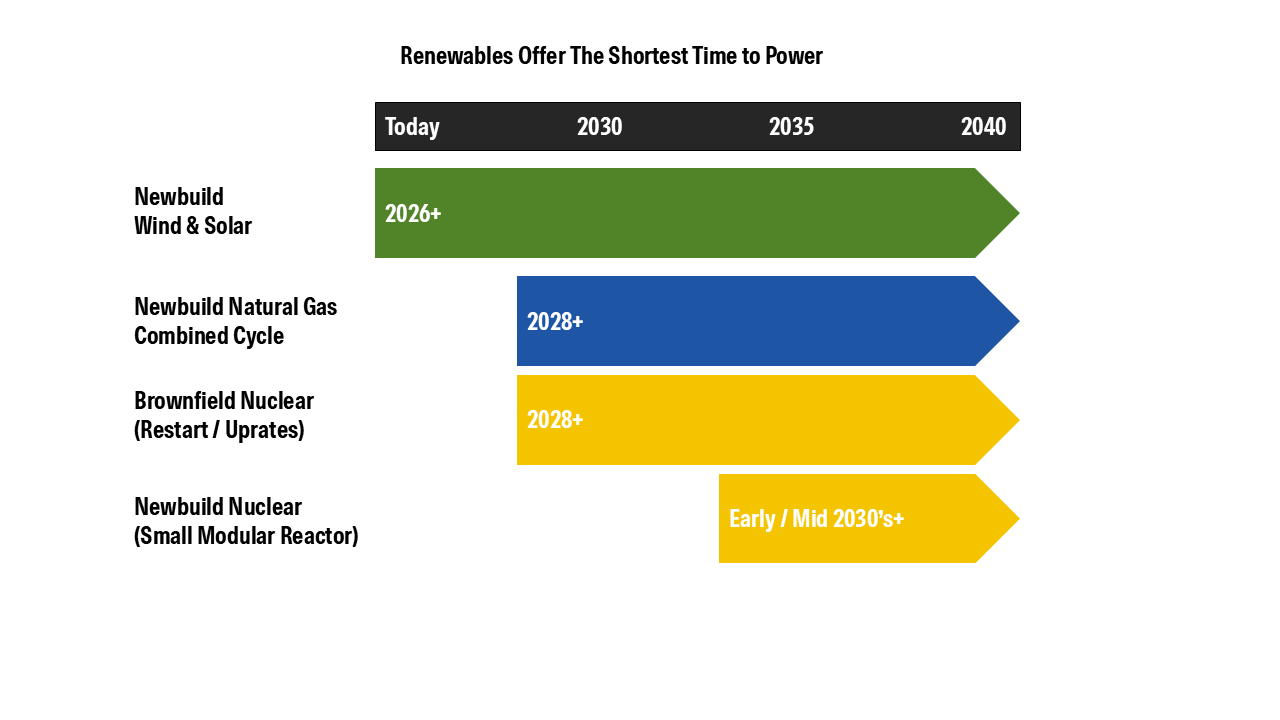
Carbon Collective co-founder Zach Stein says: “Perhaps a new floor has been set for solar stocks, and the industry can begin its multi-year recovery in earnest from here. The uncertainty is largely gone. The growth curve for electricity demand is spiking (thanks to electrification and AI), and even in spite of these federal policy changes, solar and battery systems may still be the cheapest/fastest way to bring new electricity to market, particularly given the extremely long delays (up to seven years) for new natural gas turbines.”
Why Analysts Are Optimistic About Renewables
- While the budget narrows the eligibility of wind and solar for tax credits, it also provides tax credit eligibility for a variety of clean energy sources. And analysts say the older bill was never meant to be permanent, but simply to create a bridge for the energy transition.
- Renewables are cheap. Lazard recently found that solar and wind energy projects are more competitive than fossil fuels, even without subsidies. At the same time, “there’s more volatility in oil prices than in renewable energy,” says Hortense Bioy, head of sustainable investing research for Morningstar Sustainalytics.
- After a bear market, renewables-related companies are cheap too. Consider that AES AES shares recently shot higher after Bloomberg reported the renewable energy company is exploring a sale amid demand from AI and cryptocyrrency mining s.
- Companies will keep using renewables as part of the energy mix that Castelli describes, because electricity demand is jumping. Castelli and Fulop think data center power capacity will triple to 80 GW by 2030, driven by generative AI data centers. The forecast is partly based on Nvidia’s NVDA projected data center revenue and corresponding chip shipments. The analysts write that about 60% of additional demand will be met by natural gas. About 25% will be from renewable energy additions, and 15% from “select restarts and expansions of existing nuclear capacity. We don’t see new-build nuclear … as a viable option until the early-to-mid-2030s.”
Renewables Are Faster to Produce
Renewable Energy Stocks that Will Benefit
To be sure, natural gas will play a key role. But “valuations appear stretched. In addition, we are cautious on valuations in select engineering and construction firms, including Quanta Services and MasTec, given continued multiple expansion,” Castelli and Fulop write.
They continue: “With the policy overhang now cleared, we think now is the time for investors to begin wading back into select renewable energy firms, such as First Solar FSLR, Brookfield Renewable BEP, and Vestas Wind Systems VWS. Each has mitigating factors to recent renewable energy policy changes, such as being tied to domestic manufacturing or benefiting from geographic diversification. In contrast, we see less value in areas hardest hit by legislative changes, such as rooftop solar."
Here are the metrics and analyst commentaries for these stocks. For more on climate funds, read this.
Brookfield Renewable
- Morningstar Rating: ★★★
- Price to Fair Value: 0.94
- Moat Rating: None
- Uncertainty Rating: Medium
“Brookfield holds a well-diversified global portfolio of clean energy technologies assets. The company targets 10% annual growth in funds from operations through a combination of organic growth and mergers and acquisitions. The current market volatility provides opportunities for Brookfield to find attractive deals.
“Brookfield’s diversification across geographies and technologies insulate it from potential US renewable energy policy changes. Nearly half of its capacity is hydro and roughly 40% of its portfolio is outside of North America. We estimate wind and solar projects in the US contribute approximately 20%-25% of its cash flow. As such, we think the firm is well insulated from any headwinds by recent changes to renewable energy policy.”
Vestas Wind Systems
- Morningstar Rating: ★★★★
- Price to Fair Value: 0.78
- Moat Rating: None
- Uncertainty Rating: High
“Vestas enjoys a leading position in the onshore wind turbine market and is improving its competitiveness in faster-growing offshore wind. Since the start of 2022, Vestas’ profitability has been suppressed by cost inflation for commodities used to produce wind turbines and setbacks in its services business. For 2025, management has guided toward an EBIT margin of between 4% and 7%, as low-margin legacy projects were completed in 2024. We expect the company to reach the lower end of the guided range, at 4.6%, as the production ramp-up of the newly launched V236-15MW offshore wind platform will be margin dilutive.
“Shares appear cheap, trading at a 20% discount to our fair value estimate, driven by negative sentiment surrounding the outlook for wind energy and uncertainty under President Donald Trump’s administration. Our forecasts anticipate Vestas will be able to deliver fiscal 2025 revenue of EUR 19 billion, in between its EUR 18 billion-EUR 20 billion full-year guidance. Longer term, we model a medium-term EBIT margin of below 8%, which is conservative relative to the company’s 10% target.”
First Solar
- Morningstar Rating: ★★★★
- Price to Fair Value: 0.79
- Moat Rating: None
- Uncertainty Rating: High
“First Solar is the world leader in thin-film solar panel technology. The United States and India represent the vast majority of sales efforts, where policies leave the company in a more favorable competitive position compared to geographies without trade barriers (ie: Europe).
“We think the company is well-positioned to supply solar modules for solar buildout in the US.
“Historically, its US market share has hovered around 25-30%, but we expect this to increase to in excess of 50%. First Solar was a key beneficiary of domestic manufacturing incentives under the Inflation Reduction Act. Importantly, these incentives were left essentially unscathed in the recent One Big Beautiful Bill Act – providing improved confidence into First Solar’s medium-term earnings power.
“The market is concerned with the buildout of domestic supply by competitors as well as weak bookings in recent quarters. However, we believe the limited bookings were partially a function of the company’s patience. Additionally, we see the recent clearing of US policy uncertainty as likely to reaccelerate bookings momentum at healthy ASPs ($0.30/watt) in the second half of 2025.”
The author or authors do not own shares in any securities mentioned in this article. Find out about Morningstar’s editorial policies.

 United States