
Is AI Investment Poised for Growth? Top Picks and Promising Applications for 2025
Companies are ramping up tech investments to capitalize on the AI boom.


The focus on artificial-intelligence-driven technologies has shifted from curiosity to the forefront of enterprise strategies. For investors and financial advisors looking to capitalize on tech, generative AI may represent a long-term opportunity grounded in robust economic potential.
In the recent Fortifying Castles in the Sky report, we explore what’s in store for AI investments in 2025 and beyond.
What Are Public Cloud Vendors, and Why Are They Important?
Public cloud vendors are technology companies that provide cloud computing services, offering scalable and on-demand internet access to infrastructure, platforms, and software. These providers manage hardware, networking, and security layers, allowing businesses to focus on deploying and managing their own applications and services.
The importance of public cloud vendors lies in their ability to drive innovation, reduce operational complexity, enhance flexibility, and offer cost efficiencies. By leveraging these services, organizations can scale resources up or down as necessary, enabling agility and responsiveness to changing market demands.
Additionally, public cloud infrastructure supports rapid development cycles by providing tools and resources for building, testing, and deploying applications. These benefits make public cloud vendors integral to modern businesses, particularly in industries undergoing digital transformation.
Generative AI’s Rapid Growth and Expansion
Generative AI is considered one of the most revolutionary technological advancements in the last 25 years.
Its capacity to process vast datasets, deliver nuanced insights, and generate humanlike content allows companies across industries to improve productivity and find innovative solutions. The broad promise of automation, creative collaboration, and operational efficiency has sparked significant demand.
Revenue Associated With AI Is Poised for Material Expansion

Key market forecasts estimate that the AI market’s compound annual growth rate will exceed 18% overall, with generative AI services growing as high as 75% CAGR over the coming five years.
Enterprise adoption of generative AI is moving beyond early experiments with chatbots and code generation. Businesses are building more-sophisticated applications, such as customer service agents capable of resolving complex issues and tools for live financial reporting.
Top Use Cases for Generative AI
Customer Service Enhancements
Advanced AI-powered chatbots can now resolve more-complex customer concerns without human intervention, leading to higher operational efficiency and greater customer satisfaction. Deflection rates for support requests are expected to decline significantly.
Automating Complex Workflows
From writing code to managing business analytics, generative AI supports labor-intensive processes, enabling significant productivity improvements. Applications like Microsoft’s GitHub Copilot assist developers by generating and refining code automatically.
Collaborative Workforces
Platforms like Google Workspace and Microsoft Office 365 are rolling out AI-based tools for automated transcription, meeting summaries, and action items, facilitating seamless collaboration among team members.
While these examples highlight AI’s potential, the technology’s demand is also driven by the rapid decline in costs per inference and token usage, making adoption more accessible across businesses, large and small.
Why Hyperscaler Capital Expenditure Is Pivotal for AI’s Growth
Three major public cloud vendors—Amazon.com AMZN (AWS), Microsoft MSFT (Azure), and Alphabet GOOGL (Google Cloud)—are driving investment in generative AI infrastructure.
These giants collectively plan to allocate over $250 billion in 2025 to support data center growth and AI initiatives. Three main factors differentiate these players.
Financial Position
Hyperscalers have the financial resources required to build the infrastructure necessary to support the growing demand for AI workloads.
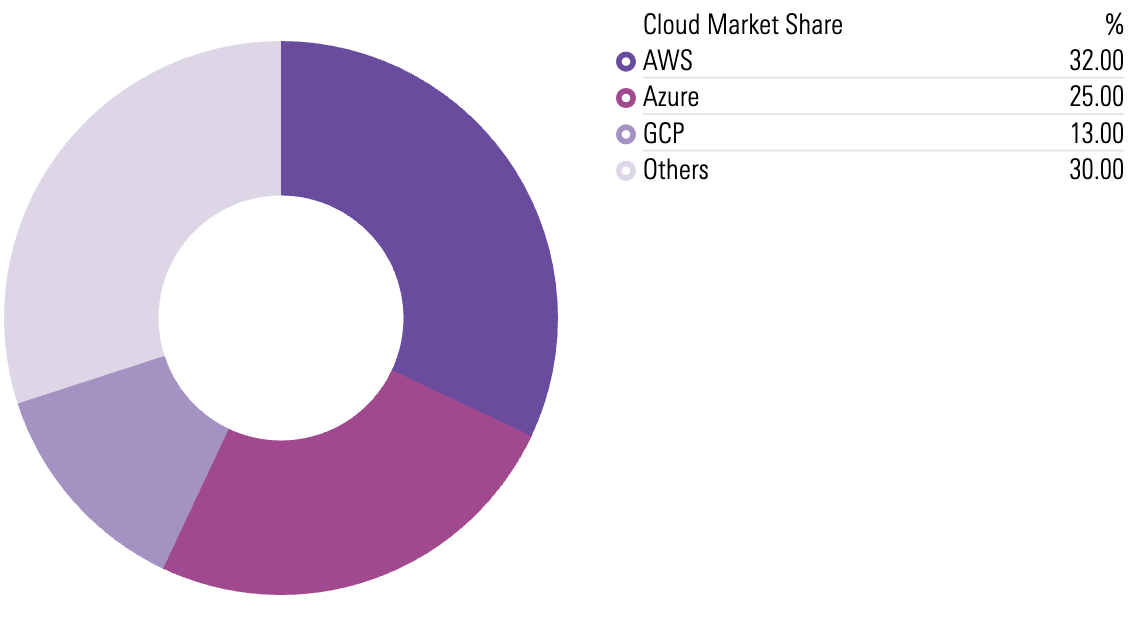
For example, Amazon, Microsoft, and Alphabet control more than 70% of the infrastructure-as-a-service and platform-as-a-service markets globally. We do not see many other viable competitors with the financial resources to invest at scale.
A Proven Track Record of Innovative AI Chip Design
Each hyperscaler has invested in developing proprietary AI chips to drive cost efficiency and performance. Alphabet’s TPU, Amazon’s Inferentia and Trainium, and Microsoft’s Maia accelerators give these companies an edge in running AI workloads while improving energy efficiency.
We Think the Three Major Cloud Service Providers Are All Strong Competitors in AI
Distribution Power
Their global data center networks allow these hyperscalers to serve enterprises worldwide, pairing technical excellence with deep customer relationships.
Products like Azure OpenAI, Google Vertex AI, and AWS Bedrock enable companies to deploy AI services seamlessly across industries. They also have customer relationships that run both broad and deep, thus solidifying their distribution advantage.
This level of investment underpins the hyperscaler advantage: Their ability to scale builds a moat around smaller competitors. The data centers they design and operate also demonstrate cooling, chip performance, and workload distribution efficiencies that improve scalability over time.
Three Providers Dominate the Global Market for laaS and PaaS Services
Is AI a Solid Investment for 2025?
Pathways for Monetization
Generative AI is already providing real returns, even with billions of dollars in sunk costs to create data centers and to train models. The three leading hyperscalers have built a $20 billion revenue run rate as of 2024, expected to surpass $100 billion by 2029.
These monetization pathways include:
- Charging enterprises for generative AI API services powered by infrastructure built on vast data centers.
- Upselling AI-enhanced features for software products, as seen with Microsoft’s Office 365 Copilot ($30 per month).
- Embedding AI in existing consumer platforms, such as Google’s generative search overviews and YouTube content creation tools.
The global adoption of generative AI has also triggered incremental spending on public cloud infrastructure. Consumption-based pricing models for APIs and tokens allow enterprises to dynamically scale their usage, creating new revenue opportunities for hyperscalers.
The Case for Long-Term Growth
Key demand signals indicate that generative AI is far from a short-lived trend. Public cloud leaders have stated that their AI services are capacity-constrained, driven by strong adoption volumes.
For companies like Microsoft (via its OpenAI integration) and Alphabet (through Google Cloud), generative AI represents both an immediate revenue opportunity and a strategic asset for diversification.
While some skepticism surrounds the high capital expenditures, the expectation is that investments will taper off around 2026 as utilization ramps up. Data centers built today to support AI workloads can easily pivot to other use cases, further mitigating risks tied to demand fluctuation.
Where Generative AI May Have the Most Impact
Generative AI’s scope spans industries, with notable disruptions expected in the following sectors:
Enterprise Software
AI-enhanced application suites are becoming standard. From customer relationship management tools to marketing automation, AI’s role as a “co-pilot” is redefining how businesses operate.
Healthcare
Generative AI has applications in diagnostics, drug discovery, and personalized patient care. For instance, it can analyze medical images or generate actionable insights from patient symptom patterns.
E-Commerce and Retail
Advanced recommendation engines powered by generative AI can refine the shopping experience, while demand forecasting improves inventory management.
Cybersecurity
AI can automate threat detection and response, offering enterprises faster protection while reducing reliance on human analysts.
Supply Chain Optimization
Predictive analytics powered by generative AI can anticipate logistical bottlenecks, enabling more agile operations throughout supply chains.
Top Picks for Investors
Microsoft and Alphabet are the leading players in generative AI investment:
Microsoft
Microsoft’s collaboration with OpenAI makes it uniquely positioned to capture the demand for large AI models. Its revenue opportunities extend across Azure, Office 365, GitHub, and other tools, with more than 10% of its annual revenue potential tied to AI.
Alphabet
Google Cloud remains a strong contender in public cloud services, while Alphabet’s integration of AI into search and Workspace offers additional monetization avenues. Despite ongoing regulatory challenges, the company is expected to diversify its revenue stream further.
Amazon, while a heavyweight in cloud services, may see lower near-term profit multiplication from generative AI compared with its peers because of the massive size of AWS’ e-commerce revenue.
Future Monetization Opportunities for Public Cloud Vendors
Cloud providers can differentiate by offering industry-specific AI models and compliance tools. Others are investing in edge computing, driven by the growth of IoT devices that gather and share data with little human input.
Edge services like real-time analytics and localized AI support low-latency needs in sectors such as autonomous vehicles and smart cities. Providers can also monetize AI through APIs and developer tools, giving businesses easy access to advanced capabilities with little to no human interaction.
Subscription-based pricing models for these services provide recurring revenue streams while fostering widespread adoption.
Finally, public cloud vendors may also explore partnerships with telecom providers to power private 5G networks. Such collaborations can support advanced use cases, including augmented and virtual reality, while simultaneously driving the adoption of network-dependent cloud solutions.
Generative AI’s Profitability Promise: Do Public Cloud Vendors Stand to Print Cash in the Cloud?
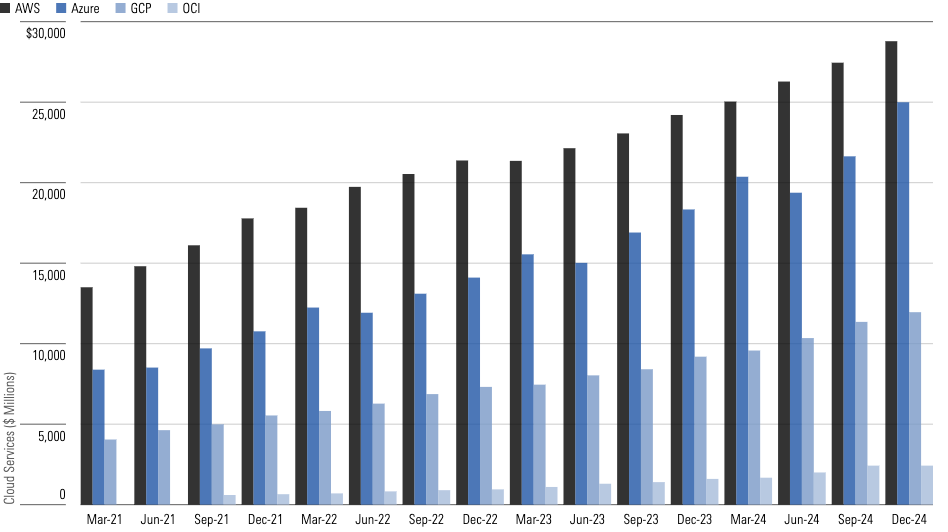
As AI-related spending continues to ramp up, public cloud vendors are seeing a marked pickup in customer demand for their public cloud offerings as more customers try to leverage generative AI in their workflows.
Cloud Vendors Are Seeing Robust Demand for Cloud Services
Generative AI presents an unprecedented opportunity for public cloud vendors to expand their profit margins.
By offering AI-driven tools and services, these companies can attract a broader range of customers, from startups seeking innovative solutions to established enterprises undergoing digital transformation.
The scalable nature of cloud infrastructure enables vendors to optimize costs while delivering higher-value services such as auto-generative content creation, automated workflows, and advanced predictive analytics.
This combination of scalability and innovation positions public cloud vendors to capitalize on the growing demand for AI capabilities, potentially translating into significant revenue growth in the coming years.
Advisors seeking technological transformation stand to benefit from aligning with top-tier cloud vendors driving this shift. While AI’s future is exciting, understanding the business models behind these investments provides essential context in assessing where opportunities truly lie.
The long-term strategic positioning of these companies suggests that AI is more than a passing innovation; it’s central to the future of entire industries.
The author or authors do not own shares in any securities mentioned in this article. Find out about Morningstar’s editorial policies.

 United States