
Consumer Defensives: Despite a Slew of Macro Pressures, Bargains Fill the Space
Dollar General and Kraft Heinz are among our top consumer defensive picks.


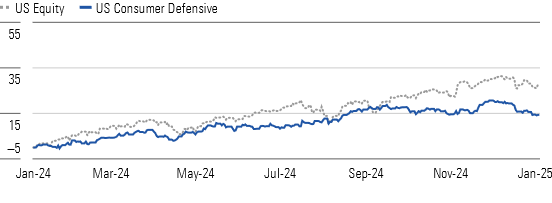
The Morningstar US Consumer Defensive Index dipped 2.8% in the fourth quarter, overshadowed by the broader market’s 3.0% upswing. Despite this, the median consumer defensive stock under our coverage trades at just a 3% discount to its fair value estimate.
Consumer Defensive Missed Its Invitation to the Broader Market's Lift
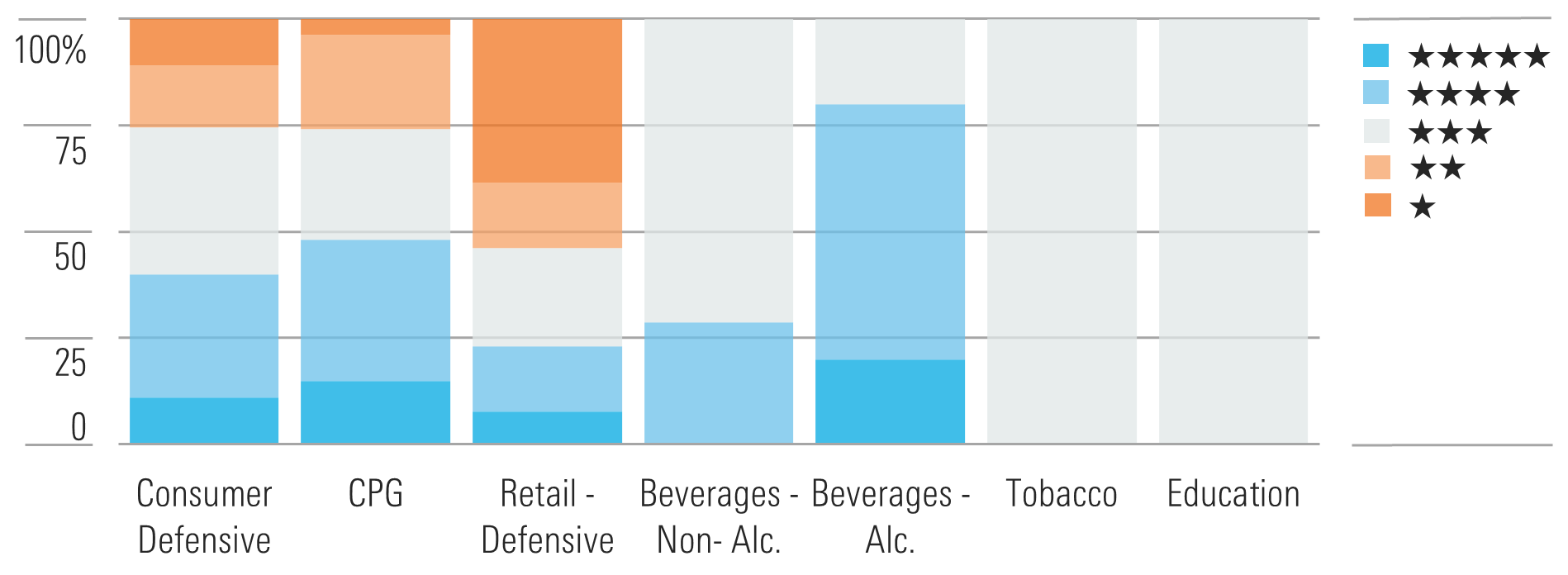
That said, we posit attractive opportunities remain for value-seeking investors, with 36% of our coverage trading in 4- or 5-star territory. Zooming in, we encourage investors to seize opportunities in the consumer packaged goods and beverages sectors, where an unsettled macroeconomic landscape is straining consumers’ financial health, particularly among the lower-income cohorts, intensifying competitive dynamics. Even against this backdrop, with an array of solid brands and stout standing with retailers, we think moaty operators are poised to weather the onslaught and defend their positions.
With Scant Discounts, Investors Should Feast on CPG and Beverages
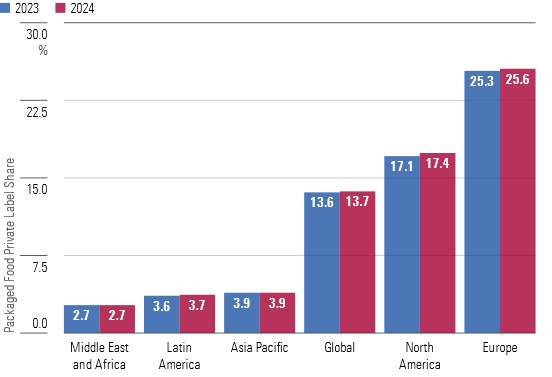
Confronted with cumulative inflation and elevated interest rates in 2024, consumers strategically turned to lower-priced private-label fare to stretch their budgets. As such, packaged food private label dollar penetration in North America and Europe each rose 30 basis points to 17.4% and 25.6%, respectively. However, globally, the gain was more muted at 10 basis points, rising to just 13.7%. This likely reflected regional disparities in private label adoption, particularly in emerging markets, where we surmise lower consumer trust and a fragmented retail industry limit its prevalence. Still, amid ongoing pressure, consumers may maintain these frugal habits, especially if national brands fail to align their products with shoppers’ preferences or effectively tout their value. Regardless, we believe competitively advantaged firms will focus on consumer-centric product innovation and marketing to secure their standing.
Private Label Fare Makes Subtle Inroads in Packaged Food
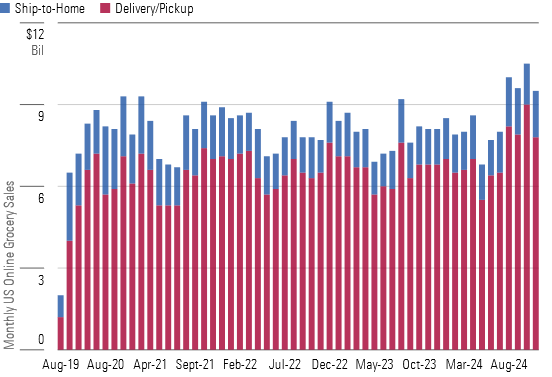
However, the marginal pivot toward private labels has not dulled consumers’ thirst for the convenience of e-commerce. In November 2024, online grocery sales surged 18% to $9.6 billion compared with the prior year, exceeding pandemic figures, propelled by an expanding base of monthly active users now topping 77.8 million US households. In our view, established names with strong brand equity and negotiating clout should benefit the most, as consumers often reorder or seek out what’s familiar when shopping online. As such, brands and retailers must work to ensure product availability across all channels.
Shoppers Embrace Online Convenience as Sales Eclipse Pandemic Marks
Top Consumer Defensive Sector Picks
Estée Lauder Companies
- Fair Value Estimate: $162.00
- Morningstar Rating: ★★★★★
- Morningstar Economic Moat Rating: Wide
- Morningstar Uncertainty Rating: Medium
We believe Estée Lauder’s EL shares are enticing, trading at around a 50% discount to our fair value estimate. Investors have grappled with a slow recovery in China (which has stifled demand and the firm’s margins), a CEO transition, and an unexpected dividend cut. Still, we think Estée’s brand investments and execution will help return margins to historical levels while ensuring the firm’s standing (underpinned by category-leading brands and preferred vendor status) remains. Further, we think Estée is well-positioned to benefit from secular premiumization trends in both developed and emerging markets.
Kraft Heinz Company
- Fair Value Estimate: $56.00
- Morningstar Rating: ★★★★★
- Morningstar Economic Moat Rating: Narrow
- Morningstar Uncertainty Rating: Medium
Trading at around a 45% discount to our fair value estimate and offering a 4%-5% dividend yield, we think Kraft Heinz KHC stock is attractive. We suspect investors are skeptical over whether it will shun a material volume contraction in a tough economy (higher inflation and lackluster consumer spending) amid intense competition (increased promotions by other brands and private labels) after recent price hikes. However, we hold a favorable view of the firm’s efforts to unearth cost savings to support brand spending (research, development, and marketing), which should help drive top-line growth in the longer term.
Dollar General
- Fair Value Estimate: $115.00
- Morningstar Rating: ★★★★★
- Morningstar Economic Moat Rating: Narrow
- Morningstar Uncertainty Rating: Medium
We view Dollar General’s DG shares as significantly undervalued, trading at a 35% discount to our fair value estimate. The retailer faces near-term challenges as its core low-income consumer base continues to grapple with constrained spending capacity, further burdened by reductions in federal aid. These pressures are compounded by necessary investments in labor hours and store remodels. Despite the challenging backdrop, we still believe the retailer’s competitive advantage is intact, as impressive store density and distribution scale let it serve rural towns more cost-effectively than its peers.
The author or authors do not own shares in any securities mentioned in this article. Find out about Morningstar’s editorial policies.

 United States