
When Safe Withdrawal Rates Collide With RMDs
Could required minimum distributions lead to premature asset depletion?


“But what about my RMDs?” That’s the question I’ve heard the most frequently in the context of our research on safe withdrawal rates.
For retirees seeking to take a fixed real withdrawal from their portfolios (for example, a starting percentage with that dollar amount adjusted thereafter for inflation), our latest research suggests caution is in order. Incorporating forward-looking return expectations, we concluded that a 3.7% starting withdrawal rate was “safe” for retirees who want to set their starting withdrawal amount and never look back.
But for retirees who are subject to required minimum distributions from their tax-deferred accounts, those pesky RMDs can easily run in excess of 3.7%, especially later in their retirements. How should they square the amount they need to take out to satisfy the IRS while also ensuring they don’t prematurely deplete their assets?
The reassuring news is that the 3.7% we cite in our research corresponds to a 30-year drawdown period—someone who retires at 65 and expects to live until 95, for example. For retirees who are well into retirement—for 75- or 80-year-olds, for example—a significantly higher withdrawal rate than 3.7% looks safe today. In fact, our projected safe withdrawal rates for those with shorter time horizons is comfortingly close to the amounts dictated by RMDs—but RMDs are even more conservative.
RMDs Unpacked
The system for calculating RMDs is, quite simply, your balance of tax-deferred assets divided by your life expectancy (plus a bit of an extra cushion to account for the possibility of a younger spouse beneficiary; more on this in a minute). In other words, you need to take a higher percentage from your account as you progress through retirement because the number of years you’ll be drawing up on the money is shrinking as you age. People starting RMDs at age 72, for example, use a life expectancy of 27.4 to calculate their RMDs. That translates into a withdrawal percentage of 3.7% (coincidentally the same as our 2024 safe starting withdrawal percentage). At age 75, using a life expectancy of 24.6, the RMD amount as a percentage of the tax-deferred portfolio jumps to 4.1%. It goes to 4.9% at age 80 and 6.3% at age 85. By age 95, RMDs are more than 11%.
In our research, we follow the same general logic and escalate safe withdrawal percentages as the retiree’s time horizon shrinks. Our “base case”—which corresponds with the aforementioned 3.7%—assumes a 30-year withdrawal horizon. It roughly corresponds to someone retiring at a traditional age—say, 65—who expects to be alive for another 30 years. But with shorter time horizons—say 10 or 20 years—we assume a shorter life expectancy, and safe withdrawal percentages become more generous. (They also point toward a more conservative asset allocation than is the case for longer time horizons, but that’s a separate tangent.) In the exhibit below, for example, the highest safe withdrawal percentage for a 20-year horizon (that is, a 75-year-old retiree) is 5.2%. It’s 9.7% for a 10-year horizon.
30-Year Starting Safe Withdrawal Rate %, by Asset Allocation, 90% Success Rate
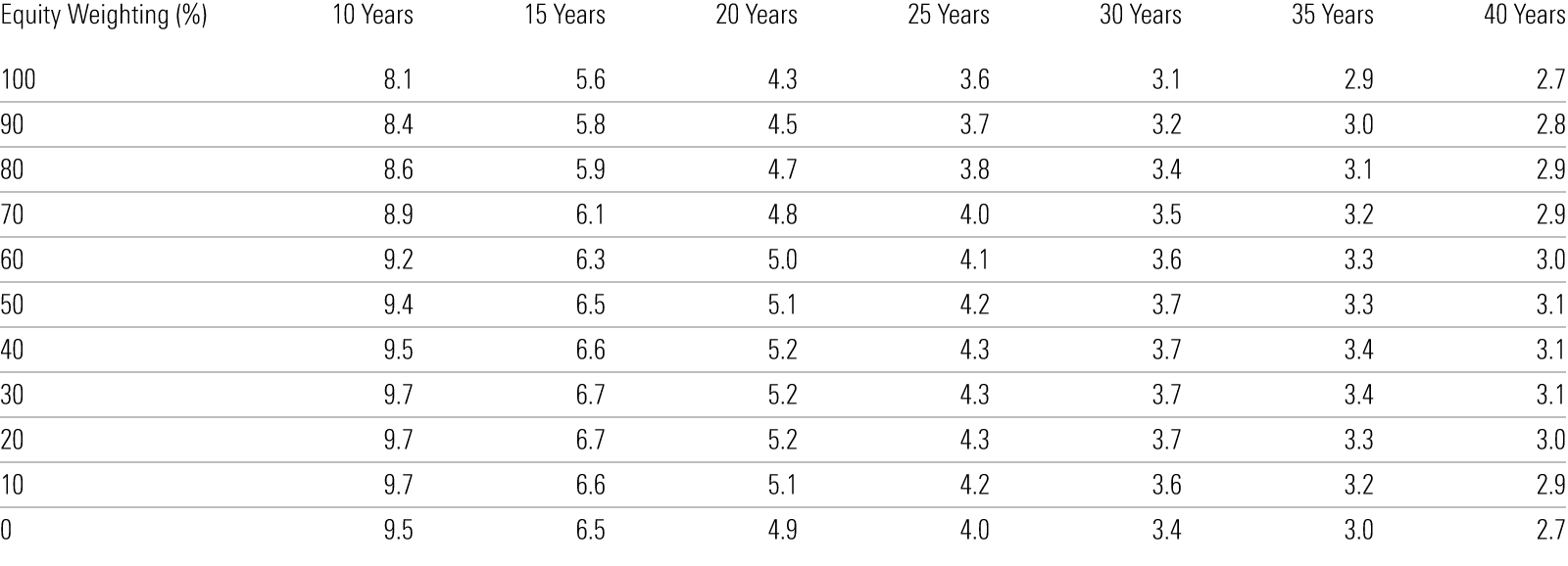
Safe Withdrawal Rates Meet RMDs
You can see the directional similarities when you compare our 2024 safe withdrawal rates by age with RMD-derived withdrawal percentages by age.
But as the table above shows, using RMDs to guide withdrawals is even more conservative than our research. That’s because the RMD calculation provides a bit of leeway to account for the fact that retirees often use their tax-deferred accounts to fund a household’s cash flow needs, not just those of the account owner. If an individual’s IRA is the sole retirement asset in a household, the idea is that RMDs wouldn’t cause the account to be fully depleted once the original account owner dies. As such, the Uniform Lifetime Table is based on joint life expectancies. Specifically, the formula used to determine an IRA account owner’s distribution period makes the very generous assumption that the beneficiary spouse is 10 years younger than the account owner, even though that may well not be the case. (The Joint Life and Last Survivor Expectancy Table is for account owners whose spouses are truly more than 10 years younger; the distribution periods on that table are longer still.) The net effect of this assumption, especially for single people or spouses who are close in age and have similar life expectancies, is that RMD-based withdrawals are quite conservative.
Of course, it’s worth noting that the RMD methodology is fundamentally different from the withdrawal system we use as the base case in our research. With RMDs, retirees recalculate their withdrawal amounts annually to incorporate changes in life expectancy as well as changes in their portfolios’ value. Our base-case withdrawal system, by contrast, assumes that a retiree settles on a starting withdrawal percentage and then inflation-adjusts the Year-1 withdrawal amount each year thereafter. There are some other important distinctions to note, too. While we use a 90% probability of success for our safe withdrawal research, the RMD method has a 100% probability of success on an ongoing basis. Each year’s withdrawal will always be a percentage of the remaining balance. The RMD amount may not be enough to live on, but it will never fully deplete the portfolio.
Additional Safeguards
Yet even as the RMD system includes built-in safeguards against premature asset depletion, retirees who are especially cautious or want to be sure to leave a nice cushion behind for their spouses or children can address those concerns in a few key ways.
The big one is that just because RMDs necessitate that retirees draw funds out of their tax-deferred accounts and pay taxes on them, there’s no reason that unneeded RMDs can’t be reinvested. A taxable brokerage account is the most accessible vehicle, and retirees can invest the funds pretty tax-efficiently in municipal bonds or funds, broad-market equity exchange-traded funds, traditional index funds, or a combination. For RMD-subject investors who are still working, RMDs can be reinvested right back into an IRA. A Roth makes sense in this context in that new contributions won’t face the revolving door of RMDs that traditional tax-deferred accounts face.
In addition, retirees who are especially anxious about running out of money later in life are often worried about long-term-care expenses. Those outlays tend to act as kind of a “balloon payment” at the tail end of their retirements, and the odds of needing paid long-term care are roughly 50/50. To help allay those worries for people who don’t have long-term-care insurance, I like the idea of creating a separate bucket for long-term-care expenses, effectively hiving off those assets from the portfolio that you use to calibrate your spending.
The author or authors do not own shares in any securities mentioned in this article. Find out about Morningstar’s editorial policies.

 United States