
Cliffwater’s Huber: Why Advisors Are Finally Coming Around to Private Markets
A wealth management expert on the investment thesis for interval funds and why private market fund fees are so high.


Phil Huber is uniquely placed to understand the investment proposition for private assets. A wealth manager for years, he also wrote The Allocator’s Edge: A Modern Guide to Alternative Investments and the Future of Diversification. In 2024, Huber joined Cliffwater, an alternative investment adviser and fund manager, where he’s head of portfolio solutions and produces investment research. Morningstar talked with Huber as President Donald Trump signed an executive order that paves the way for including private-market assets in 401(k) retirement plans.
Among other things, Huber discussed the enthusiasm for private markets, why advisors were slow to adopt, and the range of so-called evergreen funds and whether they’re appropriate for individuals. Cliffwater runs interval funds, which Huber wouldn’t discuss specifically, though he was willing to describe their general merits.
Leslie Norton: President Trump has signed an executive order encouraging access to private market investments in retirement plans.
Philip Huber: In the near term, it’s more of a policy signal than a market-moving event. It directs regulators to revisit existing rules around including private equity, real estate, and cryptocurrency in 401(k) plans, but does not make immediate changes. Plan sponsors and providers will likely wait for greater clarity before acting, given ongoing concerns around liquidity, fees, and fiduciary risk.
Why Advisors Are Turning to Private Markets
Norton: Let’s talk about the burst of enthusiasm for non-public investments.
Huber: There are a few factors at play. These markets are substantially larger than 10-15 years ago, when allocators thought private markets were a rounding error in the global markets. Today, they’re 10%-15% of the total global market. There’s an opportunity for additional diversification or return enhancement, ways to potentially improve the risk-adjusted returns of a diversified portfolio.
Investors' Familiarity with Private Market Assets
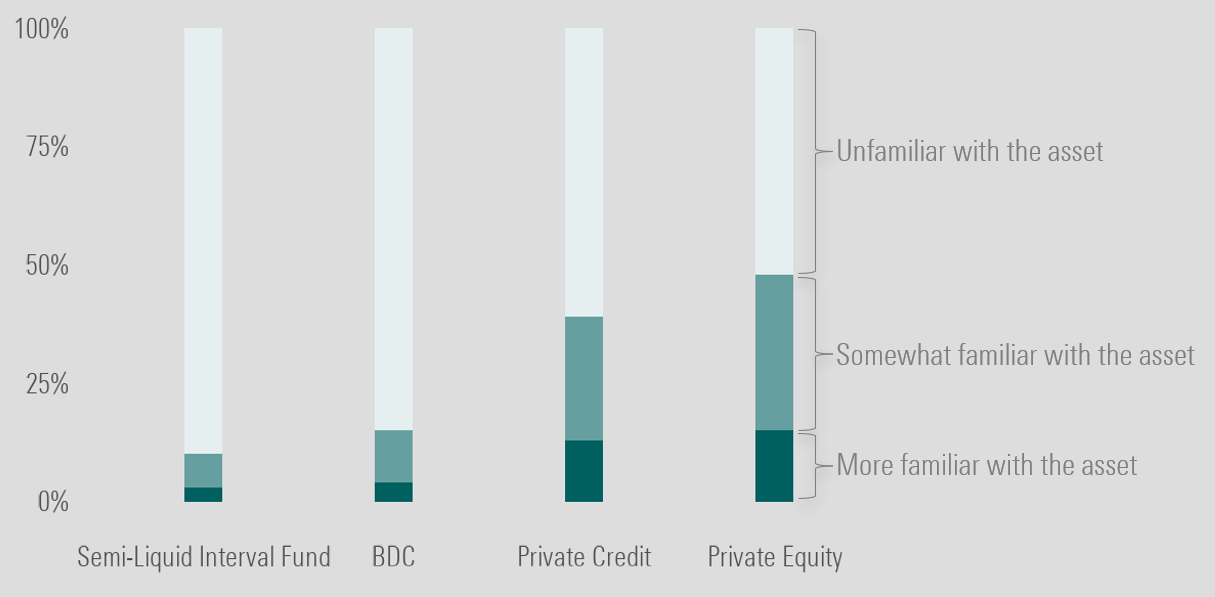
Norton: What held advisors back?
Huber: Until recently, as much as there might have been a potential high expected return on investment, the “return on hassle” was quite low. There was a lot of operational legwork involved in the traditional sense—minimums were very high, and qualification requirements were restrictive for a lot of investor types.
Capital calls and distributions were another nuisance. Advisors would have to handle and monitor Schedule K-1 tax reporting versus the more traditional performance reporting of time-weighted returns for mutual funds and ETFs that they’re used to. Then, if they were going through drawdowns [capital requests] in private markets, it involves concepts like IRR [internal rate of return] and MOIC [Multiple on Invested Capital, which measures the total value of an investment relative to the initial amount invested]. It’s an alphabet soup of performance metrics that most advisors aren’t attuned to. Add up these factors, and it was a high hurdle for adoption.
Norton: What’s changed?
Huber: There’s now an increased awareness and availability of products in more investor-friendly, evergreen-type structures, such as interval funds, that address a lot of those operational pain points. Five-plus years ago, the options available weren’t necessarily high quality. Managers with deep private market backgrounds are now entering the space. Blue-chip private market managers have some brand familiarity for advisors. There are also what I would call consultants turned asset managers, like Cliffwater, whose brands are less known to the average investor but who for decades have been helping pensions, endowments, and other institutional pools of capital allocate to private markets, and are now translating these capabilities to private wealth.
In these asset classes, manager selection is critical. There’s a higher dispersion of outcomes between top and bottom performers than in public markets. That diversification can be your friend as far as investing across a large subset of managers, vintage years, and different strategy types. But trying to do that on a bottom-up basis, picking many different single managers, would be operationally unfeasible and add a lot of unnecessary complexity.
Norton: Where are we seeing adoption now?
Huber: In open-architecture multi-manager vehicles, either through interval funds, tender funds, or others. These are evergreen structures that give advisors almost one-stop diversification and broad exposure to these markets.
Should Individuals Be in Private Markets?
Norton: Is this appropriate for the mass market?
Huber: Financial advisors represent an important guardrail. Frankly, novice investors, who don’t have the requisite knowledge or experience, might face a tough hurdle. Our funds are only available through financial advisors. There are probably some direct-to-retail options, but the vast majority are similar to us, not directly targeting the mom-and-pop investor, but [working] through the wealth management channel, which can aid in determining suitability.
Norton: What are some common questions from advisors?
Huber: This is new terrain for a lot of advisors. It starts with understanding the asset classes. How are they similar or different are they from their public market equivalents? How should they underwrite and do due diligence on these strategies? Another phase relates to semi-liquid evergreen structures. They need to do due diligence on things like liquidity and liability management. These are inherently costlier than fund structures. It’s more than just the management fee. There are other pieces related to how these strategies charge what they do. So they need to spend time understanding those charges and the valuation processes.
Interval Funds and Other Evergreen Funds
Norton: Tell us about the fund types.
Huber: A drawdown fund is a finite-life vehicle, typically a 10-to-12-year period. Your money is invested over a multi-year period and distributed back to you in future years. Liquidity is determined by the GP.
Then you often hear the terms “semi-liquid,” “evergreen,” and “perpetual” thrown around. They mean the same thing. They include tender funds, interval funds, BDCs, and non-traded REITs. BDCs focus on credit, REITs on real estate. Tender funds and interval funds are broadly flexible to invest across different asset types.
Evergreen structures are designed to be perpetual vehicles. The investor, or their advisor, has more control over entry and exit timing. With evergreen funds, there are periodic opportunities to redeem your assets.
Norton: What’s the thesis for interval funds?
Huber: The interval fund complex has matured significantly in recent years. Whereas real estate and private credit saw most of the early adoption in this structure, increasingly, private equity and infrastructure-focused strategies are entering the fray. They’re not appropriate for every investor due to their limited liquidity and higher degree of complexity. But they can offer a balance of quality, convenience, and price. We view them as an important evolution in how private markets are delivered to individual investors.
Interval funds are generally available through financial advisors and are well-suited for high-net-worth investors who want to allocate to private markets without the high minimums, restrictive eligibility requirements, manual subscription processes, cumbersome tax and performance reporting, and the complexities of managing episodic capital calls and distributions. There are no lengthy subscription documents where you need to chase down clients for signatures. They trade via ticker symbol at all the major custodians, strike a daily NAV, and report performance on a time-weighted basis. Interval funds are much cleaner to integrate into an advisor’s standard portfolio management and performance reporting tech stack.
For interval funds, liquidity is contractual and irrevocable. This is different from tender offer funds, non-traded REITs, and non-traded BDCs. Interval fund managers are required to repurchase at least 5% of outstanding NAV each period. That doesn’t mean that investors will always receive 100 cents on the dollar. In periods of elevated redemptions above 5%, investors may only receive a portion of their requested liquidity. While that experience isn’t pleasant, many investors take comfort knowing that interval fund managers can’t just show up one quarter and say they’re only repurchasing 2% or 1% of outstanding shares. There have been notable examples with other evergreen structures in the recent past where investors’ expected liquidity was cut back significantly
Norton: Where do these fit into an asset allocation strategy? If you reallocate, where would it come from?
Huber: There’s no right answer to this. Different investors have different liquidity needs and different budgets for illiquid assets, based on the tax nature of their accounts or their investment holdings. What does the overall allocation look like? Are they more aggressive, more conservative? Most commonly in our practice, we see 10%-20% of the total portfolio across different private markets—credit, equity, real estate, infrastructure, etc.
In my book, I write about how the term “alternative investment” is very loaded. It doesn’t serve a great purpose. At times, it does more harm than good. So the alts bucket includes very disparate items, like private equity, Bitcoin, and catastrophe reinsurance, which are unfair to bucket together.
Private markets are similar in underlying risk exposure to their public market equivalents, but with the added feature of illiquidity. And then you have more diversifying strategies such as managed futures and reinsurance—things designed to be less correlated to the broader macro risk factors. More and more, we’re just seeing advisors place private equity as a component of the broader equity allocation for their clients, similar to the allocation decisions they make regarding large cap vs. small cap, value vs. growth, or US vs. international. We’ve continued to see things like direct lending complement or replace corporate high-yield bonds. They’re becoming integrated into the broader equity and income sleeves.
Will Private Investments Draw Individual Investors?
Norton: In the past, I’d assumed these products were basically sold, not bought. Is there follow-through from individual investors?
Huber: There is a structural shift in how advisors think about building and designing diversified portfolios. Once, people would do 1%-2% allocations to alternatives to check the box. Now we’re seeing significant shifts in those allocations. Advisors are smartening up to the potential benefits in these various asset classes. There’s an excitement now around it. There’s greater breadth and quality of product, so they’re comfortable with allocation and manager selection.
Cliffwater publishes a quarterly report on the broader perpetual alternative funds landscape that aggregates data across the various evergreen fund types. Adoption of these vehicles has really started to accelerate in recent years. Today, there are roughly 250 evergreen funds across all types, representing north of $400 billion of combined AUM.
I think we’ve reached the point of no return, similar to the ETF industry 20 years ago. It was a learning curve with ETFs, which sounds silly today, when there are trillions of dollars in ETFs.
Norton: What will determine whether private market investing gains traction with investors?
Huber: They have to deliver the expected results. Their investors are adding complexity, sacrificing liquidity, and bearing more variability in terms of manager dispersion. They have to see strong performance results, and many funds haven’t been around for that long. Not a lot of evergreen products have decade-plus track records. So it will take some time. Over time, you need to see those pronounced benefits relative to equivalent public market options.
Investor Success and Fees
Norton: Fees are among the most important variables when it comes to investor success. What makes private markets different?
Huber: There’s no strategy so good, as Cliff Asness likes to say, that it can’t be made bad by too high a fee. Investors scrutinize what they’re paying for. There are inherent reasons private market fees are higher. These investments take a lot more skill and work than buying shares on the Exchange. There’s no operational lift required for that. For private markets, there’s a higher cost hurdle for talent, expertise, and actually executing these types of deals. Over time, you should see fees come down.
Where you want to be mindful is in multi-manager strategies in private markets. They can provide diversification benefits, but also come with an additional layer of fees. This second layer of fees can be mitigated through the use of co-investments, which are typically a fee-free and carry-free way to directly invest in or lend to a company. I would caution against just going with the lowest-cost option in private equity or private credit.
Norton: There’s an opinion that private debt may be the area of the market that really gains traction. So, where do you come down on private debt versus private equity?
Huber: Cliffwater was relatively early in the world of private debt. In our institutional consulting business, we have been allocating to private debt since 2006. In 2015, we created the Cliffwater Direct Lending Index, which is the industry’s preferred benchmark for the asset class. Our founder, Stephen Nesbitt, has been a prolific thought leader in the space. We have high conviction in private debt. We manage private equity assets as well.
Private equity has a wider spectrum of outcomes at the manager level. Things are more narrow in private debt, where your yield is your upside, and the risk is all to the downside. When investors look at private debt, they should think about it as a beta asset class, as opposed to alpha. Your actual net return will be a function of credit losses and fees, as well as expenses. We are big believers in diversifying very broadly and keeping position sizes very small in direct lending, as well as fees and expenses. Both are potentially powerful asset classes.
The author or authors do not own shares in any securities mentioned in this article. Find out about Morningstar’s editorial policies.

 United States