
Are Annuities the Missing Piece of Your Retirement-Income Puzzle?
We look at the costs and benefits of using annuities to increase income in retirement.


Annuities have a bad reputation due to their complexity, lack of transparency, and limited flexibility. However, for retirees focused on maximizing their spending in retirement, the simplest annuities can serve as a useful tool.
In our recent annual study on safe withdrawal rates, my colleagues Amy Arnott, Christine Benz, Tao Guo, and I looked at the role immediate and deferred annuities can play in retirement and found they can have a positive impact on spending in retirement. Purchasing one using a portion of your retirement assets does leave less of your nest egg available for market appreciation.
The chart below shows the key findings from the annual study on using different sources of guaranteed income in retirement.
Retirement Spending With Guaranteed Income Summary
For the annuity examples, we used a starting portfolio value of $1 million and used various portions of it to purchase immediate annuities with fixed cost-of-living adjustments of 3%. We assumed the remaining cash was invested in the base case portfolio of 40% equity and 60% fixed income used throughout the study. Withdrawals were made using the starting safe withdrawal rate of 3.7% for the first year and inflation-adjusted in subsequent years. We covered how Social Security impacts retirement income here and flexible withdrawal strategies that can also boost spending here.
As foreshadowed above, each of the scenarios we tested with different allocations to both types of annuities did lead to higher lifetime spending than our base case scenario. However, they also had lower median ending balances and lower total spending + ending balances than the scenarios where the retiree only opted to use Social Security as their guaranteed income source.
What You Need to Know About Annuities
Immediate Annuities
Immediate annuities, typically referred to as single premium immediate annuities, are the most basic type of annuity. For a lump-sum payment, an insurer will provide a fixed amount of income per month (which generally doesn’t increase with inflation) for the rest of the owner’s life or a predetermined amount of time. For example, a 67-year-old female purchasing a $100,000 immediate annuity in October 2024 would receive about $7,400 a year for the rest of her life, according to Immediateannuities.com. Men typically receive slightly higher payouts because of shorter life expectancies. Editor’s note: Long-term interest rates have risen since we ran our study in October, so payouts today are slightly higher.
Annuities can protect retirees from longevity risk but typically leave them exposed to inflation and a reduction in purchasing power over time. But it’s possible to find annuities that include a fixed cost-of-living adjustment. Adding a fixed 3% COLA to the scenario above drops the payout rate from 7.4% to 5.56% ($5,560 in the first year). Annual payouts increase with inflation—$5,689 after the first year, $5,820 after the second year, and so on—taking approximately 10 years for the COLA-adjusted payouts to match the non-COLA payments. After that, the COLA benefits offer a better longevity hedge as long as inflation stays below 3%. Like delaying Social Security, the longer the annuity owner lives, the greater the benefit and vice versa.
Immediate annuities can be valuable for covering basic living expenses, especially when combined with Social Security. Allocating part of a portfolio to an immediate annuity increases lifetime spending but may reduce ending balances after 30 years. This is because the annuity purchase represents a withdrawal, preventing those funds from appreciating.
For example, allocating $100,000 from a $1 million portfolio to a 3% COLA immediate annuity increases lifetime spending by about $30,000 compared with relying solely on Social Security and portfolio withdrawals. However, the median ending balance drops by roughly $230,000 because the $100,000 used for the annuity purchase is no longer invested. This may seem like a terrible trade, but in this scenario the spending boost from the immediate annuity is guaranteed, whereas the ending median balance could vary widely. Lower COLA rates, such as 2%, could further increase lifetime spending because of higher initial payouts. The exhibit below shows how different funding levels for an immediate annuity change the available lifetime spending amount and median ending balance for a retiree over 30 years.
Base Case Plus Social Security and Immediate Annuity: Lifetime Spending and Median Ending Balances at Year 30 (USD Mil)
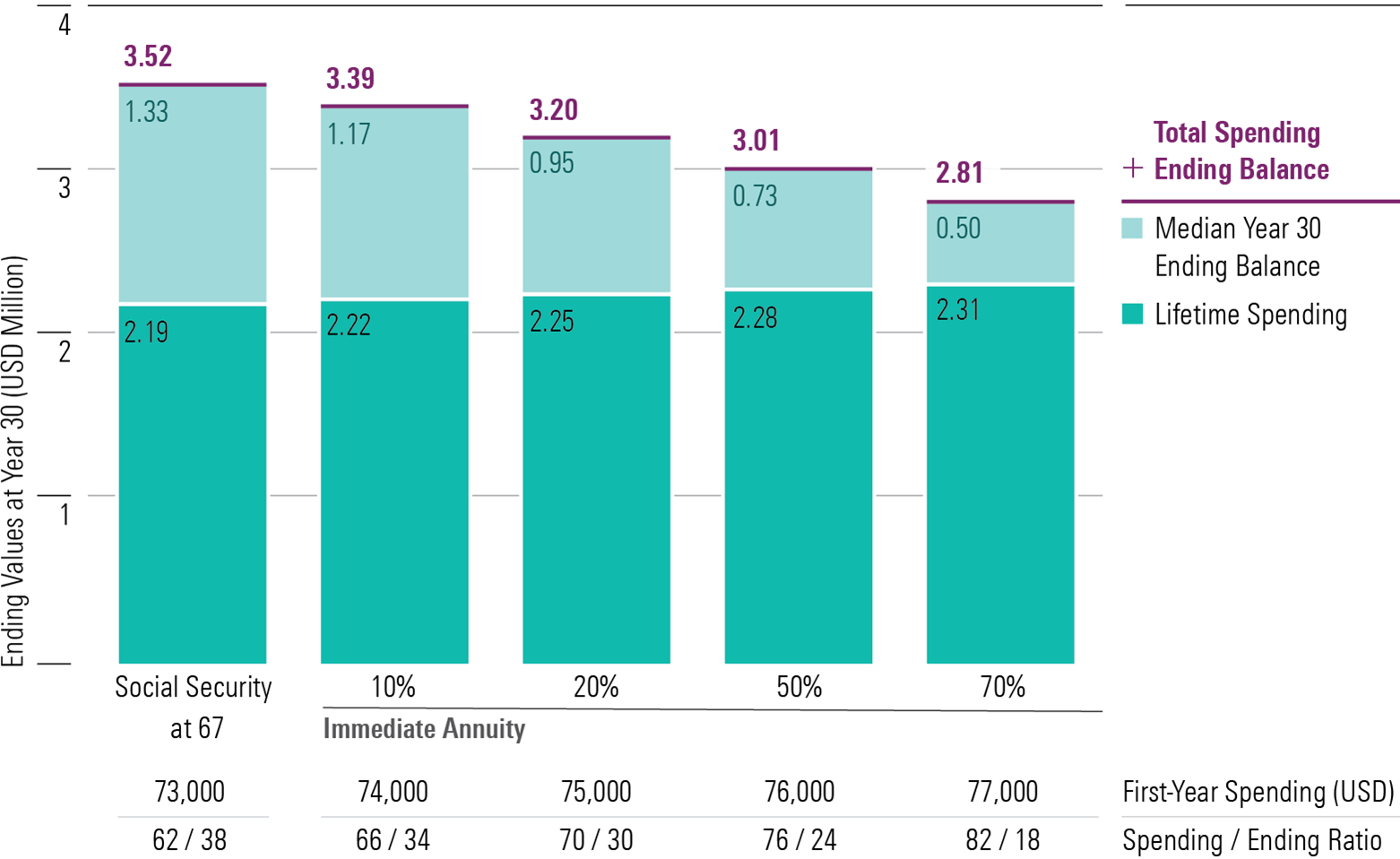
Immediate annuities also mitigate sequence-of-returns risk, reducing the chance of depleting a portfolio because of market downturns during the first decade of retirement. They provide peace of mind for retirees concerned about outliving their assets. However, they may not suit those aiming to leave significant inheritances or charitable donations.
Deferred Annuities
Deferred annuities delay income payments to a future date, typically 10–20 years postretirement. This deferral results in higher payouts than immediate annuities, with longer delays yielding even greater payments. For example, a 67-year-old woman purchasing a $100,000 deferred annuity with a 3% COLA in October 2024 would receive $15,600 annually starting in October 2034, increasing to $16,068 in 2035. Delaying payments to age 85 raises the first payout to $39,600. These amounts surpass the $5,560 annual payment from an immediate annuity, albeit over a shorter time frame.
However, deferred annuities carry additional risks. The insurer’s long-term financial health becomes critical since payments begin years after purchase. Inflation also erodes the real value of future payouts, even with COLA riders. For example, using a 2.32% inflation rate, a $3,300 monthly payment starting at age 85 would equate to just $2,200 in today’s dollars. Moreover, future COLA increases may not keep pace with actual inflation.
Another drawback is the need to fund living expenses from the investment portfolio before annuity payments begin. This depletes the portfolio and reduces median ending balances over 30 years. For instance, using 10% or 20% of a $1 million portfolio to purchase a deferred annuity starting in 10 or 18 years requires withdrawals from remaining portfolio assets, compounded by Social Security income, until the annuity kicks in. The exhibit below shows the results of our scenario analysis using different allocations to deferred annuities.
Base Case Plus Social Security and Deferred Income Annuity, Lifetime Spending and Median Ending Balances (USD Mil)
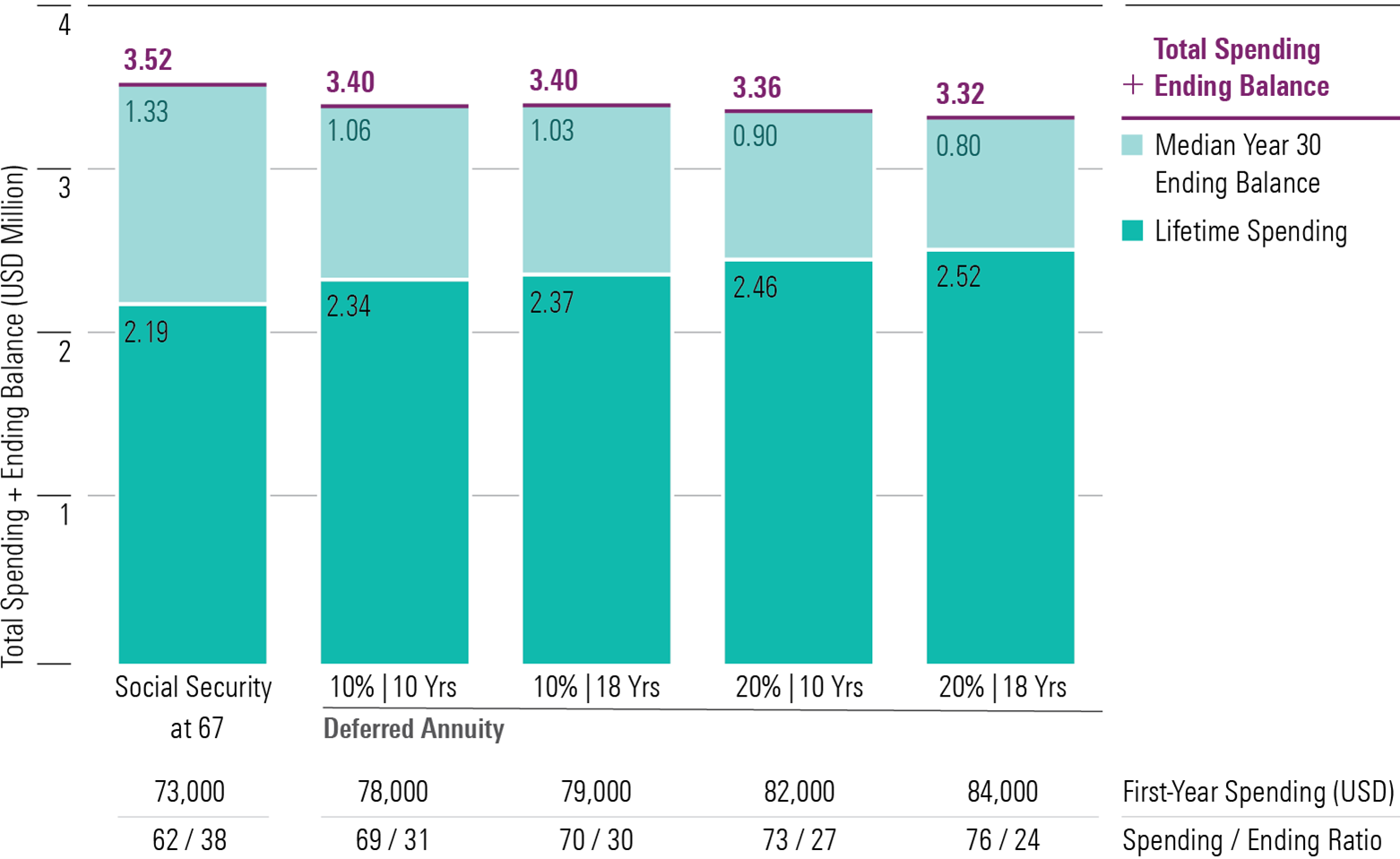
The deferred annuities increase spending significantly more than immediate annuities, but because the individual must live off portfolio withdrawals and Social Security alone for longer, the median ending balances are lower. In the least restrictive scenario, the 10% allocation to a deferred annuity that starts in 10 years, the $2.34 million average lifetime spending is higher than the scenario in the previous example where 70% of the initial portfolio was used to purchase an immediate annuity. The median ending balance was also much higher since 90% of the initial portfolio was left over after the annuity was purchased instead of 30%. Keep in mind this scenario assumes the retiree lives the full 30 years. Still, deferred annuities can be an attractive longevity hedge, provided the retiree lives long enough to reap the benefits.
Ask Your Advisor These Questions Before Direct Indexing for Tax Management
Editor’s Note: This article was updated to correct the spelling of Tao Guo's name.
The author or authors do not own shares in any securities mentioned in this article. Find out about Morningstar’s editorial policies.

 United States