
Why the Fed Rate Hike Spells Bad News for Private Equity Exits
Higher capital costs come on top of the threat of AI, an exit bottleneck, and damped investor appetite.


Private equity dealmakers in the US are poised for higher borrowing costs as the Federal Reserve on Wednesday raised interest rates for the first time since 2023.
The rate-setting committee unanimously agreed to raise its benchmark target range by a quarter of a percentage point, and officials largely agreed that, at the current trend, one more hike would be needed in 2026.
The decision lifted the federal-funds rate to a target range of 3.75% to 4.00%, in line with what market participants expected heading into the September meeting.
Kyle Walters, a private equity analyst at PitchBook, described the rate hike as “directionally negative for PE exit activity,” though it is unlikely to cause significant damage on its own.
“The larger question is whether this rate hike is a one-off or if more are to follow. If it’s the latter, that would have a more negative impact on monetization efforts, as most [leveraged buyout] debt is floating rate, which results in higher interest expense on these companies, and can damage the financial statements prospective buyers look at.”
A series of rate hikes would pressure an industry already facing tough times, beset by AI’s threat to the future of once-resilient business models and an exit bottleneck that has reduced cash distributions and damped investor appetite.
Federal-Funds Rate: Historical Data and FOMC Projections
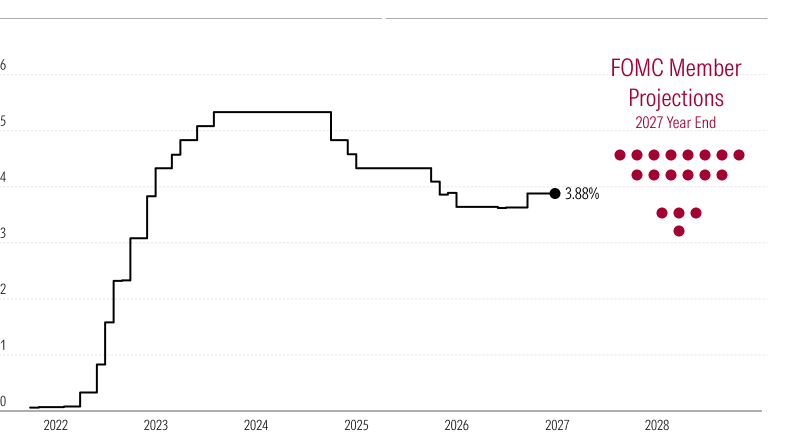
The bottleneck began to form as far back as 2022, when the Fed sharply hiked interest rates to rein in runaway inflation, and has driven a stubborn gap between the pricing expectations of buyers and sellers ever since.
US private equity exit value fell to $102.6 billion in the second quarter, down 46.3% from the previous quarter and 7.4% year over year, according to PitchBook’s latest US PE Breakdown. Private equity exits are the process by which a fund sells or lets go of a portfolio company. Typically, the portfolio company is acquired by a corporate buyer, sold to another private equity sponsor via buyout, or taken public. Private equity firms exit investments to realize gains for their investors, though exits can also be used to limit losses on underperforming investments.
The middle market bore the brunt of the decline, recording just $24.7 billion in exits—the lowest quarterly reading since the second quarter of 2020, underscoring the liquidity constraints the lower end of the market is facing. Mega-exits above $1 billion accounted for the majority of the second quarter’s tally.
“As deals get more expensive, exits get harder, and investors need to prepare for a shift in pricing and in exit strategy,” said Jeremy Swan, managing partner and practice leader of asset management and financial services at business advisory firm CohnReznick, on Wednesday’s rate hike.
Exit time horizons had been getting longer well before the announcement. The median hold period for US private equity assets reached 4.5 years at the end of second-quarter 2026, the highest level in about two decades.
Editor’s Note: This article was originally published on Pitchbook.com.
The author or authors do not own shares in any securities mentioned in this article. Find out about Morningstar’s editorial policies.

 United States