
Too Many Active Funds Are Priced to Fail. Should Investors Steer Clear?
Key takeaways from Morningstar’s ‘Active/Passive Barometer’ report.


My colleagues Bryan Armour, Ryan Jackson, Eugene Gorbatikov, and Hyunmin Kim recently published the semiannual “Active/Passive Barometer” report. Among other things, the report tallies up the percentage of active funds that have topped a passive composite over various trailing periods, breaking them down by Morningstar Category. Here’s the report’s money chart:
Active Fund Success Rates by Category
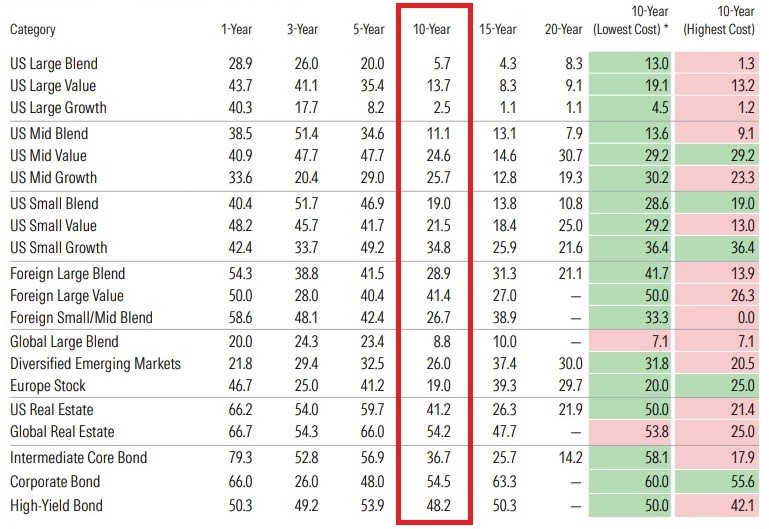
It’s not a pretty picture: Most funds failed to survive and outperform over longer time frames. The report also breaks down the distribution of active funds’ excess returns versus index funds over the 10 years ended Dec. 31, 2024. For instance, here’s what it looks like for surviving active large-blend funds.
Distribution of Active Large-Blend Funds Excess Returns
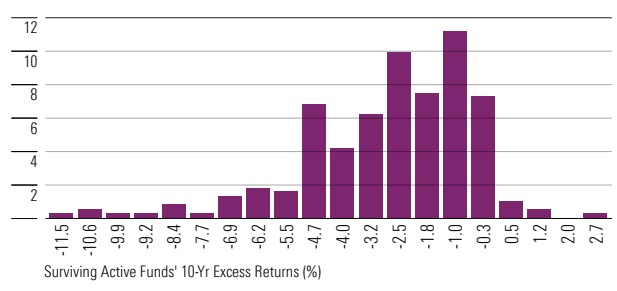
The average active large-blend fund lagged the average large-blend index fund by nearly 2 percentage points per year (though slightly narrower on an asset-weighted basis). It’s not a shock to see active funds struggle in a fiercely competitive segment like US large-cap stocks. But a 1.9% per year shortfall?
Assume the Price Is Wrong
What it comes down to is this: Funds often still charge too much considering the value they’re able to muster before fees, on average. To illustrate, consider the following, in which I compare funds’ trailing 10-year average prefee excess returns (versus their style-appropriate benchmark as of Dec. 31, 2024) to their average fee.
Active Funds' Average Trailing 10-Year Excess Returns and Fees
In some cases, the average fund is underwater before fees. In others, the average fund is able to scratch out some outperformance before fees but expenses gobble up most of that, leaving little for investors. The math just doesn’t add up in a number of these areas, especially US large cap.
The upshot? If you’re a determined active-fund investor, at least start from the premise that the fee is too high. In that way, instead of rationalizing what might be possible, you’re trying to disprove what’s probable—that is, the fund lagging after expenses. Approached that way, you’re likelier to assess what’s achievable in a clear-eyed way.
Find a Keeper
Suppose an active fund you’re looking at passes that test—you think it can clear its fee hurdle. Fine, will it stick around? After all, around 38% of the active funds in the report started but didn’t finish the full 10-year period, either because they got merged into a different offering or the fund company liquidated them altogether.
Active Fund Survival Rates by Morningstar Category
To state the obvious, you have no chance of beating the passive alternative if your fund doesn’t survive. Can you predict if your fund will live or die? Not in any foolproof way, but the report offers a clue on how to tip the odds in your favor: by avoiding the priciest funds, roughly half of which didn’t survive to the end of the period, and favoring the cheapest, which died about a third less often.
Active Fund Mortality Rates: Cheapest vs. Priciest Quintiles
That’s worth bearing in mind if you’re a contrarian sort. You wouldn’t be wrong to think that a laggard could become a leader and vice versa. Reversals happen, after all, and that’s why it’s not too far-fetched to think that active large-cap funds could resurge if the biggest stocks falter or that active bond funds could struggle if the economy slows and credit spreads widen. But none of that matters if the low-cost, against-the-grain fund you’ve chosen folds.
Be Picky
Sobering as the numbers were for active funds, if you squinted hard enough, you’d find there were a few bright spots.
For example, over the 10 years ended Dec. 31, 2024, around 37% of active intermediate core bond funds topped the passive average, but that number rose to 58% if you focused on the cheapest quintile of those funds. Remarkably, the survival rate for that cheapest quintile was around 65%, so that means 90% of the lowest-cost active intermediate core bond funds that survived outperformed the passive bogy.
Active Intermediate Core Bond Funds: Trailing 10-Year Success Rates
Similarly, 41% of active foreign large-value funds succeeded over the 10-year period. But that figure rose further still (50% success rate) if you focused on the lowest-cost quintile, and especially if you narrowed it to the survivors in that cohort (91% success rate).
High-yield bonds were no picnic for active managers—only around 48% of active funds beat the passive composite, and it was one of the few areas where emphasizing cheaper funds didn’t boost success and survival rates. But on an asset-weighted basis, active high-yield bond funds topped the passive average by half a percentage point per year. In other words, the payoff to success was larger, something that shouldn’t be dismissed.
The point? While it might seem logical to allocate the most to active funds in areas like US large-cap that can comprise a big chunk of an asset allocation, the data argues to do otherwise. If you’re going to do it, a big “if” for most investors, the evidence suggests you ought to focus on international stocks and bonds where such funds are likelier to succeed.
Conclusion
The Active/Passive Barometer report appraises active fund success with cold, hard data. The results aren’t pretty, with most actively managed funds lagging a passive composite.
The report reinforces three realities: Many active funds charge more than they should, making them a buyer-beware proposition; active funds die in large numbers, making it critical to assess a fund’s staying power upfront; and it is critical to carefully pick your spots, given the unevenness of active fund success.
Most investors are well-advised to take a pass and opt for a low-cost index fund or exchange-traded fund instead.
Switched On
Here are other things I’m writing, reading, listening to, or watching:
- “The Last Decision by the World’s Leading Thinker on Decisions” by Jason Zweig
- Brian Moriarty and Eric Jacobson on lingering questions surrounding the launch of the first “private credit” ETF
- “Rethinking Defined‐Outcome ETFs: Performance, Fees and the Tradeoffs” by Robert Huebscher
- Christine Benz on whether you should pay off your mortgage early or not and Amy Arnott on how to build an investment portfolio
- “Expected Value, Fessing Up, Highly Engineered Profits, and the Natural Language of Finance” by Tom Brakke
- “The Bed, The Room, The Rain, and You” by Hinds
Don’t Be a Stranger
I love hearing from you. Have some feedback? An angle for an article? Email me at jeffrey.ptak@morningstar.com. If you’re so inclined, you can also follow me on Twitter/X at @syouth1, and I do some odds-and-ends writing on a Substack called Basis Pointing.
The author or authors do not own shares in any securities mentioned in this article. Find out about Morningstar’s editorial policies.

 United States