
These Fund Managers Could’ve Gone Fishin’ and Earned Double the Return
A ‘do-nothing’ portfolio trounced the performance of the average tactical allocation fund. There’s a lesson in that for jittery investors.

“Should I make a change?”
With the markets heaving to and fro, that question has probably rattled around in your head lately. At times like these, with emotions running high, we’re more prone to second-guess our asset mix and make changes to it, like upping our stake in cash and bonds out of fear.
I get it. I feel nervous, too. But unless you’re recalibrating to ensure you have enough money to last you through retirement or have had a significant change in your goals and financial circumstances, you’re better off staying the course.
I say that for a few reasons. First, I’m mindful that each new round of market tumult tends to feel different to us in the moment. But the reality is that these episodes arise routinely, making patience and humility important. Second, I’ve looked at the data. And what it seems to show is investors who kept it simple and traded minimally—that is, who didn’t make a change unless it was absolutely necessary—succeeded while those who did otherwise failed.
Successes
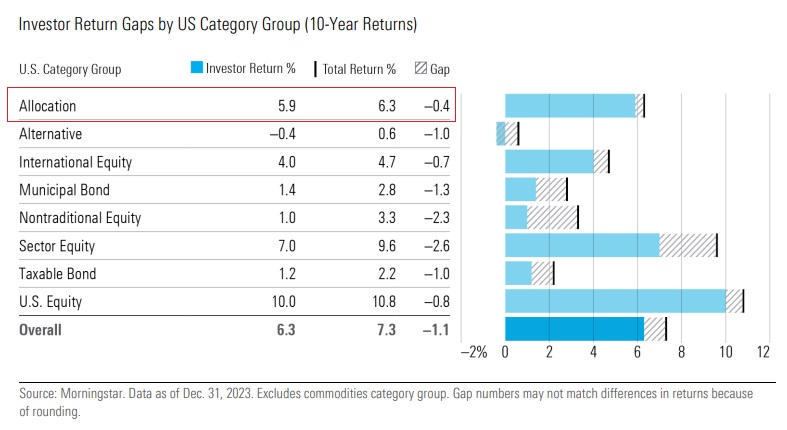
Let’s start with the investors who succeeded. In our annual “Mind the Gap” study, we estimate investors’ dollar-weighted returns. Those estimates account not only for funds’ total returns but also the timing and magnitude of investors’ purchases and sales.
What we’ve consistently found is investors in set-it-and-forget-it strategies like target-date funds captured the largest share of their funds’ returns. Notably, these funds automate asset allocation and rebalancing, obviating the need for investors to buy or sell in an ad hoc way. This appears to have helped those investors to avoid costly errors, where they’d buy high and sell low.
Allocation Fund Investors Succeeded
Failures
And then there’s data on the investors who failed. Certainly, you can find evidence of this in the “Mind the Gap” study—for instance, investors in nontraditional equity and alternative funds earned a much smaller share of their funds’ total returns, reflecting these strategies’ greater complexity and the greater variability of investor cash flows. Indeed, the more volatile the flows to a particular type of strategy were, the more trouble investors had in capturing their funds’ total returns.
Monthly Flow Volatility vs. Percentage of Return Captured
But I was also interested in an area where success was conspicuous mostly by its absence: tactical allocation funds. These are funds run by portfolio managers who aim to swerve around the market, making frequent allocation changes based on fundamental or technical analysis they conduct. Here’s a time-lapse that should give a sense of how much these managers shifted their funds’ allocations around over the decade ended March 31, 2025:
Tactical Allocation Funds: Average Percentage Asset Allocations
I ran a test to see how these funds would have done had the managers made no changes to their investments. Specifically, I tallied up their holdings as of March 31, 2015, and calculated the funds’ average percentage stake in the major asset classes—US stocks, foreign stocks, US bonds, foreign bonds, and cash. Then I assumed they invested those sums in an index fund or exchange-traded fund corresponding to each asset class and left that proxy portfolio untouched for the next 10 years. Here’s how that do-nothing strategy would have fared:
Growth of $10k: Do-Nothing Portfolio vs. Average Tactical Allocation Fund
In summary, it would have been no contest—the do-nothing portfolio would have trounced the average tactical allocation fund’s actual results. Trading was quite costly, with the do-nothing strategy earning nearly 4 percentage points per year more than the average tactical fund.
True, you could argue that’s an unfair test, as maybe these tactical managers made trades that paid off over shorter intervals compared with a strategy of doing nothing. So, I ran a second test in which I calculated the tactical funds’ aggregate average percentage asset allocations each month and then measured how a do-nothing portfolio corresponding to those allocations would have done over the subsequent three years. In this way, we get 85 different measurements, one for each rolling three-year period that falls within the decade ended March 31, 2025.
Do-Nothing Portfolio vs. Average Tactical Allocation Fund
As you can see, it didn’t really make a difference. In nearly every three-year period, the do-nothing strategy would have topped the tactical funds’ actual results.
It’s also worth noting that, in our research, we have found that the average dollar invested in tactical funds has earned significantly less than the average fund, reflecting inopportune purchases and sales by investors who have decided to take the plunge in these strategies. So, in a sense, it’s a double whammy—the average tactical fund has lagged a do-nothing strategy and the average dollar invested in a tactical fund has fallen shy of the average fund’s total return.
Conclusion
Tempting as it might seem to make changes to your investments amid heightened anxiety, you are better off holding the line. Yes, there are exceptions—as mentioned, if you are soon-to-retire or newly retired, it could be worth it to take some risk off the table depending on your circumstances. But most other investors should stick with it, for otherwise the evidence suggests they risk doing themselves more harm than good, forgoing a chunk of their investments’ future returns.
Switched On
Here are other things I’m writing, reading, listening to, or watching:
- The Odd Lots podcast with Jim Chanos on who’s “swimming naked”
- Cullen Roche on why tariffs are bad
- The Economist Editor in Chief Zanny Minton Beddoes on the radical remaking of the global economy on Fresh Air
- Animal Spirits on how to react to the tariff fallout
- I wrote a little more about buffer ETFs, focusing on the FT Vest series (they’ve worked)
- RIP to “Clint” from “Dazed and Confused”
- Lucy Dacus “Ankles”
Don’t Be a Stranger
I love hearing from you. Have some feedback? An angle for an article? Email me at jeffrey.ptak@morningstar.com. If you’re so inclined, you can also follow me on Twitter/X at @syouth1, and I do some odds-and-ends writing on a Substack called Basis Pointing.
Correction: (April 15, 2025): A previous version of this article misspelled the name of The Economist Editor in Chief Zanny Minton Beddoes.
The author or authors do not own shares in any securities mentioned in this article. Find out about Morningstar’s editorial policies.

 United States