
These Active Funds' ETF Versions Are Worth a Look
Many of the top open-end funds are now available in ETF form.

Actively managed exchange-traded funds are the fastest-growing part of the fund industry. By now, nearly all the big fund companies have embraced the idea and rolled out funds of their own. So, you might want to check out a firm’s ETF options when shopping for your next fund.
The appeal rests on two main points. First, ETFs have tax advantages that allow them to avoid capital gains distributions most of the time. For actively managed equity funds, that can compound in a big way over time. Second, ETFs don’t have to pay for account servicing, so they can charge a lower expense ratio.
There are two smaller advantages, but they are not very important to long-term investors. First, you can buy and sell your shares at any point during the trading day rather than wait for the end-of-day net asset value to be struck. For short-term traders, that’s a big deal, but it’s pretty meaningless if you are a buy-and-hold investor. Second, you get daily portfolio transparency with ETFs rather than monthly or quarterly. Again, does that really matter if you are investing for the long term? I don’t think so.
There are a couple of downsides to ETFs that explain why many of the more popular mutual funds don’t have an ETF equivalent. ETFs can’t be closed to new investors, so any strategy that already has a huge sum of money would not make sense as an ETF. That’s why there is no ETF version of Fidelity Contrafund FCNTX.
Also, because ETF portfolios need to be easily created, liquidity-constrained active strategies like small-cap growth or high-yield bond don’t work, either. In addition, derivative-driven portfolios such as Pimco Total Return PTTRX won’t work because derivatives aren’t easy to purchase or trade in small quantities.
How to Match an ETF to an Open-End Fund
We’ve seen different fund companies take different approaches. T. Rowe Price and Fidelity have mostly avoided creating ETF versions of their most popular funds. However, they have created ETF versions of some big funds that are one or two notches below in popularity. Those firms make it easy to find the twin, too, because they give it the same name as the open-end fund.
American Funds has taken a different approach because its large-cap funds are so big. It has similar strategies, but different managers, and the ETFs have the firm’s Capital Group parent name rather than the American Funds name of the mutual funds. So, you can choose an ETF version of one of the firm’s funds that you like, but with different managers, it certainly can see performance differences. Like T. Rowe and Fidelity, American has avoided launching ETF versions of its largest funds.
Active ETFs vs Mutual Funds: What to Know Before Picking a New Fund
Fund vs. Fund
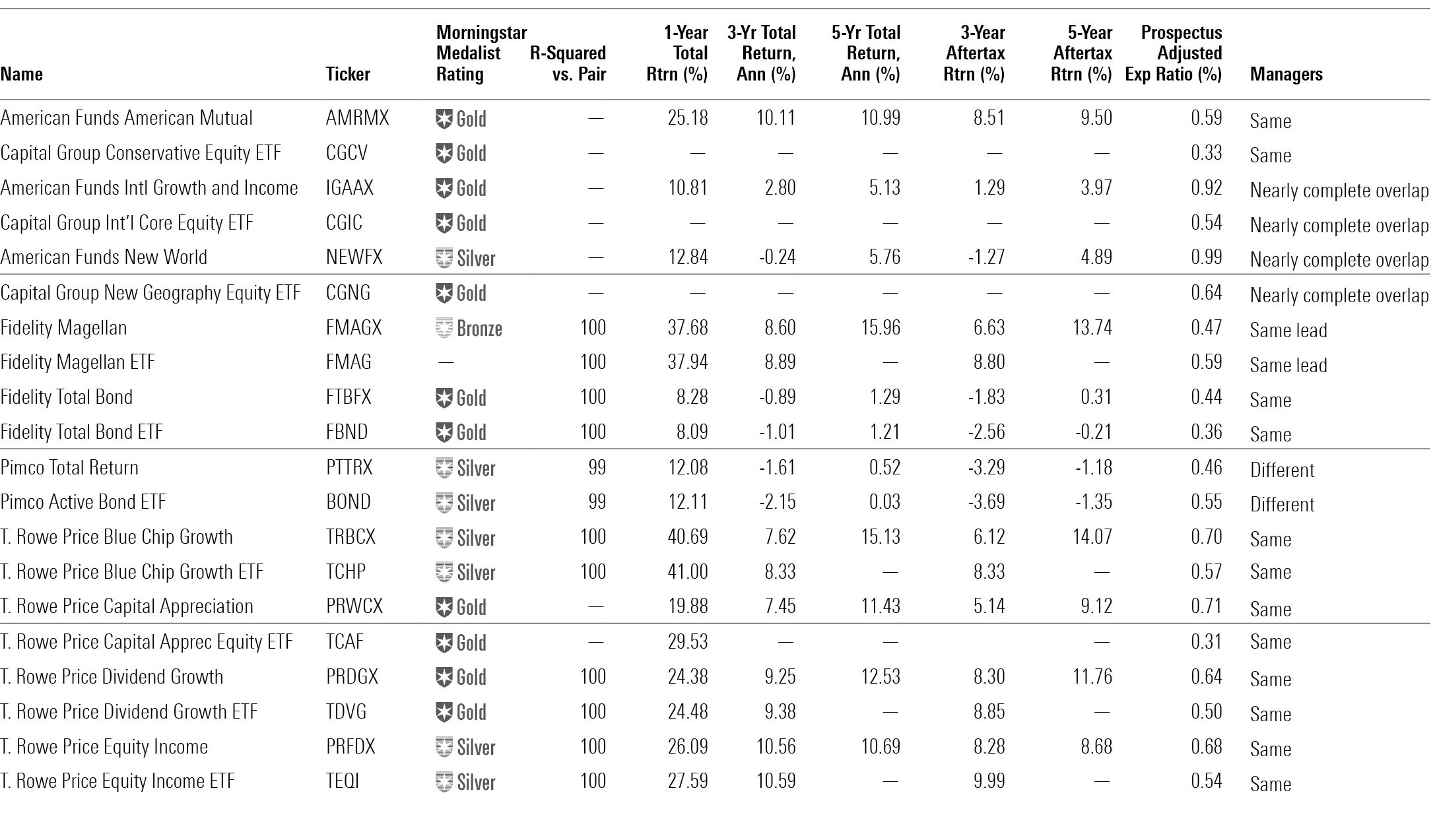
Let’s see how some of these pairs compare on fees, performance, portfolios, and aftertax returns. I’m using aftertax returns that assume the highest tax rate and that the investor held through the time period. (If an investor holds on for a only couple of years, the tax issue is moot.)
T. Rowe managed to create an ETF version of its most popular and long-closed fund, T. Rowe Price Capital Appreciation PRWCX. The trick was to carve out the equity sleeve of the fund and remove the allocation and fixed-income elements, some of which are capacity-constrained. While the equity portfolios are similar, the funds are not, given that one has a lot of fixed income and makes allocation calls and the other doesn’t. T. Rowe Price Capital Appreciation Equity ETF TCAF is, of course, cheaper. David Giroux is the rare manager who is adept at allocation, equity selection, and fixed-income management. Both have a Morningstar Medalist Rating of Gold, but if you buy the ETF be prepared for more volatility than the allocation fund’s long-term record would lead you to believe. (I own shares of TCAF.)
T. Rowe Price Blue Chip Growth TRBCX has a 100 R-squared with its ETF twin by the same name with ticker TCHP. The ETF charges 0.57% to the open-end fund’s 0.70%. The one- and three-year returns of the two funds have been quite close, but the ETF is slightly ahead owing to its fee edge. However, the ETF has a big edge in aftertax returns with an 8.33% annualized three-year return compared with 6.12% for the open-end fund. Long-held positions mean the open-end fund distributes capital gains most years, while the ETF does not. So, if you are buying for a taxable account, the ETF is the clear choice.
T. Rowe Price Dividend Growth PRDGX and its ETF, ticker TDVG, are both Gold-rated funds with a sound strategy. Returns have been quite tight as the 100 R-squared indicates. The open-end fund is behind by 10 basis points for one year and behind by 13 basis points annualized for three years. The ETF charges 14 basis points less in expenses, so the reason is clear. On aftertax returns, the ETF is ahead by 55 basis points annualized over three years. The edge is smaller than with Blue Chip Growth because ETFs don’t have an edge on dividends. Even so, I’d take the ETF in a taxable account.
The story is very similar at T. Rowe Price Equity Income PRFDX where the R-squared with TEQI is 100 and performance has been tight. The aftertax returns gap is wider here for three years, but not for any structural reasons.
At American Funds, performance won’t likely be so tight at some of the funds. In some cases, you have different managers but similar mandates. In other cases, the managers are the same. The funds are less than a year old, so we don’t have much return info to go on. Interestingly, Capital Group has priced its ETFs quite aggressively with low expense ratios.
Capital Group Conservative Equity ETF CGCV costs just 0.33% compared with 0.59% for its cousin American Funds American Mutual AMRMX. Capital Group International Core Equity ETF CGIC charges just 0.54% compared with 0.92% for American Funds International Growth and Income IGAAX. These two ETFs have managers that match the open-end lineup. Capital Group uses a portfolio optimizer to give the ETFs similar performance but with fewer holdings.
Both of the above strategies have a dividend focus that Capital Group has proved to be very adept at over the years. They seek out dividends but insist on well-run healthy companies so that you get both modest risk and capital appreciation along with that yield. Too many dividend-oriented funds go all out for income at the expense of downside protection.
Capital Group also launched an emerging-markets ETF that is roughly comparable to American Funds New World NEWFX. Capital Group New Geography Equity ETF CGNG charges only 0.64% compared with 0.99% for New World. Demerits for the New Geography name but points for a low-cost emerging-markets fund. (I own NEWFX shares.)
Pimco Active Bond BOND is an interesting case. It was originally launched as an ETF version of Pimco Total Return. It wasn’t meant to be an exact fit because it couldn’t own the derivatives that were such a big part of then-manager Bill Gross’ portfolio at Total Return. But since Gross departed, the ETF was given a new mandate to go after income more than total return, but not as much as Pimco Income PONAX. The ETF also has a different management team. David Braun, Dan Hyman, and Jerome Schneider have run the fund since 2017. We rate the ETF at Silver and think it can stand on its own merits.
You won’t find ETFs for Fidelity Growth Company FDGRX or Contrafund as they have such massive asset bases that it wouldn’t make sense to open new vehicles that can’t be closed. But you will find ETF versions of Gold-rated Fidelity Total Bond FTBFX and Neutral-rated Fidelity Magellan FMAGX.
Interestingly, the performance pattern is different for Fidelity Total Bond. Despite being at a disadvantage on fees, Fidelity Total Bond’s open-end version has outperformed the ETF, FBND. Over five years, it is ahead by 8 basis points annualized and by 52 basis points on an aftertax basis. The gaps aren’t huge, but it does suggest that the choice between the two is more of a coin flip than the other cases whether you are in a taxable or tax-sheltered account.
Longtime investors may recall there was a time when Fidelity Magellan was the largest fund in the world. But a very long run of mediocre results and the move to target-date funds in 401(k)s have shrunk Magellan down to a sliver of its former size. Hence, Fidelity Magellan ETF FMAG. The funds have a 100 R-squared, and the ETF is ahead for the trailing three years with a return of 8.89% annualized versus 8.60% for the open-end fund. At the moment, the ETF actually charges 12 basis points more. Magellan in open-end form has a performance fee, and that currently is subtracting fees because the fund lagged its benchmark.
Manager Sammy Simnegar might be the one to turn around Magellan’s fortunes. He’s a patient investor with a focus on high quality. He runs a roughly equal-weight portfolio of 50 to 80 names. His valuation sensitivity has held the fund back of late, but style goes in and out of favor. Despite the fee edge, I would still take the ETF for a taxable account because its tax edge will endure while the open-end fund’s fee edge will go away if returns improve.
A New Wrinkle in ETFs and Open-End Funds
Years ago, Vanguard got SEC approval for a unique structure that made a comparable ETF for its index funds count as a share class of the open-end fund. This allowed the open-end fund to wash its capital gains through the ETF, thus providing a low-tax structure for the ETF and open-end fund alike. Vanguard patented this process, and no other fund company wanted to pay a competitor for it.
But now that it has come off patent, scores of fund companies have filed to launch similar ETF share classes for their open-end funds. If regulators approve it, this will largely level the playing field on taxes for funds where an ETF is a practical option. Thus, the tax situation may improve for many open-end funds. Stay tuned to see if your funds are affected.
That said, ETFs should maintain their fee edge, and you have certainty of that tax edge until the ETF share classes are approved. In short, weigh your options in both vehicle types when picking new funds.
How the Pairs Compare
This article first appeared in the December 2024 issue of Morningstar FundInvestor. Download a complimentary copy of FundInvestor by visiting this website.
The author or authors own shares in one or more securities mentioned in this article. Find out about Morningstar’s editorial policies.

 United States