
Target-Date Funds Have Delivered
Target-date funds have redefined the path to retirement for an entire generation of investors.


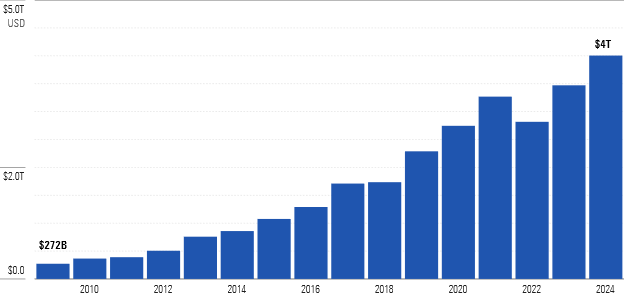
Target-date investment strategies accounted for more than $4 trillion in assets across mutual fund and collective investment trust vehicles as of the end of 2024. If target-date funds were a country’s gross domestic product, it would be the fifth-largest in the world, ranking behind the US, China, Germany, and Japan. Between inflows and market appreciation, assets have climbed at an astounding compounded rate of more than 20% annualized over the past 15 years. We explore these market trends and more in the recently released 2025 Target-Date Strategy Landscape.
Target-Date Assets Have Grown More Than 20% Annualized Over the Past 15 Years
Investors in Target-Date 2025 Funds Reached an Important Milestone
Despite their phenomenal growth, target-date funds weren’t always the obvious investment of choice among retirement investors. The US Department of Labor’s late-2007 finalization of regulations allowed target-date funds to be qualified default investment alternatives in retirement savings plans. This provided employers and fiduciaries with a valuable liability shield—a compelling incentive—for plans to default employees’ 401(k) retirement savings into target-date funds.
Since then, the strategies have flourished, and those workers invested in target-date 2025 funds reached an important milestone in 2025: their retirement. These investors were among the first to use target-date funds in notable mass, and they were about 50 years old in 2010 when target-date offerings began taking off. This has allowed many of them to experience a full 15-year cycle of regularly investing in a target-date fund, including the effects of dollar-cost averaging that come with regularly setting aside a portion of a paycheck into a retirement savings plan.
Morningstar data includes 37 target-date 2025 mutual funds or CIT funds with at least 15 years of returns through the end of 2024. Owing largely to a market that has charged steadily upward over this time, even with major drawdowns along the way, workers who invested in 2025 target-date funds since they took off in the years following the DOL’s fiduciary guidance and now retiring in 2025 have fared well.
The actual returns produced by this group of target-date funds have handily outpaced expectations from the target-date investing scenario tests and models that were commonly used around 2010. Using Morningstar Investment Management’s capital market expectations from that year, our models expected the industry average glide path to gain an annualized 6.3% over the past 15 years. In actuality, the 37 target-date strategies returned an average of 7.3% annualized.
Target-Date Funds and Recent Market Volatility
That’s even the case considering the market volatility and losses that have occurred so far in 2025. From the market’s 2025 peak on Feb. 19 through its trough on April 8, the S&P 500 lost 18.6%. Over that period, the target-date 2025 Morningstar Category average lost 7.6%. Markets have since rebounded, and year-to-date losses for the S&P 500 through April 15, 2025, stand at 8.3% versus a loss of 1.3% for the typical target-date 2025 fund.
Newly minted 2025 retirees endured this period of volatility, likely exacerbated for many by their new reality of no longer relying on a regular, predictable paycheck. But in the larger multidecade investing picture, the period amounted to a blip. Investors who stayed the course with their target-date 2025 funds remained on track for a secure retirement.
Fees Continue Reaching New Lows, Benefiting Workers
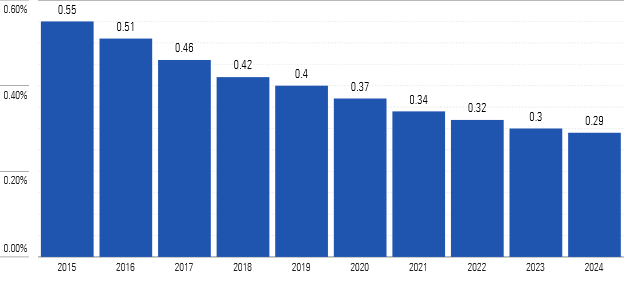
At least some of that success has come from the continued downward march of target-date fees. In 2024, target-date mutual funds’ asset-weighted fee dropped to 29 basis points from 30 basis points. Over the past decade, the asset-weighted average prospectus net expense ratio for target-date funds has declined by 48%. Lower fees translate directly into greater savings and more money compounding for investors.
Fees Remained on a Downward Trend and Reached New Lows in 2024
The fee declines have resulted from asset managers cutting prices as well as investors choosing lower-cost options such as index-based target-date funds. Passive or index-based strategies accounted for 53% of assets at the end of 2024, inching upward from their 50% market share in 2022. While we consider all target-date funds to be actively managed, since portfolio managers make asset allocation and glide path decisions, we also categorize them as passive, active, or blend, based on each target-date series’ underlying holdings (blend strategies have between 25% and 75% of their underlying holdings in index-based strategies, while active and passive strategies lie above and below that range, respectively).
Target-Date Fund Market Share by Passive, Active, and Blend Portfolio Construction
For both passive- and active-based target-date strategies, the market remains concentrated. The Vanguard Target Retirement series, for example, accounted for more than two thirds of the passive-based portion of the target-date mutual fund market. Active-based series have somewhat more competition, though the top three managers—Capital Group/American Funds, Fidelity, and T. Rowe Price—still hold more than 80% of the active-based market.
All these managers were among the first movers in the target-date space and are well represented among the higher-conviction strategies that receive Morningstar Medalist Ratings, an indication of our top-rated target-date funds. This includes the Gold-rated mutual fund series from American Funds, Fidelity, and T. Rowe Price.
As increasingly larger waves of target-date investors reach retirement, the results from earlier users like target-date 2025 fund investors speak volumes about the merits of these funds. Target-date funds have not only delivered—they’ve redefined the path to retirement for an entire generation of investors.
Correction: This text and the title of the first exhibit were corrected to indicate that, between inflows and market appreciation, assets have grown more than 20% annualized over the past 15 years, not 30%.
The author or authors own shares in one or more securities mentioned in this article. Find out about Morningstar’s editorial policies.

 United States