
Small-Cap Funds Are Getting Hammered by Outflows
A closer look at funds that are in the hot seat, and whether they can rebound.

Bad stuff can happen when funds are beset with outflows. Flows are generally of the minor variety, but at extreme levels, they can cause real problems. As passive exchange-traded funds soak up most flows these days, most actively managed funds are in outflows. Among the Morningstar FundInvestor 500, 370 funds had net outflows for the 12 months ended January 2026.
For most, it’s not a big deal. But there are a few bad things that can happen because of outflows. Funds have great economies of scale, so fees paid by shareholders as a percentage of assets fall when assets increase, and they rise when assets shrink. Second, outflows mean selling, and selling means more capital gains spread across a smaller shareholder base, leading to an increase in taxes for those holding the fund in a taxable account. A third problem is that outflows can reduce a fund’s asset base to the point where it’s no longer profitable for the company to manage, leading the firm to close or merge the fund. Fund companies also close shrinking funds with poor records to sweep mistakes under the rug.
But the greatest concern is that selling less-liquid holdings can hurt performance. It’s not uncommon for big inflows to improve returns at small-cap funds because they are buying more of their own holdings. Conversely, outflows can lead to underperformance as funds have to push too much supply out to meet redemptions, and it drives down the price of their holdings. Usually, it’s only a modest impact, on the level of 50 basis points or so.
Sometimes, however, it’s a real mess. An extreme case was Schwab YieldPlus, a short-term bond fund that Schwab suggested would be a good money market substitute. In 2008, lower-quality mortgages and more exotic mortgages got pummeled when the housing bubble burst. Over time, most of those holdings recovered their value, but at peak panic in 2008, Schwab could only find buyers at fire-sale prices. That created a vicious circle as the fund sold to meet redemptions, realized losses, drove down prices for its remaining securities, and posted poor numbers that led to further redemptions. The fund lost 25% in 2008 and 10% in 2009, despite being in a category where shareholders expected only tiny losses.
More often, we see small-cap funds whose holdings still have solid market bids in downturns but extract increasingly large discounts the more stocks get sold. Thus, a fund might take a 200-basis-point hit because of forced sales, and that hit might spur more redemptions. We also see challenges in bank-loan funds where liquidity is limited. Occasionally, bank-loan funds borrow money to meet redemptions rather than sell in a tight market.
Where You Don’t Have to Worry
I’ll dig into individual cases of big outflows, but first, let’s save you some time and touch on the Morningstar Categories where flows really aren’t a worry. Large-cap equity funds and high-quality bond funds play in extremely liquid markets and rarely have any problems buying and selling all the securities needed. True, they could still be merged away or face higher expense ratios, but that is the extent of the problem. This is also the arena for allocation funds, so it’s also rare for them to have outflow problems.
Just about any index fund is worry-free because they are mostly very liquid, and many track indexes with futures that can be traded to meet mass redemptions.
Funds Under the Gun
Invesco Developing Markets ODMAX was slammed with $9.6 billion in outflows over the past 12 months, off a $15 billion asset base. The fund endured a severe slump when former manager Justin Leverenz made a few bad calls, starting with owning Russian stocks when that country invaded Ukraine. It ended with Leverenz being dismissed in June 2025 and replaced by a London-based emerging-market team. Even though the new managers had a solid record, a whopping $4 billion flew out in the two months after the manager change. That has slowed a bit recently, but the fund had another $709 million leave in January. That burst of outflows might have hindered the fund as it has a mix of very liquid names at the top with smaller names in the rest of the portfolio. But the more modest level of outflows is likely manageable. We give the fund a Morningstar Medalist Rating of Bronze.
Two American Beacon AHL funds top the list of the most heavily redeemed funds. American Beacon AHL Managed Futures Strategy AHLAX and American Beacon AHL TargetRisk AHTPX saw more than half of their assets flee in the 12 months ended January 2026. American Beacon AHL TargetRisk is down to $150 million in assets after $160 million went out the door.
These alternative funds using futures are probably OK on liquidity issues, but when you get down to $150 million, it’s fair to ask whether the fund will be merged away or liquidated. Performance has been middling rather than bad, but investors may be reacting to restructurings at subadvisor Man AHL. Those changes led us to lower both funds’ People ratings to Above Average from High.
Small-Cap Funds Getting Roasted
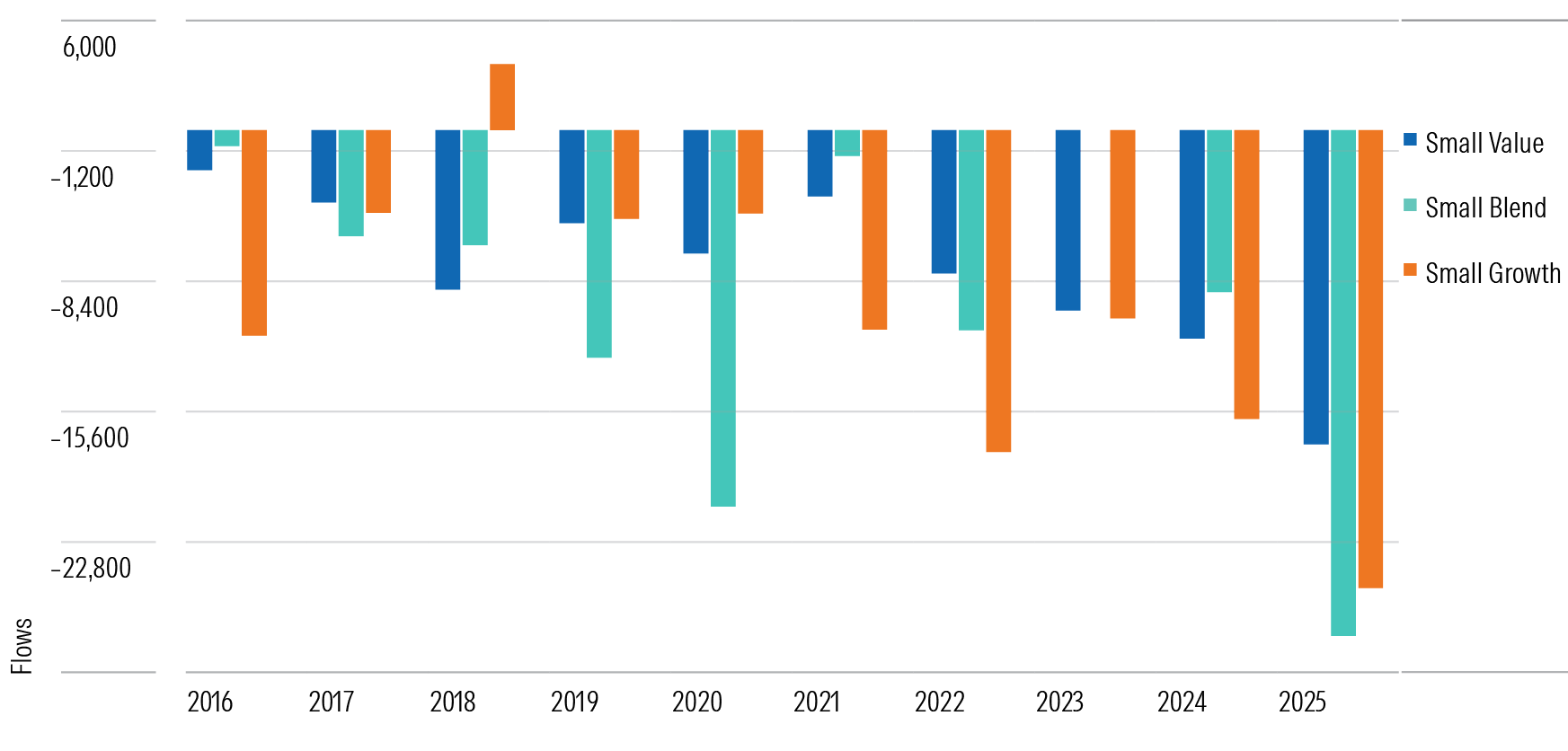
Actively managed small-cap funds are feeling the heat of outflows because so many trends are going against them. First, there’s a movement from active to passive funds. Second, large caps have outperformed small caps. Third, small caps are less liquid, making flows much more difficult to manage.
Small-Cap Annual Outflows
Artisan International Small-Mid ARTJX is one of the funds I’m more concerned about. A performance slump has spurred $1.9 billion in net outflows over the past year, taking assets under management down to $3.0 billion from $3.8 billion. (Appreciation accounts for the fact that AUM dropped less than the outflows would have suggested.) Foreign small caps are less liquid than US small caps, so it’s a real challenge to manage big flows. In fact, 13% of the portfolio is in micro-caps. Manager Rezo Kanovich reopened the fund in April 2025, but this hasn’t meaningfully slowed outflows. The fund’s distinctive portfolio lends itself to long stretches of outperformance and underperformance. The fund has endured three consecutive years of underperformance and is lagging in 2026.
Artisan Global Discovery APFDX is in a similar situation. The fund shed $115 million to fall to $156 million. That was a similar amount of flows in percentage terms as Kanovich’s fund, but the smaller absolute amount should be more manageable. Also, three-fourths of the portfolio is in US stocks, and the fund has more mid-cap and large-cap names. The greater concern here, then, is that shrinking assets could spur Artisan to shut down the fund. On the bright side, the fund’s slump has lasted only about 14 months, so it won’t take much to have a better return profile.
Speaking of slumps, Brown Capital Management Small Company BCSIX has endured a rough one. The fund is in the bottom 2% of small-growth funds over the trailing one-, three-, five-, and 10-year periods. Ouch! The fund’s emphasis on profitability and quality seems to have it in the out-of-favor part of the market. Most recently, its software companies have been hurt by the threat that artificial intelligence will allow their customers to create software directly. Not surprisingly, the fund has shed $370 million in the past 12 months, bringing it down to $450 million.
I see two problems here: First, managing those flows with modest liquidity in the portfolio is a challenge, as 27% of assets are in micro-caps. Second, a big decline in assets makes it tough to hold on to investment professionals, and in fact, the fund just lost a manager. We lowered our People and Process ratings to Average, bringing the overall rating to Neutral.
ClearBridge Small Cap Growth SASMX has seen about 38% of assets leave in the past 12 months, even though its performance was not awful. The fund’s returns have been right around the category average over the standard trailing periods. Considering the fund has low risk relative to peers, that’s actually a pretty good profile. This case really illustrates the challenges faced by active managers. The fund is doing respectably, and it matches expectations set by managers for a lower-risk strategy, but it still isn’t exciting enough to keep assets from flowing to passive competitors. Given the profile, I’m not too worried about the outflows yet.
I’m less sanguine about Negative-rated Alger Small Cap Focus AOFAX, where Amy Zhang started strong but has been in a rough slump since then, though returns are a hair better than her former employer Brown Capital’s small-cap fund. I don’t expect outflows to slow anytime soon. It will take a heroic turnaround to stop them, and I’m not too optimistic it will happen, partly because the fund has suffered from a high level of turnover in its analyst ranks. The good news is that 27% of assets are in mid- and large-cap names, which should be easy to trade. The bad news is that 18% is in micro-caps.
Artisan Small Cap ARTSX has also seen 36% of AUM leave. Bottom-decile performances in 2021 and 2023 have held back the fund’s five-year performance, but recent performance has been better, helping to improve the fund’s profile. Comanager Craigh Cepukenas stepped down in 2024, and investors will be encouraged if the remaining managers build a solid record without him. The fund has 17% in relatively liquid mid-caps but 11% in micro-caps.
A Slump or a Spiral?
When you have a slumping small-cap fund, you must assess whether it can rebound. That’s mostly about understanding the people and process and whether they still have competitive advantages. But you also need to see if outflows have become their own problem, preventing managers from turning things around.
Our Medalist Ratings tell you whether we still believe in the fund as we navigate that challenge as well.
This article first appeared in the March 2026 issue of Morningstar FundInvestor. Download a complimentary copy of FundInvestor by visiting this website.
Correction: The exhibit in this article was updated to correct a figure in the y-axis.
The author or authors do not own shares in any securities mentioned in this article. Find out about Morningstar’s editorial policies.

 United States