
Should Investors Avoid Active Funds?
Why every quest to predict the winners has failed.


An overwhelming body of academic research demonstrates that the past performance of actively managed mutual funds does not provide valuable information as to future performance, and as the annual SPIVA Persistence Scorecards regularly demonstrate, there is less persistence of outperformance than randomly expected—past performance is an unreliable predictor of future performance (though there is evidence of persistence of underperformance due to high expenses and lack of skill).
For example, in the study “Luck Versus Skill in the Cross-Section of Mutual Fund Returns,” published in the October 2010 issue of The Journal of Finance, Eugene Fama and Kenneth French found that only mutual fund managers in the 98th and 99th percentiles showed evidence of statistically significant skill—less than would be randomly expected. And that was even before considering taxes. A related study by Laurent Barras, Olivier Scaillet, and Russ Wermers, “False Discoveries in Mutual Fund Performance: Measuring Luck in Estimated Alphas,” which appeared in the February 2010 issue of The Journal of Finance, found that only 0.6% of funds had a true positive risk-adjusted net return while 24% have a true negative risk-adjusted net return. Again, these very low figures would be even lower for taxable investors, as they are all based on pretax returns.
Such evidence has resulted in the search for ways to identify the few active managers who will outperform in the future—the financial equivalent of the quest for the holy grail. The quest has been futile. The latest effort comes from Andrew Detzel and C. Thomas Howard, authors of the study “Practice What You Preach: Strategy Consistency and Mutual Fund Performance,” published in the April 2024 issue of The Journal of Investing. Before digging into their findings, we’ll review the findings of previous efforts, as it will provide cautionary tales.
Active Share
Despite the failure of prior efforts to find the holy grail of active investing (identifying a metric that could find the future outperformers), believers in active management were offered hope with the 2009 study by Martijn Cremers and Antti Petajisto, “How Active Is Your Fund Manager: A New Measure That Predicts Performance,” published in The Review of Financial Studies. The authors concluded: “Active Share predicts fund performance: Funds with the highest Active Share significantly outperform their benchmarks, both before and after expenses, and they exhibit strong performance persistence.”
Active share is a measure of how much a fund’s holdings deviate from its benchmark index. Funds with the highest active share tend to have the best performance. Thus, while there’s no doubt that, in aggregate, active management underperforms and the majority of active funds underperform every year (and the percentage that underperform increases with the time horizon studied), if an investor were able to identify the few future winners by using active share as a measure, active management could be the winning strategy.
Unfortunately, subsequent research has found problems with the conclusions drawn by Cremers and Petajisto. Using the same database they employed, Andrea Frazzini, Jacques Friedman, and Lukasz Pomorski of AQR Capital Management examined the evidence and the theoretical arguments for active share as a predictor of performance and presented their findings and conclusions in the paper “Deactivating Active Share,” published in the March/April 2016 issue of the Financial Analysts Journal. The authors concluded that, controlling for benchmarks, active share has no predictive power for fund returns.
The October 2016 paper by Ananth Madhavan, Aleksander Sobczyk, and Andrew Ang of BlackRock, “Estimating Time-Varying Factor Exposures,” provided an out-of-sample test (post-2009) of Cremers and Petajisto’s findings. They found that the measure of active share proposed by Cremers and Petajisto was negatively correlated (negative 0.75) to fund returns after controlling for factor loadings and other fund characteristics. Thus, they concluded that “it is not the case that high conviction managers outperform.”
In another out-of-sample test that used data from 2001 through 2015 on Canadian funds, Morningstar Canada found that after adjusting for the market, size, value, and momentum factors, there was no predictive value for active share. The only thing active share predicted, which should be expected, was a wider dispersion of performance outcomes—investors were taking greater risk without compensation. The same results were found in the December 2017 study “Defining Activeness: Active Share, Risk Share & Factor Share.” In their study of South African funds over the period June 2003 through March 2017, authors Emlyn Flint, Anthony Seymour, and Florence Chikurunhe found that once the results were adjusted for exposures to risk, “there is no discernible relationship between current active share and future active return.” These two papers suggest that active share’s failure has not been limited to the US—it has been pervasive.
Another paper I reviewed was Cremers’ own October 2016 study, “Active Share and the Three Pillars of Active Management: Skill, Conviction and Opportunity.” This updated study covered the period 1990 through 2015 and is free of survivorship bias. To determine alpha, Cremers used a seven-factor model. In addition to market beta and momentum, he used two size factors and three value factors because size and book/market have different relationships with stock performance depending on whether one considers all stocks, only large-cap, only mid-cap, or only small-cap stocks.
While he did find that the highest active share had an abnormal (unexplained) return of 0.71% per year, it was not statistically significant (t-stat was just 1.37). He did note that the evidence that high-active-share funds outperformed low-active-share funds was stronger for funds with low expense ratios and low turnover. Given that his data indicated the outperformance had occurred prior to 2002, I contacted Cremers and asked him if he had performance data for the period 2002 through 2015. He provided me with the table below, which shows the results over that time frame for the active share quintile portfolios (the first quintile is the lowest active share).
Active Share Quintile Portfolios, 2002-15
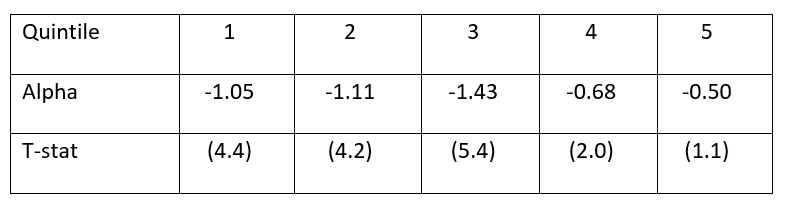
While active share may have worked before 2002, these results show that even the highest quintile of active share funds produced negative alphas in the post-2002 period. In other words, as markets became more efficient over time, the alpha was “gone with the wind.”
More Active Share Research
Morningstar provided empirical evidence on active share as a predictor with its November 2021 paper, “Unattractive Share.” Following is a summary of its findings:
- Across all categories and share classes, a typical low-active-share fund (first quintile) could be had for 0.6% to 1.0%, depending on the category. High-active-share funds (fifth quintile) cost 1.1% to 1.6%.
- From 2003 through 2020, across all categories, high-active-share funds exhibited higher risk than their low-active-share peers.
- From 2011 through 2020, high-active-share funds failed to deliver superior net-of-fee results in any category.
Christopher Jones and Maitao Mo, authors of the “Out-of-Sample Performance of Mutual Fund Predictors,” published in the January 2021 issue of the Review of Financial Studies, found that much of the predictability in fund alphas disappeared following the end of the in-sample period. Why have past predictors failed? The likely causes are that the original finding was a random (lucky) outcome; the market had become more efficient with skill level of the competition and arbitrage increasing; and fund flows into the outperformers led to future underperformance due to diseconomies of scale. Jones and Mo’s findings led them to conclude: “The clear implication of our findings is that investment practitioners, who are known to use at least some of these measures to guide portfolio selection, may be engaging in an exercise that is of dubious relevance.”
The New Holy Grail?
Earlier this year, Detzel and Howard, authors of the study “Practice What You Preach: Strategy Consistency and Mutual Fund Performance,” proposed a novel predictor of equity mutual fund performance: “strategy consistency.” They defined strategy consistency as the degree to which a fund picks stocks most chosen collectively by managers with a similar self-declared principal investment strategy. Their data sample covered the period 2007-19.
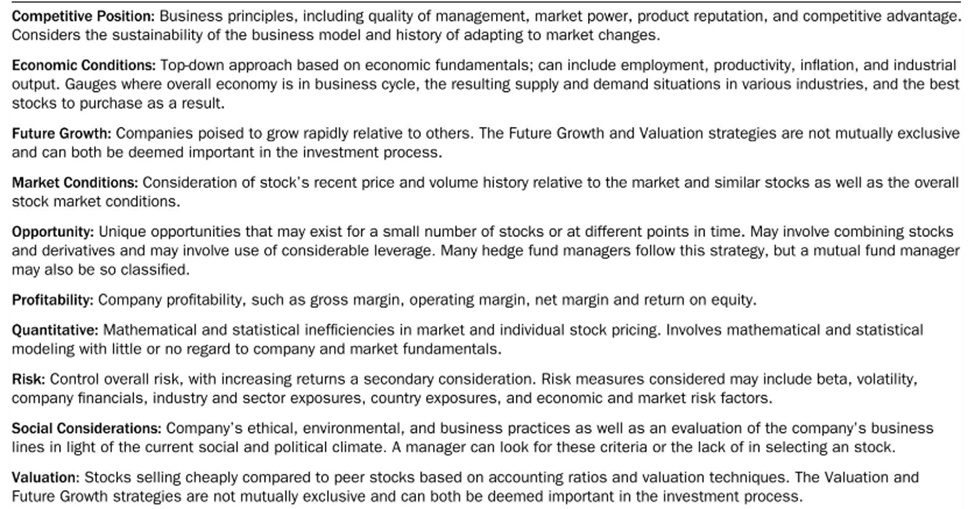
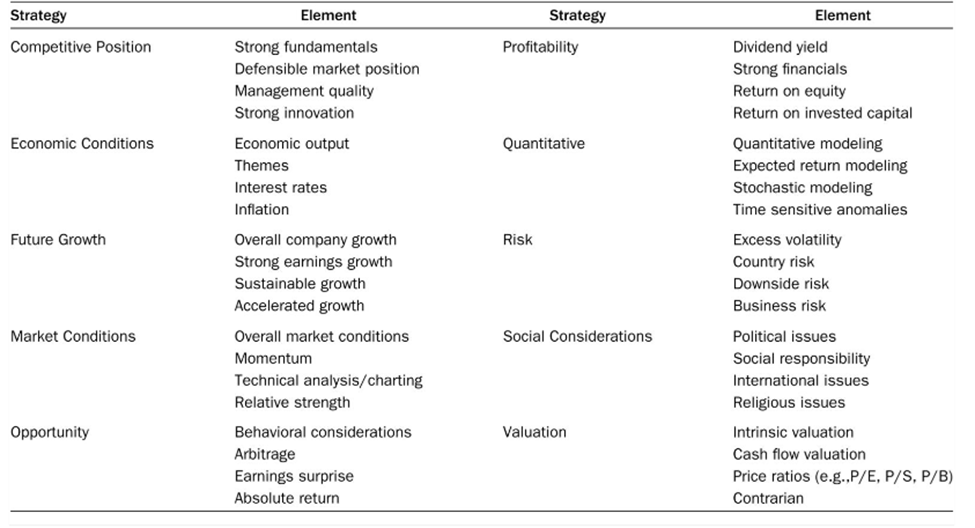
They used a proprietary strategy classification based on textual analysis of fund prospectuses. Funds are then assigned to one of 10 equity strategies based on the combination of elements they use. Panel A lists the 10 mutual fund strategies. Panel B lists the 40 strategy elements.
Panel A: Fund Strategies
Panel B: Elements Associated With Each Strategy
Detzel and Howard also measured conviction: the higher the percentage of the portfolio in the top 10 stocks in the portfolio, the stronger the conviction.
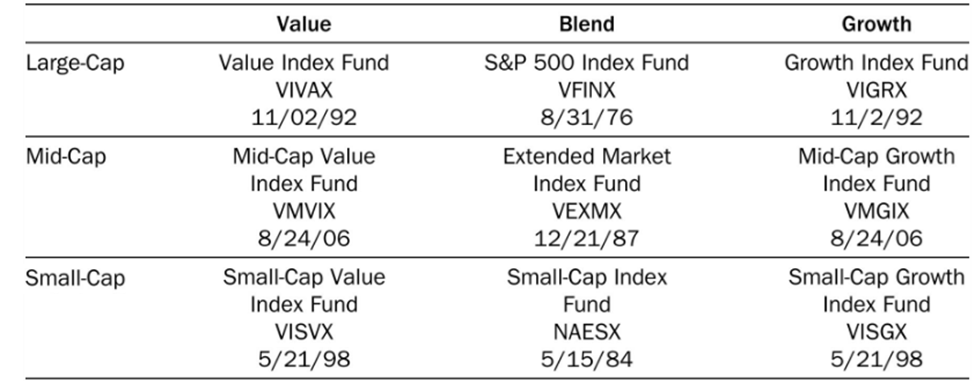
They used nine Vanguard index funds as benchmarks.
Vanguard Funds Used as Benchmarks
The authors found that “high-consistency funds earned significantly higher abnormal returns than low-consistency funds, with high-consistency funds with the strongest prior-month performance earning significantly positive abnormal returns of 4% per annum.” They added: “Our results provide a possible explanation why most mutual funds underperform their benchmarks: they pick stocks that do not closely align with their primary strategy.”
There is one major problem with their findings. While the high-consistency funds outperformed the low-consistency funds, they generated a negative alpha (negative 0.83%), though it was not statistically significant (t-stat=negative 1.01) against their benchmarks.
They also found that the strongest-conviction funds also produced a statistically significant (t-stat negative 3.31) negative alpha (negative 1.76%) against their benchmarks. And in this case the high-conviction funds produced lower excess returns (6.15% versus 6.49%)
Finally, they found that the highest active share funds produced an even more negative alpha (negative 2.89%) against their benchmarks (t-stat negative 3.3). And here we find that, on average, the high active share funds produced dramatically lower per year returns compared with the low active share funds (5.02% versus 7.14%).
These results should put to bed the idea that active share and degree of conviction are predictors of future performance. As to consistency, while they did find that high consistency funds did provide higher returns than low consistency funds, they also found that they still generated negative alphas compared with simple benchmark indexes! This raises the question of why investors should be interested in placing assets with funds that are likely to generate negative alphas.
There are a few other issues with the paper.
First, Detzel and Howard did note that Jones and Mo had found that “most mutual fund predictors fail out-of-sample,” raising the question of why anyone should believe their predictor will succeed? Note, again, that their predictor didn’t actually succeed as it predicted negative future alphas.
Second, they chose to use the language in a fund’s prospectus to determine a fund’s style. This is highly problematic because prospectuses are typically written to be so broad that they are often meaningless.
Third, the use of equal weighting of funds raises questions as to the choice of metrics. Is this a data-mining issue? Smaller funds do not face the same diseconomies of scale that larger funds must overcome. At the very least, value weighting should have been reported.
Fourth, in our book, Your Complete Guide to Factor-Based Investing, Andrew Berkin and I listed five criteria that should be considered before investing in a factor or, for that matter, any investment strategy. One of the five was a rational reason for believing the premium returns would persist, which creates the following problem, as explained by Detzel and Howard, “High consistency indicates that a given fund manager is coming to the same conclusions as other managers following a similar strategy.” Yet they also showed that most fund managers underperform. How can being most similar to all these other fund managers lead to better performance? Why should we expect their finding to persist?
The Lack of Evidence of Persistent Outperformance
In his paper, “Five Myths of Active Management” Jonathan Berk, professor at the University of California, Berkeley, suggested the following thought process:
“Who gets money to manage? Well, as investors know who the skilled managers are, money will flow to the best manager first. Eventually, this manager will receive so much money that it will impact the manager’s ability to generate superior returns and expected return will be driven down to the second-best manager’s expected return. At that point, investors will be indifferent between investing with either manager, so funds will flow to both managers until their expected returns are driven down to the third-best manager.
“This process will continue until the expected return of investing with any manager is driven down to the expected return investors can expect to receive by investing in a passive strategy of similar riskiness (the benchmark expected return). At this point, investors are indifferent between investing with active managers or just indexing, and an equilibrium is achieved.”
Berk went on to point out that the manager with the most skill ends up with the most money. He added this important insight: “When capital is supplied competitively by investors, but ability is scarce, only participants with the skill in short supply can earn economic rents. Investors who choose to invest with active managers cannot expect to receive positive excess returns on a risk-adjusted basis. … [If they did] there would be an excess supply of capital to that manager.”
Just as the efficient-market hypothesis explains why investors cannot use publicly available information to beat the market (because all investors have access to that information and it is, therefore, already embedded in prices), the same is true of active managers. Investors should not expect to outperform the market by using publicly available information to select active managers. Any excess return will go to the active manager (in the form of higher expenses).
The process is simple. Investors observe benchmark-beating performance, and funds flow into the top performers. The investment inflow eliminates return persistence because fund managers face diminishing returns to scale.
The study “Scale Effects in Mutual Fund Performance: The Role of Trading Costs,” provides evidence supporting the logic of Berk’s theory. The authors examined the role of trading costs as a source of diseconomies of scale for mutual funds. They studied the annual trading costs for 1,706 US equity funds during the period 1995–2005 and found:
- Trading costs for mutual funds are on average even greater in magnitude than the expense ratio.
- The variation in returns is related to fund trade size.
- Annual trading costs bear a statistically significant negative relation to performance.
- Trading has an increasingly detrimental impact on performance as a fund’s relative trade size increases.
- Trading fails to recover its costs—$1 in trading costs reduced fund assets by $0.41. However, while trading does not adversely affect performance at funds with a relatively small average trade size, trading costs decrease fund assets by roughly $0.80 for large relative trade size funds.
- Flow-driven trades are shown to be significantly more costly than discretionary trades. This nondiscretionary trade motive partially—but not fully—explains the negative impact of trading on performance.
- Relative trade size subsumes fund size in regressions of fund returns.
The authors concluded: “Our evidence directly establishes scale effects in trading as a source of diminishing returns to scale from active management.”
There is another reason why successful active management sows the seeds of its own destruction. As a fund’s assets increase, either trading costs will rise or the fund will have to diversify across more securities to limit trading costs. However, the more a fund diversifies, the more it looks and performs like its benchmark index. It becomes what is known as a closet index fund. If it chooses this alternative, its higher total costs have to be spread across a smaller amount of differentiated holdings (reducing its active share), increasing the hurdle of outperformance.
Berkin and I provided other explanations for why generating persistent alpha has become increasingly difficult in our book “The Incredible Shrinking Alpha”:
- Academic research has been converting what was once alpha into common factors (traits or characteristics), reducing the supply of alpha.
- The competition is getting increasingly tougher as today’s managers are more skilled and the percentage of retail investors (who are naive and thus exploitable) has been shrinking.
- The amount of chasing the shrinking supply of alpha has increased. For example, the amount of assets in hedge funds has increased from about $300 billion 25 years ago to about $5 trillion.
Investor Takeaways
In the face of all the evidence, it is difficult to make the case that consistency is any better predictor of future fund performance than past performance, active share, conviction, and all the others that have been tried and failed. Investors are best served by avoiding active strategies and their higher costs. Instead, they should limit their investments to systematic, transparent, replicable strategies (such as, but not limited to, index funds). That’s playing the winner’s game as it provides investors the greatest odds of achieving their financial goals.
Larry Swedroe is the author or co-author of 18 books on investing, including his latest, Enrich Your Future: The Keys to Successful Investing.
The author or authors do not own shares in any securities mentioned in this article. Find out about Morningstar’s editorial policies.
Larry Swedroe is a freelance writer. The opinions expressed here are the author’s. Morningstar values diversity of thought and publishes a broad range of viewpoints.

 United States