
Fund Managers on Japan: New Dawn or Same Old Story?
Opinions—and weightings—differ wildly.


For years, Morningstar manager research analysts have heard international-fund managers criticize Japanese corporate executives for their inefficient capital allocation and cavalier attitude toward shareholders. Sometimes a few managers would tell us that Japan’s executives had started to raise their game. But the majority weren’t convinced. Their verdict: Nothing had changed.
Most international-fund managers said that overall, Japan’s companies had less appeal than those in other developed countries. One turnoff was the extent of cross-shareholding: the tendency of major Japanese corporations to invest heavily in their peers rather than directing that money to innovative internal projects, to take over promising young entities, or to return it to shareholders.
Then, starting a couple of years ago, the authorities at the Tokyo Stock Exchange told corporate executives to get their act together or face the consequences.
Did that prompt corporate action robust enough to boost Japan’s allure for international-fund managers? In recent discussions with Morningstar, and in their published commentaries, fund managers provide wildly varying views. But the data shows the consensus to be: Wait and see.
The Background
Cross-shareholding wasn’t the only trait holding international managers back. Executives weren’t easy to reach. Dividends were an afterthought, and share buybacks were rare. Many Japanese companies—not only small domestic-focused ones—did not bother to produce corporate reports in any language besides Japanese. The fact that managers had difficulty finding reliably growing firms in that market didn’t help matters.
As noted, portfolio managers would occasionally claim that changes were afoot. Even the optimists, though, conceded that such improvements were occurring only sporadically and only at a few firms. Meanwhile, plenty of skeptics scoffed that the alleged improvements were so scarce and unimpressive that they were barely worth mentioning.
With that in mind, it’s not surprising that US-domiciled foreign large-cap funds consistently held smaller stakes in Japan than the widely followed MSCI EAFE Index did.
The Exchange Strikes
With a series of directives starting in late 2022, the Tokyo Stock Exchange essentially ordered companies to use their cash in a more efficient and shareholder-friendly manner. If they failed to comply, the Exchange would impose two blunt penalties. One, it threatened to publicly name companies that were falling short. Second, it warned that these companies could be delisted from the exchange.
Those threats got the attention of company leaders. Firms started paying dividends or increasing their amount. More companies announced share buybacks. Executives were more willing to speak with investors. The exchange followed up with a mandate for corporations to publish reports in English.
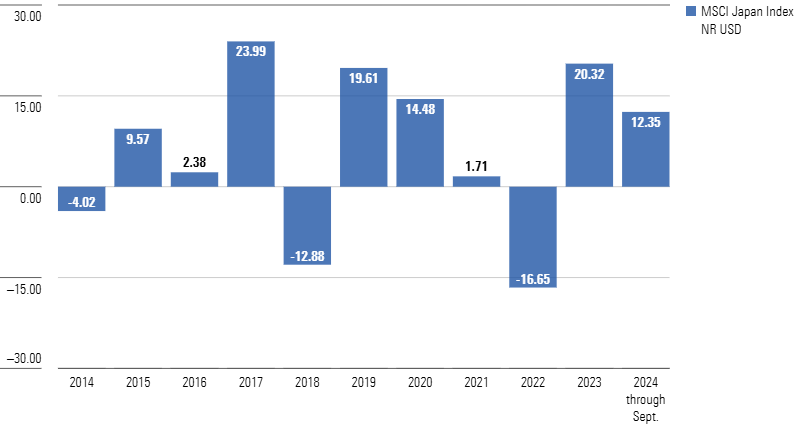
Japan began to attract attention from global investors. The Financial Times noted that Warren Buffett was just one of the global investors who visited Tokyo or contacted local brokers to investigate the opportunities. Although corporate reforms likely weren’t the only factor—for example, a weakening yen improved the outlook for Japanese exporters—Japan’s market, which had suffered through a lackluster 2021 and woeful 2022 in US dollar terms, rose sharply in 2023. The run continued into 2024. A sudden rise in the value of the yen led to a pullback this summer, but the rally soon regained momentum.
Japan stock market returns, 2014-2024
The Reaction From Mutual Funds
So, did this flurry of interest in the Japanese stock market extend to US-based international-fund managers?
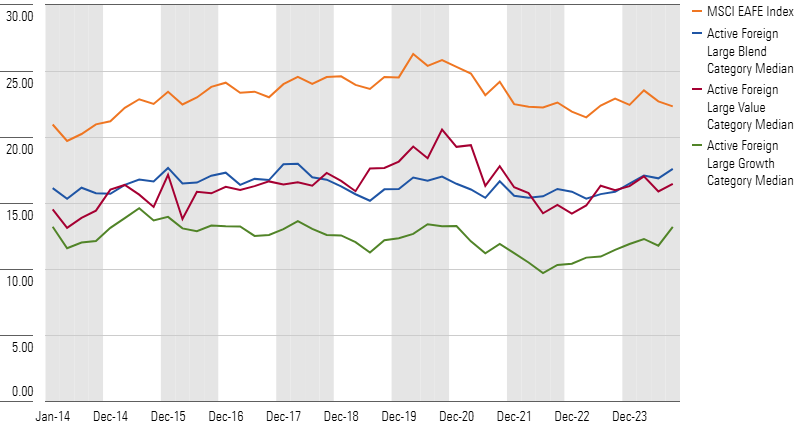
Only a bit. As shown on the graph below, the median Japan weightings for all three international large-cap Morningstar Categories—foreign large value, foreign large blend, and foreign large growth—have climbed a couple of percentage points or so since the beginning of 2023 (that is, after the Tokyo Stock Exchange’s directives), while the MSCI EAFE Index’s level remained about the same. But all three category medians remain well below the index level. Foreign large growth, which has long had the lowest Japan exposure of the three categories, made the most noticeable move upward in the past two years, but it remains in last place.
Even these small gains in weightings weren’t necessarily sparked by enthusiasm for the Japanese market’s prospects. They could have resulted mostly from market appreciation of existing Japan holdings rather than making new purchases or bulking up positions already in the portfolio.
(The category medians do consistently surpass the Japan weightings of another popular benchmark, the MSCI ACWI ex US Index, but that index contains such heavy exposure to emerging markets (currently about 27% of assets) that its weightings of Japan and other big developed markets are too low for the purpose of this comparison.)
Percentage of assets in Japan, 2014-2024
‘A Great Place to Visit’
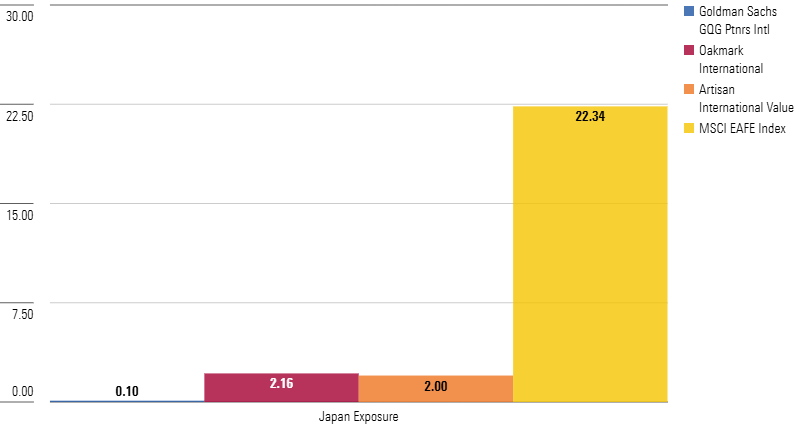
Comments from prominent fund managers may help explain why many of their peers remain cautious. A main-stage event at the Morningstar Investment Conference in Chicago in June 2024 featured a joint interview with Rajiv Jain, lead manager of Goldman Sachs GQG Partners International Opportunities GSIMX, and David Herro, lead manager of Oakmark International OAKIX. At one point, Morningstar’s Dan Lefkovitz asked these award-winning investors why their funds have such minuscule stakes in Japan despite the improvements in corporate governance and revival in its market performance. They offered memorable responses.
The overall Japanese market has a relatively moderate valuation, but Jain said that the country’s most appealing growth options—which he praised as “fantastic companies”—are too expensive for his tastes. He prefers cheaper alternatives elsewhere. As for corporate reforms, Jain pointed out that Japanese corporate earnings growth over the past five years has been only slightly better than China’s and well below the rates in Europe and the US. That said, he quipped that with the value of the US dollar so strong versus the yen, Japan would be a wonderful destination for a vacation.
Herro echoed Jain’s skepticism. Corporate reforms are happening, he said, “but almost at a snail’s pace.” In his view, it’s “more talk than it is action.” He noted that the average return on equity of Japanese companies has barely risen in the past three decades. He concluded with a summation unlikely to make its way onto any Japanese government website: “It’s a slow growth economy, declining population, no immigration, low productivity. So it should be priced that way, and it’s just not priced that way.”
But Japan does have a bright side. “It’s a great place to visit,” Herro said.
A third outstanding manager, David Samra of Artisan International Value ARTKX, concedes that corporate behavior is improving. His main reason for bypassing the Japanese market is his lack of confidence in government financial management. The stark decline in the yen, he points out, has resulted in a painful rise in the cost of food and energy, hitting Japanese consumers hard. The yen’s penchant for volatility creates another element of uncertainty. For Samra, investing in Japan is a dicey proposition.
Percentage of assets in Japan for GSIMX, OAKIX, and ARTKX.
This Time Is Different?
Those gloomy observations might seem to shut the door on Japan’s prospects. But more optimistic managers exist, and they’re eager to share their thoughts.
Perhaps the most vocal enthusiast is Christopher Lees, manager of JOHCM International Select JOHIX. That offering has one of the highest Japan weightings among all foreign large-cap strategies. It had 27% of assets in Japan in its September portfolio, well above the level in the MSCI EAFE Index, its benchmark. Speaking with Morningstar in August, Lees said that a decade ago Japanese corporations didn’t truly understand what reforms were necessary to become more competitive and shareholder-friendly. Now, he says, the needed restructuring is taking place in many industries, with companies selling off their underperforming divisions and instituting share buybacks.
In Lees’ view, the Tokyo Stock Exchange’s directives have received a rapid and decisive response, visible by clear improvements in the actions and demeanor of Japanese corporations. In recent meetings, he says, company executives even ask him for advice.
Mondrian International Value Equity’s MPIEX September Japan stake was just a little lower than the JO Hambro fund’s. In a third-quarter 2024 commentary, Mondrian’s managers echoed many of Lees’s points. They said the improvements in corporate governance are broad-based and noteworthy. Specifically, they cited a reduction in cross-shareholding; substantial growth in dividends and share buybacks; the addition of independent directors to corporate boards; and a trend toward aligning management compensation with shareholder returns.
Lees points to Hitachi and Fujifilm as firms that have taken restructuring to impressive levels, while Mondrian praises Mitsubishi Electric and notes that Toyota Group, notorious for the extent of its cross-shareholdings, has begun unwinding some of them and has instituted buybacks.
For his part, Carl Vine of M&G manages funds that focus on Japan, so perhaps it’s not surprising that he lands on the positive side of the ledger. Even so, he’s been a Japan and pan-Asia specialist since the 1990s, so his perspective is worth a listen. Speaking to Morningstar’s “The Long View” podcast this past April, he said the current enthusiasm for Japan’s stock market rests on a stronger foundation than the previous bursts of optimism he’s seen in his nearly three decades following that market.
Like the others, he says the Tokyo Stock Exchange’s directives—and importantly, its threats—got through to Japanese executives in a way prior government encouragement had not. “Probably more so than in previous bull episodes,” he said, “it feels to me like there’s real substance to this.”
Conclusion
In the extent of their pessimism, Jain, Herro, and Samra are outliers. Not many international funds have near-zero weightings in Japan. That said, even with the recent slight increase in category medians, US-domiciled international funds remain substantially underweight in Japan. The majority of managers, it seems, are waiting for more concrete evidence of change—or lower prices for those companies that have more agreeable habits—before they’ll consider making decisive moves in their Japan stakes.
Some might be tough to persuade. Herro’s list of concerns, for example, is a daunting one. Yet the optimists are seeing real change on the ground. Just because there have been previous false dawns doesn’t mean the sun will never rise.
Regardless, most investors should not meaningfully change their allocations or fund choices based on their opinion of Japan’s prospects. But it makes sense to be aware of your funds’ positioning. That will prevent you from being caught off guard when your funds show little response to a strong Japan rally (or worse, take a big hit from a Japan decline). In the meantime, it will be interesting to see whether Japan’s corporate reforms turn out to be extensive, meaningful, and long-lasting—and if so, whether that will finally prompt more international-fund managers to climb on board.
Note: Research and graphics assistance provided by manager research analyst Tony Thorn.
The author or authors do not own shares in any securities mentioned in this article. Find out about Morningstar’s editorial policies.

 United States