
Yields Rise on Concern That Fed Will Raise Rates
ECB fails to deliver additional monetary easing.

Treasury bond prices dropped sharply last Friday, sending yields higher as fixed-income investors became more concerned about the increased potential for a rise in the federal funds rate sooner rather than later. In the United States, the market-implied probability that the Federal Reserve will increase the federal funds rate after the Federal Open Market Committee meeting Sept. 20-21 has doubled over the past month; however, even after doubling off a low base, the market is still pricing in only a 24% probability that the Fed will raise the rate this month. While it is unlikely that the Fed will act in September, the probability of a rate increase in the December meeting rises substantially. As December is the first meeting after the presidential election, the Fed will have a greater sense of freedom to act. The current concern is that if there is a significant market impact on financial assets, the Fed could be accused of influencing the election.
Sovereign bonds in the global developed market also sold off last week, sending yields to their highest levels over the past few months, although, in many cases the sell-off only brought yields back up to 0% after being negative since mid-June. Despite market rumors to the contrary, the European Central Bank held its monetary policy steady after its meeting last Thursday. Many prognosticators had opined that the ECB was considering loosening its already historically easy monetary policy by increasing its asset-purchase programs and/or lowering interest rates even further into negative territory. Some investors were disappointed by the lack of action and decided to reduce sovereign bond positions in the expectation that bond prices could fall further. In their view, without an increase in bond buying by the central bank, bond prices may not be able to hold their current levels.
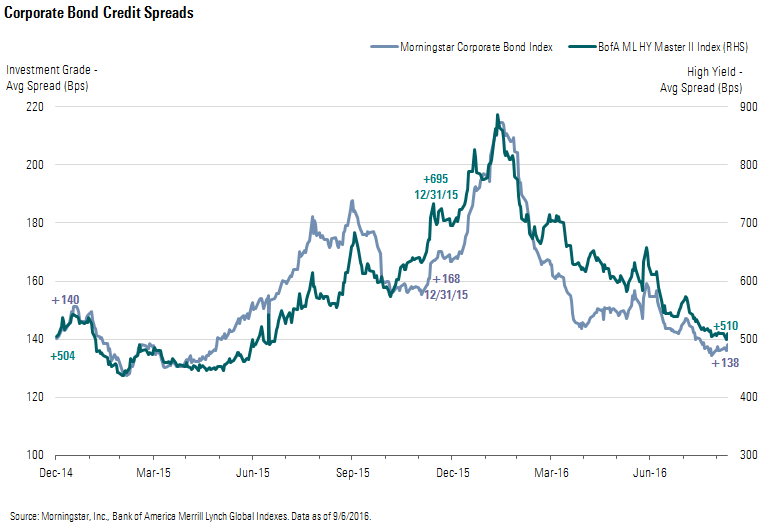
Corporate credit spreads attempted to tighten early in the week, but sold off on Friday in sympathy with the downturn in the stock market. On a week-over-week basis, the average spread of the Morningstar Corporate Bond Index (our proxy for the investment-grade market) widened 1 basis point to +138 and the average spread of the Bank of America Merrill Lynch High Yield Master Index also widened 1 basis points to +510.
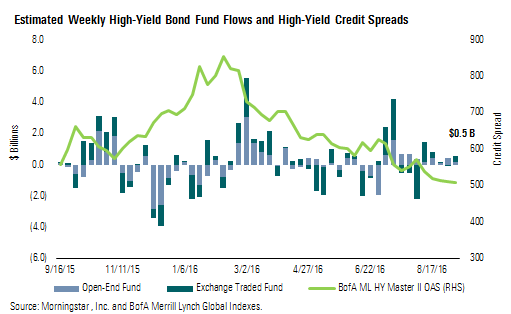
The new issue market for corporate bonds sprang back to life after the Labor Day holiday as a deluge of issuers tapped the capital markets for funds. With the resurgence in new issues, the secondary market also picked up the pace and returned to more normalized levels after slowing significantly at the end of August. Fund flows remained positive last week, but with only $0.5 billion of cash flowing into the high-yield market, this was not enough to have a meaningful impact.

 United States