
With Dell Deal Out of the Way, New Issue Market Opens to Other Issuers
Market calls Fed's bluff.

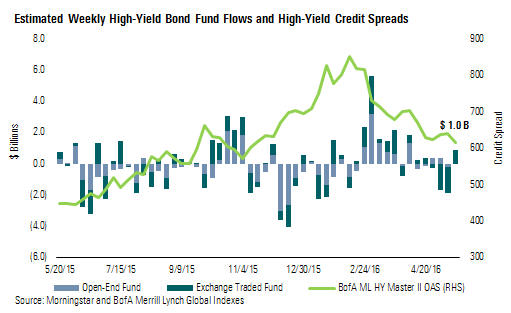
While corporate credit spreads for investment-grade bonds ended the week unchanged from the prior week, high-yield credit spreads continued to tighten. The average spread of the Morningstar Corporate Bond Index held at an average credit spread of +151 basis points over Treasuries, whereas in the high-yield market, the average credit spread in the Bank of America High Yield Index tightened 19 basis points to +622.
The main news in the corporate bond market last week centered on Dell's $20 billion new issue offering (upsized from the originally announced $16 billion), which kept many other issuers from tapping the corporate bond market. We had cautioned the prior week that the underlying technicals of the market had become tenuous. While demand has been robust, we noted that if too much new issue supply came to market too quickly, the market could experience some indigestion. It appears that underwriters realized this and advised clients to hold off on tapping the markets at the same time as the Dell deal. The issuers we cover raised less than $8 billion in the new issue market last week. Excluding the Dell deal, that volume represented one of the slowest weeks over the past year.
Now that the Dell deal is out of the way, the deck is clear for other issuers to tap the markets. With Federal Reserve officials intimating that they may raise interest rates further in the near term and numerous large acquisitions outstanding that still need to be funded, the combination of low interest rates and tight credit spreads will entice issuers to lock in cheap financing. For a list of issuers that we expect to tap the public debt capital markets over the near term, please see our May 20 publication, Potential New Issue Supply: Investment Grade and High Yield.
Proceeds from Dell's $20 billion bond offering will be used to help fund its acquisition of EMC EMC (rating: A+/UR-, narrow moat). The transaction consisted of:
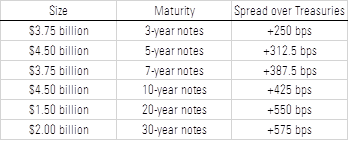
Dell's notes are secured by a first lien on certain assets as well as guarantees by domestic operating subsidiaries of both Dell and EMC, excluding VMware. This transaction marks the second-largest investment-grade debt issuance this year and the only secured debt issuance in the investment-grade space.
Market Calls Fed's Bluff Last week, the Federal Reserve released its minutes from the April meeting. Commentary in the minutes surprised the market with a tone that was more hawkish than expected. Further, several Federal Reserve officials remarked that the June Federal Open Market Committee meeting was a "live" meeting, implying that the Fed may raise the federal funds rate in June if forthcoming economic data supports such an action. The asset markets initially sold off on the news, and the probability that the Fed would raise rates in June, implied by fed futures contracts, rose to 30% on Thursday. As an indication of the anxiety in the markets regarding a rate increase, on Wednesday, the S&P 500 fell 1.2% in intraday trading when the news hit the tape; however, the market quickly reconsidered its opinion as to whether the Fed would actually raise rates in June and appears to be calling the Fed's bluff. Markets rebounded, and the S&P 500 ended the day essentially unchanged. By the end of the week, the market-implied probability of a rate increase slid to 26%, and the S&P 500 had risen 0.3% on a week-over-week basis.
To feel comfortable enough to raise rates, the Fed will need to see strong enough economic data to convince it that economic growth is on a sustainable rebound. Recent data has been slightly discouraging, as the sequential annualized growth rate of U.S. GDP has declined for the past three quarters. U.S. economic growth has declined from 3.9% in the second quarter of 2015 to 2.0% in the third quarter of 2015, 1.4% in the fourth quarter of 2015, and 0.5% in the first quarter of 2016. Job growth also slipped, as April nonfarm payrolls increased by only 160,000. Not only did that significantly miss the consensus estimate, but it also came in well below the lowest estimate of the range. The unemployment rate held steady at 5.0%, but only because of a decline in the labor force and reduction in the participation rate. In addition to the slowdown in economic activity, inflation also appears to be slipping. For example, the year-over-year increase in the headline personal consumption expenditure index (the Fed's preferred measure of inflation) decelerated to 0.8% from 1.0% last month, and the year-over-year increase in core PCE slipped to 1.6% from 1.7%.
Besides digesting the regular economic data that will be released before the June meeting and its impact on the Fed's economic outlook, the Fed's action at the June 14-15 meeting may be complicated by international factors. On June 23, the week following the FOMC meeting, Britain will hold a vote to decide if it should remain part of the European Union. If Britain decides to exit, many believe this could lead to significant economic disruption within the EU, which could have follow-on impacts globally. While the polls report that the British will vote to remain in the EU, many business leaders are conservatively preparing for a possible exit. For example, Nick Read, Vodafone's VOD (rating: BBB+, narrow moat) CFO, said his firm was holding a significant amount of cash on its balance sheet. He specifically cited the potential for Brexit as the reason to hold higher-than-usual levels of cash to sustain liquidity in case there is a "disturbance in the market." Once the risk of Brexit has passed, he expects cash to decline to more normalized levels for the firm.
Fast-Money Investors Rush Back Into High-Yield ETFs; Traditional Mutual Fund Investors Remain on the Sidelines Fast-money accounts reversed course last week and rushed back into high-yield exchange-traded funds as new unit creation rose by $1 billion. More-traditional retail investors held their ground, however, as fund flows into open-end mutual funds were essentially unchanged last week.

 United States