
With Brexit Behind Us, Markets Bounce Back
Fed funds futures still pricing in low probability of rate hike this year.

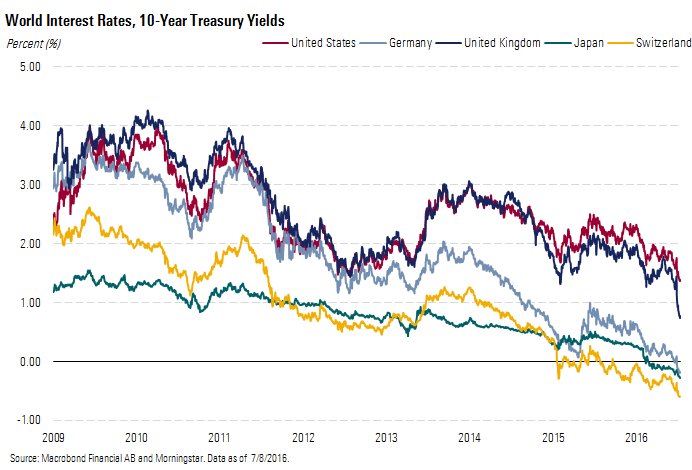
While we didn’t think Britain’s vote to exit the European Union was going to have a significant negative long-term impact on the global economy, we expected the market disruption to last a little longer. However, the markets have recuperated very quickly. Corporate credit spreads are approaching their pre-Brexit lows, and the S&P 500 hit an all-time high. Even with the market rebounding back into a “risk on” attitude, interest rates of developed-market sovereign bonds sank to new lows as investors bid up bond prices. The yield on the 10-year U.S. Treasury ended the week at a new low of 1.36%; even so, global investors continued to view the U.S. Treasury bond as attractive compared with other sovereign bonds. The 10-year German bund dropped to an even greater negative yield of (0.19)%, the Japanese 10-year government bond sank to an even greater negative yield of (0.28)%, and the Swiss 10-year ended the week at an astounding negative (0.60)%.
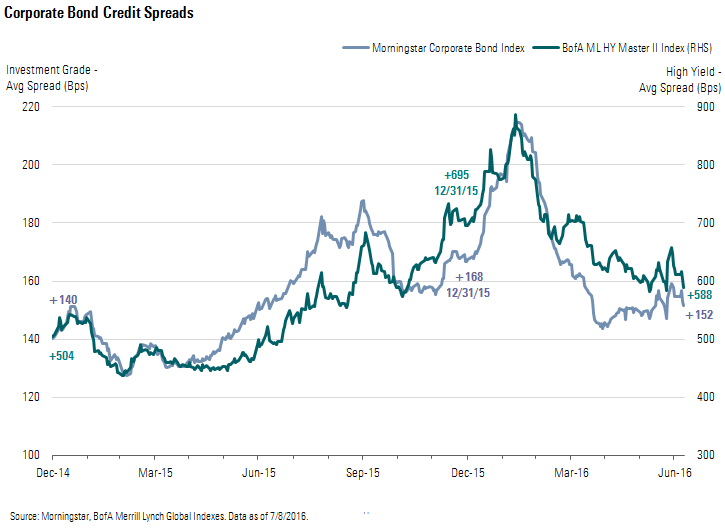
As interest rates sink to even lower levels, corporate bonds have become increasingly more attractive on a relative value basis. With underlying interest rates as low as they are, the extra return provided by the credit spread on corporate bonds above the underlying benchmark Treasury bond has become an increasingly larger portion of total return. Credit spreads tightened across the board as investors clamored to outbid each other last week. One corporate bond trader remarked that he couldn’t keep bonds in inventory, as buyers quickly lifted offers and sellers were nowhere to be found.
The average spread of the Morningstar Corporate Bond Index tightened 3 basis points last week to +152, and the credit spread of the Bank of America Merrill Lynch High Yield Master II Index tightened 24 basis points to +588. As an indication of how much sentiment has changed, even though oil prices dropped almost $4 to just over $45 per barrel last week, credit spreads in the energy sector tightened. The last time oil prices were at this level, credit spreads in the investment-grade energy sector were approximately 20 basis points wider in mid-May; in the high-yield market, the average spread of the energy sector was 200 basis points wider than now.
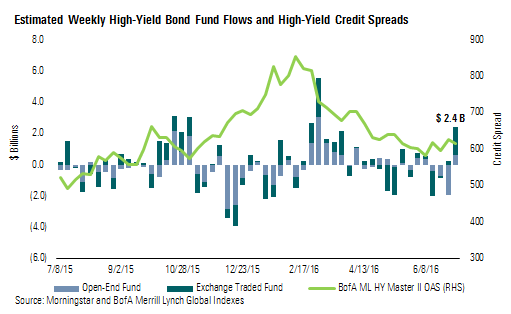
Trading action in the corporate bond market was further influenced by renewed inflows into the asset class last week. As portfolio managers received those inflows, they looked to put cash to work; however, as expected for a holiday-shortened week, new issue volume was relatively light and the lack of new issues compounded the problem of scarcity of bonds to put money to work. In the high-yield market, high-yield mutual funds and exchange-traded funds reported a combined inflow of over $2.4 billion last week. This was the fifth-greatest weekly inflow over the past 52 weeks.
Although credit spreads are not cheap, they are only slightly tighter than their long-term averages. When the European Central Bank announced an increase in the size of its asset-purchase program and expansion into buying nonfinancial corporate bonds earlier this year, we opined that corporate bonds would benefit from this new demand, and we continue to think the corporate bond market will perform well in the current environment. The ECB’s purchases will effectively remove supply of corporate fixed-income securities from the public markets and create new cash that must then be reinvested. As this cash is reinvested, bond traders may have to push prices up on European corporate bonds, thus lowering credit spreads, in order to buy bonds to reinvest the proceeds. Furthermore, companies will probably shift new bond issuance toward euro-denominated bonds to take advantage of the much lower all-in yields. As credit spreads in Europe tighten and the new supply of U.S. corporate bonds diminishes, it will naturally result in tighter credit spreads in the United States as well.
Fed Funds Futures Still Pricing In Low Probability of Rate Hike This Year Even though the nonfarm payroll report jumped to 287,000 (significantly surpassing even the most bullish prognostication), housing data appeared promising, and favorable ISM purchasing manager data indicates a healthier U.S. economy, the market-implied probability of a rate hike this year barely budged. The market-derived probability of a rate cut inherent in the current futures market remained at only 6% for a September rate hike and rose to a 24% probability for a December rate hike.
Cheap Financing for M&A May Prompt Renewed Wave of Corporate Buyouts Last week, we placed our rating for Danone BN (rating: BBB+/UR-, narrow moat) under review with negative implications after the company announced it reached an agreement to purchase WhiteWave WWAV (not rated, no moat) for over 20 times EBITDA in a debt-financed transaction. While this is an extremely high valuation for an acquisition in the dairy sector and looks expensive on the face of it, with underlying interest rates in Europe trading at negative rates and credit spreads at moderate levels, the cost to finance the transaction is almost nothing. Before the announcement, the yield on Danone's euro-denominated seven-year bonds was indicated below 0.40% (not a typo). Considering that the relevant benchmark German bund trades at a negative yield, the all-in yield is lower than the credit spread. Depending on the credit rating of the combined company, Danone may be able to finance the transaction at a blended average interest cost of under 1%.
While the volume of mergers and acquisitions over the past few years has reached record highs, it appears this wave of the big getting even bigger is likely to continue. We expect we will continue to see Europe-domiciled companies make significant debt-financed acquisitions. In the current financing environment, European companies will be evaluating acquiring U.S. companies as they can finance the debt at minimal cost, acquire a company in a growing economy (as opposed to the moribund European economy), and acquire assets that are denominated in the appreciating U.S. dollar.
Also, the ultra-low cost of debt is likely to lead to even more debt-funded share-buyback programs. With interest rates so low and credit spreads at reasonable levels, there is an arbitrage for dividend-paying companies to repurchase stock to reduce the dividend payments with bonds whose interest rates are lower (even on a pretax basis) than the dividend yield being paid. Even at the risk of suffering credit rating downgrades, we expect this temptation will be greater than many companies can resist.

 United States