
Volatility Rising
Many high-yield investors decided to head for the sidelines last week.

From the Federal Reserve’s various quantitative easing programs that began almost eight years ago to the European Central Bank’s recent negative interest rate policy and asset-purchase programs, in conjunction with the seemingly endless easy monetary programs from the Bank of Japan, the markets have long been feeding on a liquid(ity) diet. Myriad easy money policies have supplied the global markets with a steady supply of newly created money that has been recycled into the asset markets. As this newly created money has been invested, it has helped to send interest rates across the world to historical lows (in many cases generating negative yields) and to push the U.S. stock market to near all-time highs.
The markets’ dependence upon ever easier monetary programs is starting to be put to the test as investors appear to be concerned that central banks may no longer be as willing to continually force-feed the markets increasingly larger portions of liquidity. The anxiety began after the ECB decided to hold its monetary policy steady earlier this month, as opposed to loosening it further, as expected by the market. After the ECB’s announcement, the price of many European sovereign bonds quickly fell, which pushed the yields for some bonds back into positive territory for the first time since mid-June. The price on Germany’s 10-year bond fell enough to push its yield into positive territory of 0.02% after trading as low as negative 0.19% in mid-July. Sovereign bonds had rallied significantly this summer as investors rushed to safety after the United Kingdom surprised the world and voted to exit the European Union. Yet even though the yields on many long-dated sovereign bonds have risen back into positive territory, there remains approximately EUR 12 trillion of debt trading at prices so high that if investors hold the bonds to maturity, they will lock in a total loss.
Similarly, after hitting their recent lows in early July, long-term U.S. interest rates have continued to rise over the past month. Over the past four weeks, the yield on the 10-year Treasury bond has risen 14 basis points to 1.70%, and the 30-year Treasury bond has increased 17 basis points to 2.45%. This week, investors will be paying attention to the outcome of the Federal Reserve’s Federal Open Market Committee’s meeting Sept. 20-21, which includes an updated release of the Fed’s economic projections. Investors will also be paying attention to the Bank of Japan’s monetary policy meeting held on those same days; however, the BOJ is not scheduled to release updated economic projections. Investors may be hoping for some additional policy easing from the BOJ, as there has been much market speculation that Japanese policy makers may increase quantitative easing programs in a bid to stimulate their domestic economy.
At the beginning of the year, the market was expecting three to four interest rate hikes in the United States in 2016; however, this expectation has dwindled to only one. Currently, the futures market is pricing in a 12% probability that the Fed will hike the federal funds rate after the September meeting, but the probability that the Fed will hike rates in December rises to 55%. The U.S market is currently pricing in a high probability that the current ultra-loose monetary policy will remain in place over the near term. After the December meeting, the market-implied probability of an additional rate hike is only 25% through July 2017.
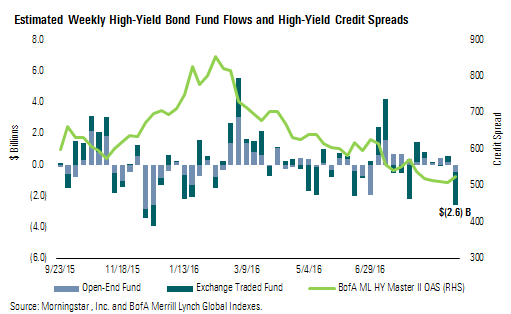
After several weeks of calm in the marketplace, rising volatility began to take its toll on investor psyches in the high-yield market, and many investors decided to head for the sidelines last week; $2.6 billion of funds were pulled out of high-yield open-ended funds and exchange-traded funds. Investment-grade corporate bonds held relatively steady as the average credit spread of the Morningstar Corporate Bond Index widened only 1 basis point to +139 bps; the high-yield market did not fare as well as the Bank of America Merrill Lynch High Yield Master Index widened 17 basis points to +527 bps, its widest level since early August. As we near the end of the third quarter, investors will be on the watch for any companies that lower third-quarter guidance. With economic metrics in the U.S. indicating ongoing sluggish growth and international economic growth in the doldrums, many companies may find it difficult to meet revenue or earnings growth targets.
Morningstar Credit Ratings, LLC is a credit rating agency registered with the Securities and Exchange Commission as a nationally recognized statistical rating organization (“NRSRO”). Under its NRSRO registration, Morningstar Credit Ratings issues credit ratings on financial institutions (e.g., banks), corporate issuers, and asset-backed securities. While Morningstar Credit Ratings issues credit ratings on insurance companies, those ratings are not issued under its NRSRO registration. All Morningstar credit ratings and related analysis contained herein are solely statements of opinion and not statements of fact or recommendations to purchase, hold, or sell any securities or make any other investment decisions. Morningstar credit ratings and related analysis should not be considered without an understanding and review of our methodologies, disclaimers, disclosures, and other important information found at https://ratingagency.morningstar.com.

 United States