
Volatility Remains Low, but French Elections Could Drive Turmoil
New issue volume and secondary market trading volume slow to normalized levels.

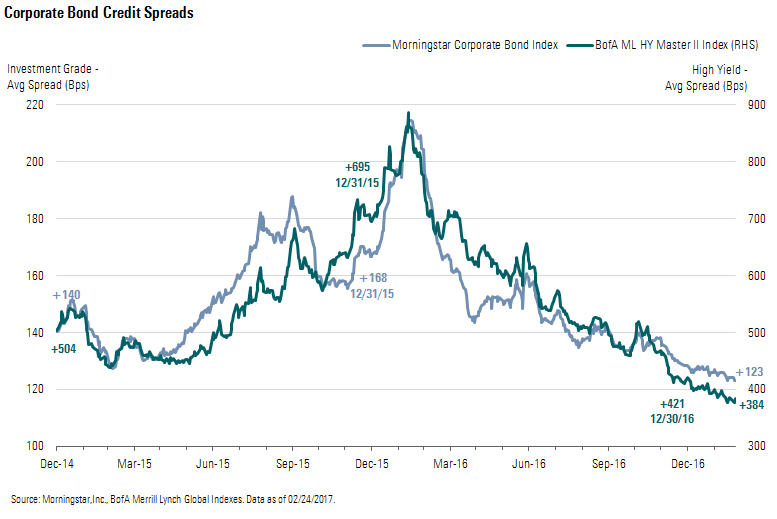
Major U.S. stock market indexes hit all-time highs last week, but investment-grade corporate credit spreads remained in a very tight trading range. Since the end of last year, the credit spread in the investment-grade corporate bond market has traded within a 5-basis point range. The average spread of the Morningstar Corporate Bond Index, our proxy for the investment-grade bond market, tightened 1 basis point to +123 last week. In the high-yield market, the credit spread of the Bank of America Merrill Lynch High Yield Master Index tightened only 2 basis points to +384. While stock prices have been rising on the expectations that revisions to tax and regulatory policies will reinvigorate economic growth and earnings, investors in corporate bonds have been unwilling to chase credit spreads tighter.
Volatility in the corporate bond market is also very low in Europe. The average credit spread of the Morningstar Eurobond Corporate Index has traded within a 5-basis-point range thus far this year. However, while volatility in the corporate bond markets remains low, there are signs that some investors are becoming increasingly concerned that the French presidential election could result in a shakeup of the eurozone. The first round of voting is scheduled for April 23. If no candidate achieves a majority vote, then a runoff between the two with the most votes will occur May 7. Recent polls show that National Front leader Marine Le Pen’s popularity has been gaining and she could garner enough votes to enter the runoff. The National Front has long advocated against the European Union, and Le Pen’s platform calls for a referendum on France’s membership in the EU as well as restoring a national currency.
With Le Pen’s rise in the polls, some investors have sought the safety provided by German sovereign bonds. Year to date, the yield on the 2-year German sovereign bond has dropped 18 basis points, with 14 basis points of the decline occurring just last week. Based on the price of this bond, the yield has reached a new historical low of negative 0.95%. The yield on Germany’s 5-year sovereign bond dropped to a negative 0.60% at the end of last week and is only 2 basis points higher than its historical low. Considering that if investors hold either of these bonds to maturity, they will have locked in a loss, these yields reveal that investors are willing to pay a premium to safeguard their principal. The only way an investor can make money would be to sell the bond to another investor who would be willing to lock in an even greater loss.
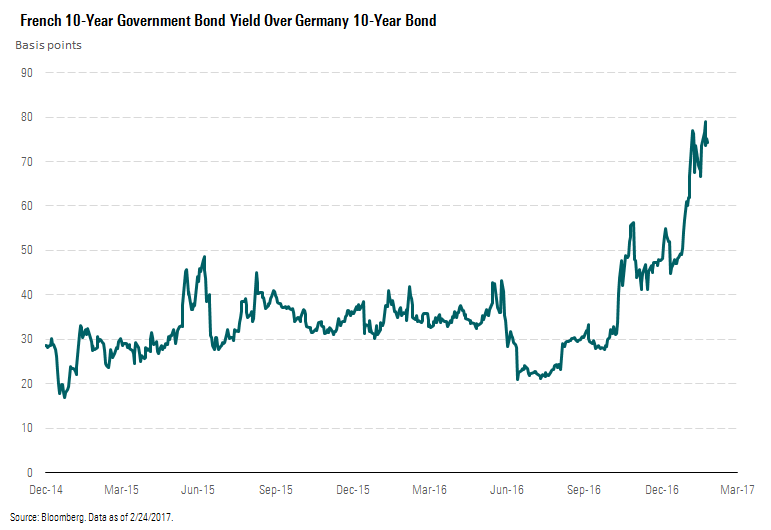
While the yield on German sovereign bonds has been plunging, the spread between the yield on German and French sovereign bonds has been widening. Although the credit spread between the two is still much lower than where it peaked during the European sovereign debt crisis in 2011, it has widened 26 basis points since the end of last year. Currently, the spread is 74 basis points, the widest it has been since 2012, when the markets were still recovering from the European sovereign debt crisis.
New Issue Volume, Secondary Market Trading Volume Slow to Normalized Levels After a record amount of new issuance was brought to the corporate bond market in January, the new issuance market has slowed considerably. Similarly, after registering historically high trading volume in the secondary corporate bond market, the amount of bonds that traded hands over the course of the week declined toward more normalized levels. According to Bloomberg, of the five highest-volume trading sessions since the data began in 2005, four have occurred this year, with the other occurring last November. Six of the top ten highest-volume sessions has occurred just this year.
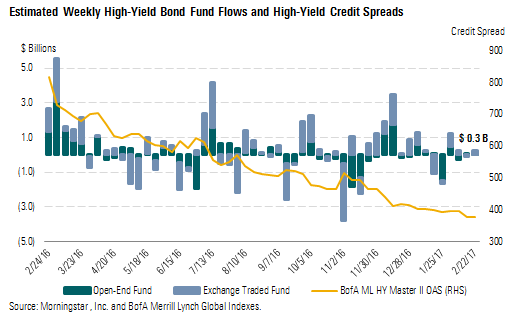
While the stock market seems to climb ever higher, fixed-income investors remain especially cautious, especially in the high-yield market. Fund flows into the high-yield asset class were essentially unchanged last week, rising only $0.3 billion last week. The small amount of inflows into exchange traded funds slightly offset the amount of outflows among the open-end mutual funds.
Morningstar Credit Ratings, LLC is a credit rating agency registered with the Securities and Exchange Commission as a nationally recognized statistical rating organization (“NRSRO”). Under its NRSRO registration, Morningstar Credit Ratings issues credit ratings on financial institutions (e.g., banks), corporate issuers, and asset-backed securities. While Morningstar Credit Ratings issues credit ratings on insurance companies, those ratings are not issued under its NRSRO registration. All Morningstar credit ratings and related analysis contained herein are solely statements of opinion and not statements of fact or recommendations to purchase, hold, or sell any securities or make any other investment decisions. Morningstar credit ratings and related analysis should not be considered without an understanding and review of our methodologies, disclaimers, disclosures, and other important information found at https://ratingagency.morningstar.com

 United States