
And Then Panic Set In
Credit spreads wider, but demand for 'right kind' of investment-grade bonds continues.

Nervousness in the corporate bond markets has been palpable thus far this year. While the credit spreads for investment-grade and high-yield corporate bond indexes have been widening since last summer, the widening had been relatively orderly. The weakness was in response to the decline in commodity prices, and most of the significant widening within the indexes had been contained to sectors most correlated to the energy and metals and mining. These sectors have continued to underperform this year, yet investors are becoming increasingly cautious that credit spreads of other economically sensitive sectors may begin to deteriorate more rapidly. Last year, the main concern was that the economic deceleration among Asian economies would lead to credit rating downgrades and defaults among the energy and metals and mining sectors (which is coming to fruition). More recently, the anxiety is expanding to other cyclical sectors as contagion from China and other emerging markets may be spreading and could negatively affect domestic economic growth.
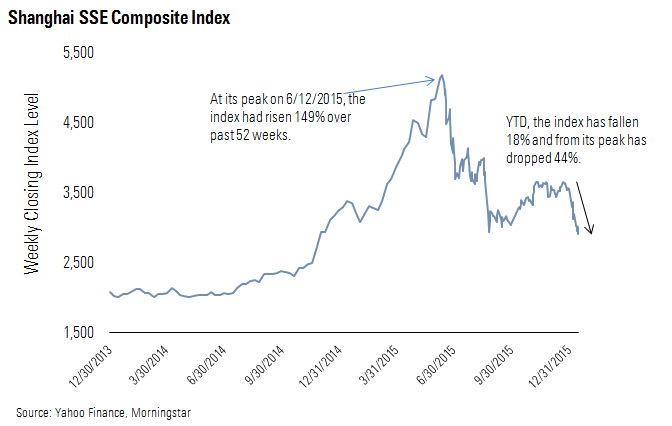
After stabilizing last fall, asset prices in China and the emerging markets resumed their slide at the beginning of this year. Year to date, the Shanghai SSE Composite Index has dropped 18%, and since its peak last June, it has dropped 44%. In the fixed-income markets, the Morningstar Emerging Market Composite Bond Index has fallen 1.21% thus far this year. Underlying the composite index, the Morningstar Emerging Market Sovereign Bond Index has declined 1.31%, the Morningstar Emerging Market Corporate Bond Index has declined 1.44%, and the Morningstar Emerging Market High Yield Corporate Bond Index has declined 2.14%.
Credit spreads leaked wider for the first half of last week but appeared to stabilize Thursday morning. As the stock market rebounded, corporate bond traders thought the market had sounded the all-clear signal. However, this rebound proved to be just a dead-cat bounce, and the equity market fell out of bed on Friday. Weak economic reports released Friday morning seemed to confirm that the economic malaise has spread to the United States. December retail sales declined 0.1% for the month, indicating that holiday sales were not as robust as hoped. Also, industrial production fell 0.4%. Considering that consumer spending has been the pillar that has held up GDP growth recently, a slowdown in sales in conjunction with declining industrial production prompted many economists to reduce their estimates for fourth-quarter GDP growth.
As equity prices fell throughout Friday, the nervousness among the corporate bond market transformed into panic as traders looked to exit long positions and bids were few and far between. Credit spreads gapped wider as few investors were willing to try to catch the proverbial knife. The weakness was exacerbated as traders were reluctant to add risk heading into a three-day weekend in which U.S. markets would be closed Monday, but international markets would be open.
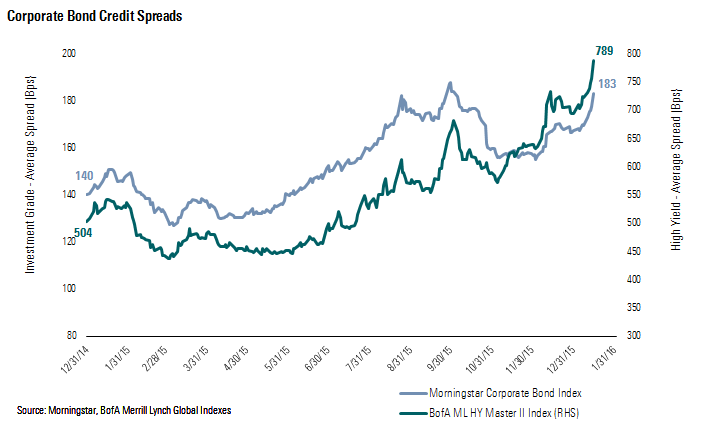
On a week-over-week basis, the average spread of the Morningstar Corporate Bond Index (our proxy for the investment-grade corporate bond market) widened 13 basis points to +183 and the spread of the Bank of America High Yield Master II Index widened 66 basis points to +789. About half of the credit spread widening occurred on Friday. Also indicative of the risk aversion in the markets, the S&P 500 fell 2.2%, oil fell below $30 per barrel intraweek (its lowest price since 2003), and copper remained below $2 a pound (its lowest price since the credit crisis).
In a flight to safety, investors flocked to U.S. Treasury bonds, bidding up prices and sending the entire yield curve down. Last week, the yield on the 5-year declined 13 basis points to 1.45%, the 10-year fell 10 basis points to 2.03%, and the 30-year dropped 11 basis points to 2.81%. Thus far this year, the yield on the 5-year has declined a total of 31 basis points, the 10-year has fallen 24 basis points, and the 30-year has dropped 21 basis points.
As a result, the Morningstar US Government Bond Index has performed admirably, rising 1.48% year to date. The decline in interest rates has more than offset the wider credit spreads in the investment-grade corporate bond market, and the Morningstar Corporate Bond Index has increased 0.47% this year. However, the decline in interest rates was not able to offset the amount high-yield credit spreads have widened. Thus far this year, the Bank of America High Yield Master II Index has recognized a loss of 2.79%. Comparatively, equities have taken the brunt of the sell-off, as the S&P 500 has already fallen 8.0% this year.
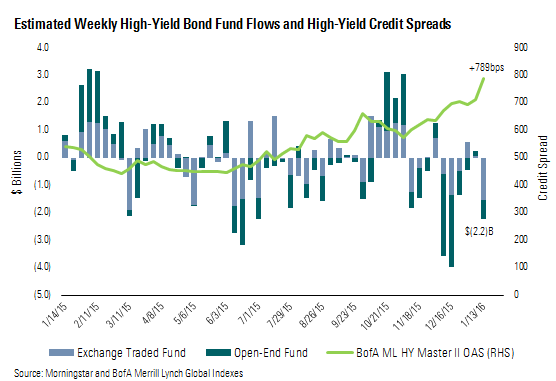
Discretion was the better part of valor in the high-yield market, as investors continued to retreat from high-yield mutual funds and exchange-traded funds. Last week, a little over $2.2 billion was pulled out of the high-yield asset class. Over the past six weeks, almost $11 billion has been redeemed from high-yield mutual funds and ETFs.
While the headline indicators indicate growing weakness in the U.S. economy and many economists are becoming increasingly pessimistic, Robert Johnson, Morningstar's director of economic analysis, is not among them. In his opinion, the economic metrics released last week are more indicative of run-of-the-mill volatility that is likely to reverse itself, perhaps as soon as the first quarter.
For example, while the retail sales report was lower than expected, Johnson believes that if it were adjusted for deflation, the sales report would have reflected an increase as opposed to the officially reported decrease. He points out that many of the most economically sensitive discretionary categories, such as restaurant and sporting goods sales, showed surprisingly good strength. Before drawing any firm conclusions, Johnson suggests waiting until the consumer price index is released this week to accurately gauge the results. He also points out that the industrial production report was not as bad as reflected by the media. The report had a balance between positive and negative sector results and the manufacturing unit production and employment categories are flat for the year, not down. He further highlights that "poor seasonal adjustment factors for the auto industry continue to plague many monthly reports while year-over-year auto data, which is generally less affected by seasonal adjustments, seems to be a lot steadier." For greater detail, please see Johnson's most recent weekly economic publication.
Credit Spreads Wider, but Demand for 'Right Kind' of Investment-Grade Bonds Continues While the risk-off sentiment has pushed corporate bond credit spreads wider across the board, this belies the underlying current of demand for investment-grade corporate bonds. For example, last week Anheuser-Busch InBev BUD (rating: A-/UR-, wide moat) priced $46 billion of new bonds. This is the second-largest new issue corporate bond transaction in history, trailing Verizon's VZ (rating: BBB, narrow moat) $49 billion megadeal in 2013. The fact that AB InBev was able to successfully price such a large transaction, and that the demand for the notes was multiple times oversubscribed, reveals that a strong bid remains in the investment-grade corporate bond market for the right kind of paper.
We note the preponderance of spread weakness has occurred in sectors correlated to the energy and metals and mining industries or by issuers that have experienced idiosyncratic risk. Fundamentals in the energy and metals and mining sectors have been plagued by a prolonged decline in commodity prices that has heightened credit risk and led to rating downgrades. However, we believe there is still appetite in the corporate bond market for large, well-known issuers in defensive sectors. Investors have shown a strong preference for issuers with household brand names, especially those issuers rated single A or better.
Anecdotally, several bond trading desks have noted that there is continued demand from foreign investors (both European and Asian) for U.S. dollar-denominated investment-grade corporate bonds. These investors have been attracted by the high all-in yield that U.S. dollar-denominated corporate bonds offer as well as the safety of investing in the U.S. dollar.
We placed our credit rating for AB InBev under review with negative implications in October 2015 following the firm's announcement that it will purchase SABMiller SBMRY (rating: A/UR-, wide moat) in a $106 billion transaction. We anticipate a resolution of the review upon full regulatory approval and will align SAB's rating accordingly. Pro forma for the acquisition, AB InBev's debt leverage will increase meaningfully and interest coverage will decline. Based on our preliminary pro forma estimates, we expect that debt leverage will climb to about 5.0 times and EBITDA/interest will be about 4.0 times compared with our current 2015 forecasts of 2.5 times and 7.4 times, respectively. However, we note that management has an outstanding acquisition record of increasing profitability through expense reduction and delivering efficiency gains. We forecast debt leverage will fall below 3.5 times by 2018 and reach mid-2.0 times by 2019. Our rating reflects AB InBev's wide economic moat, driven by its considerable scale and strength as the largest global beer producer with industry-leading EBIT margins, high excess returns on invested capital, and sizable cash flow generation.

 United States