
Summer Vacation Is Over, and New Issue Market Is Back in Session
FOMC meeting lining up to be especially contentious.

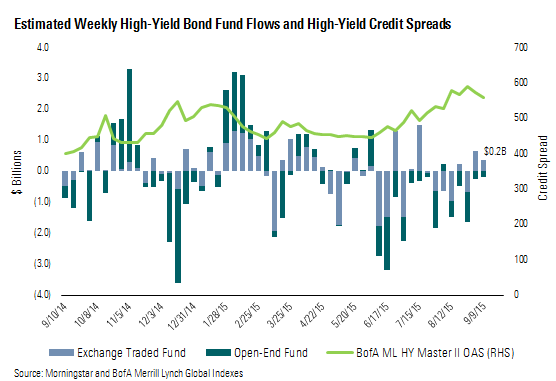
After generally widening over the past few months, corporate credit spreads held relatively steady last week, even in the face of an onslaught of new issuance. The average spread of the Morningstar Corporate Bond Index was unchanged at +175 basis points over Treasuries, and in the high-yield bond market, the average credit spread of the Bank of America Merrill Lynch High Yield Master Index tightened 12 basis points to end the week at +562.
After the new issue market essentially shut down during the typical seasonal slowdown in August, it reopened in September with a vengeance. Of the issuers we follow, $33 billion of U.S. dollar-denominated debt was issued over the past two weeks. Not to be outdone, the amount of new issuance in euros added up to an impressive EUR 31 billion. To price that much volume, new issue concessions (the difference between where the credit spreads of the new bonds priced and the company's existing bonds of similar maturity) offered on the bonds were relatively generous, averaging about 20 basis points. In the secondary market, the new issues performed well, tightening in toward the credit spreads at which the existing bonds were trading; however, in some cases the credit spreads of the existing bonds widened out toward where the new issue bonds printed.
While there was enough demand in the corporate bond market to soak up this supply, investment-grade bond returns have struggled to generate positive returns year to date. Between the combination of wider corporate credit spreads and slightly higher interest rates, the total return of the Morningstar Corporate Bond Index remains in the red at negative 0.22%. With a higher credit spread and lower sensitivity to interest rates, high-yield bonds have outperformed, as the total return of the Bank of America Merrill Lynch High Yield Master Index is 0.68%
Fund flows in high-yield mutual funds and exchange-traded funds remained steady for the second week in a row. Investors had been pulling money out of high yield for the prior six weeks as they had become increasingly worried about the impact of the Chinese government's devaluation of the yuan, the decline of commodity prices to multiyear lows, lower-than-expected earnings from global industrial firms, and economic metrics that indicate that the Chinese economy is softening at an accelerating rate.
While all of these concerns are pertinent, we maintain that the high-yield asset class should continue to outperform investment grade for the remainder of this year. Robert Johnson, Morningstar's director of economic analysis, projects 2015 U.S. GDP growth of 2.0%-2.5%. To reach his full-year forecast, economic growth in the United States would need to average 2.7% for the second half of the year. While the depressed prices of commodities will impair the credit quality of the companies in those sectors, this level of economic growth should be enough to hold down default rates, which will in turn support the high-yield market. In addition, the Fed still appears to be on course to begin raising short-term interest rates sometime this year, which may have the knock-on effect of pushing long-term rates higher. As such, with the expectation that default rates will remain low and interest rates appear poised to head higher, the high-yield sector, with its lower duration and higher credit spread, should outperform the investment-grade sector in the second half of the year.
FOMC Meeting Lining Up to Be Especially Contentious The next scheduled meeting of the Federal Open Market Committee is Sept. 16-17. While the market has been carefully dissecting economic data and parsing the speech of every governor of the Federal Reserve going into this meeting, it is unclear if the FOMC is finally going to be ready to begin raising interest rates. Generally, the economic data has been neither strong enough nor weak enough to lead to a firm conclusion. Given the commentary of the Federal Reserve governors in their public speeches and interviews, this meeting is shaping up to be especially contentious between the hawks and the doves. Whether the FOMC begins to raise rates or continues to hold them at zero, we suspect there will be several dissensions as to the outcome this month.
Those in favor of raising rates are pointing to the sharp acceleration of economic growth in the second quarter and contend that economic metrics indicate the economy has maintained its positive momentum thus far in the third quarter. Real GDP rose at a 3.7% annualized rate in the second quarter, which handily beat consensus estimates. Even though GDP only rose at a 0.6% annualized rate in the first quarter, the average for the first half of the year is a respectable 2%. In addition, employment has been steadily growing and the unemployment rate has fallen to 5.1%, which is within the committee's estimates range of central tendency for unemployment in 2015 and its long-run estimate.
Those in favor of keeping short-term rates at zero point to the deceleration of inflation, low employment participation, and middling economic growth. The core personal consumption index excluding food and energy moved away from the Fed's 2% inflation goal as it slowed to 1.2% last month from the prior reading of 1.3%. Employment participation has stagnated at a rate of slightly over 62%, whereas it averaged of 66% before the credit crisis. In addition, the recent market volatility and weakness in global economic growth may tip the scales in favor of those advocating waiting to raise rates.
The FOMC may decide that decelerating international growth and lower asset prices may weaken financial conditions, which by itself is similar to tightening monetary policy. Yet, after many months of preparing the markets for rising rates, other governors may not want the FOMC to be viewed as being pushed around by the markets. One potential outcome would be for the Fed to raise rates in order to bolster its credibility, but then make it explicitly clear that future interest rate increases will depend on additional economic strengthening, and their growth rate will be much slower than in the past.

 United States