
Strong Economic Data Propel Risk Assets Higher
Investment-Grade Bonds Fairly Valued, but Pockets of Overvaluation Appearing

For the second week in a row, corporate credit spreads in the investment-grade bond market ended the week unchanged whereas high-yield credit spreads continued to tighten. In the investment-grade corporate bond market, the average spread of the Morningstar Corporate Bond Index held steady at an average credit spread of +150 basis points over Treasuries. In the high-yield market, the average credit spread in the Bank of America High Yield Index tightened 14 basis points to +608. Short-term Treasury bonds rose a few basis points but longer-term Treasury bonds remained unchanged. Although risk assets in the form of high-yield bonds performed well, the equity markets took on a life of their own. The S&P 500 made a run toward 2,100, rising 2.3%, but just barely missing that goal post and ended the week at 2,099. At this level, the S&P 500 is only 33 points below its all-time high.
Strong housing data, healthy durable goods orders and exports, and rising oil prices were more than enough to bolster investor confidence and overcome any negative sentiment driven by the prospects of rising interest rates. In fact, some of the data was so strong that Morningstar Director of Economic Analysis Robert Johnson, CFA, remarked "Some of the headlines were stunning, perhaps even too good to be true, with new home sales up an unexpected 16% in a single month. The year-over-year data in most reports was healthy, but not nearly as electrifying as the monthly data. So, just as we cautioned readers not to panic in February when things looked terrible, we now worry that some might become too optimistic. The potential of higher interest rates and demographics are likely to limit GDP growth to the low end of our normal 2.0%–2.5% range for the full year, with a temporary bounce to closer to 3% for the second quarter."
Several officials from the U.S. Federal Reserve, including Chairperson Yellen, made public remarks about raising interest rates in the near term, if economic data continues to support such an action. Intraweek, the market-implied probability of the Fed raising rates in June, as determined by the Fed futures contracts, rose as high as 38%. Yet, as we highlighted last week, the market is still betting that the Fed is bluffing. By Friday close, the probability of the Fed raising rates in June fell back to 28%. Interestingly, the probability of the Fed raising rates at its July meeting rose to over 60%, but that meeting does not have a scheduled press conference and updated economic projections. Considering the significance of raising interest rates, some believe it's highly unlikely that the Fed would raise rates without also releasing updated economic projections and holding a press conference to relay its reasoning. The Sept. 20–21 meeting does have a press conference and economic projections, but that meeting will be held amid presidential campaign season and less than two months prior to the election. The Fed may not wish to raise rates this close to an election as it would not want its moves to be interpreted as politically influenced. There is another meeting on Nov. 1–2, but it is even more unlikely that the FOMC would raise rates the week prior to an election. That then leaves the Dec. 13–14 meeting, which does have a press conference and updated economic projections.
Investment-Grade Bonds Fairly Valued, but Pockets of Overvaluation Appearing While the current credit spread level of the Morningstar Corporate Bond Index is only 17 basis points tighter than its long-term average, there are some areas that are beginning to appear overvalued. For instance, we saw investors reach for yield in some of the lower-rated issues that were brought to market last week. Spirit AeroSystems SPR (rating: BBB-, no moat) issued $300 million, 10-year senior unsecured notes at a spread of 200 basis points over Treasuries. The company's credit profile has been improving and in March we upgraded our corporate credit rating to BBB- (the lowest investment-grade category) from BB+ (the highest junk bond category). We also assigned a positive outlook as we think the firm's credit quality will continue to improve. However, in our view, the notes were priced at a credit spread that was too tight relative to the underlying credit risk. Typically, issuers that are upgraded to investment-grade from high yield will not trade at spreads as tight as they may otherwise because the issuer will not be well-known to the investment-grade market. Additionally, smaller bond issues (those under $500 million) will trade with a slightly higher spread in order to compensate institutional investors for lower secondary market liquidity. Finally, we expect this issuer to be back in the market in the near term as the firm is likely to issue new long-term bonds to refinance notes that are callable next March. For greater detail, please see Rick Tauber's note Spirit AeroSystems in Market With Its First Investment-Grade Deal; 10-Year Fair Value +220, published May 24.
Walgreens Boots Alliance's WBA (rating: BBB-, no moat) is another example of a lower-rated issuer that issued bonds we think are overvalued. Walgreens issued $6 billion of notes across several different maturities to help finance its acquisition of Rite Aid. Initially, after the Rite Aid transaction closes, we expect pro forma lease-adjusted leverage to rise about 1 turn to the mid-4s area, which pushes the issuer to the weak end of its BBB- rating category. Among the different maturities, the 10-year notes were priced at +165 basis points over Treasuries. Comparatively, we think the bonds of higher-rated Express Scripts ESRX (rating: A-, wide moat) are a better investment. Its bonds offer similar compensation as Walgreens' bonds, despite Express Scripts' much stronger credit profile. For example, Express Scripts' bonds due 2024 recently traded around +160 basis points over Treasuries.
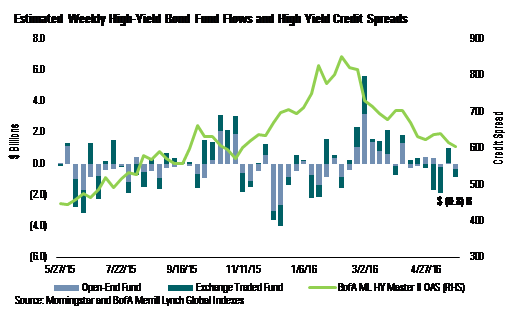
Outflows Resume in High Yield Asset Class Investors pulled assets out of the high yield asset class last week as both open-end mutual funds and exchange-traded funds reported outflows. The outflows were relatively balanced between the two as $313 million was pulled from open-end funds and $503 million was redeemed out of ETFs.

 United States