
Skeptical Corporate Bond Market Ignores BOJ's Negative Interest Rate Policy, Waits for Yellen's Testimony
Economic conditions not as bad as headlines appear.

Two weeks ago, the Bank of Japan announced that it would begin a negative interest rate policy. Most asset markets popped higher on the news, as many investors thought this monetary action would help stoke global economic growth. However, the corporate bond market did not strengthen as other risk assets did and seemed to be skeptical that the monetary policy action would be the panacea to cure economic ills. This foreshadowing by the corporate bond market was borne out last week as the temporary pop in asset prices was short-lived and most markets slid lower. In the equity markets, the S&P 500 dropped 3.1% and among the major commodities, oil fell $2.75 to $31 per barrel.
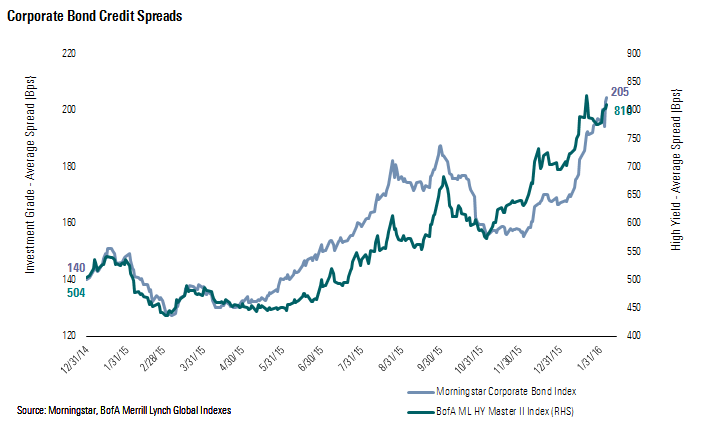
The average spread of the Morningstar Corporate Bond Index (our proxy for the investment-grade corporate bond market) widened 7 basis points last week to +205. The spread of the Bank of America Merrill Lynch High Yield Master II Index widened 36 basis points to +810. Further highlighting the low demand for risk assets, the new issue market for corporate bonds came to a near standstill. The window to the new issue market for corporate bonds was not necessarily closed, but only a handful of issuers braved the market volatility. Typically, issuers and their investment bankers will decide early in the morning if market conditions support bringing new deals to market. Considering the volatility in both the overnight and premarket markets, these go/no-go calls required a high degree of agility, as oftentimes what appeared to be a supportive market overnight quickly turned downward as U.S. equity futures markets opened.
As risk assets fell, investors sought the safety of Treasury bonds. The yield curve among longer-dated bonds tightened 8-9 basis points as the 5-year bond ended the week at 1.25%, the 10-year at 1.85%, and the 30-year at 2.68%. Further bolstering Treasury bond prices, the U.S. Treasury Department announced it was decreasing the amount of longer-dated bonds (5 years and over) it issues this quarter through April by $18 billion. Between the asset-purchase programs of the European Central Bank and the Bank of Japan and the increasing amount of sovereign bonds already trading at a negative yield, the lower supply of positive-yielding, long-dated Treasury bonds, could keep a lid on how much interest rates could rise over the near term.
Last week started on a sour note as the China manufacturing PMI report for January fell to 49.4 from 49.7, indicating that economic activity in China is contracting. Recently, China reported that its GDP growth rate had declined to 6.9% in 2015, its slowest growth rate in 25 years. With manufacturing contracting, the markets need to be prepared that growth is most likely slowing further. In the United States, the ISM manufacturing index rose slightly to 48.2 in January from 48.0, which is an encouraging trend, but a level below 50 indicates that manufacturing conditions are continuing to contract as the strengthening U.S. dollar has been squeezing exports. Conversely, the ISM nonmanufacturing index was reported at 53.5, a decrease from the prior month, but a level above 50 still reflects continued expansion in the service sectors. The PMI services index also remained above 50, posting at 53.2 for January. The weak payrolls report Friday took the last of the wind out of the sails as the addition of 151,000 new jobs significantly missed consensus expectations; however, not all of the news in the payroll report was bad. Even though the number of new jobs was lower than expected, the unemployment rate declined to 4.9%, hourly wage growth rose solidly, and hours worked lengthened.
The divergence of bad news (decelerating economic growth abroad and weak job growth at home) and good news (declining unemployment rate and rising wages) has left the markets perplexed as to not only the timing and pace of monetary policy movements, but even which direction the Fed will head next. Federal Reserve Chair Janet Yellen is scheduled to present the semiannual Monetary Policy Report to the U.S. House of Representatives on Wednesday and Thursday. The markets will listen closely and react quickly to any hints regarding which economic metrics the Fed is placing more reliance on and where future monetary policy may be headed. Most likely, the Fed will hold its policy steady at the March meeting, which means that the June meeting would be the earliest that it could realistically rate the federal funds rate any further. However, any hint that the Fed is still considering raising rates at the March meeting, or switching to a more dovish stance, could send the market meaningfully up or down.
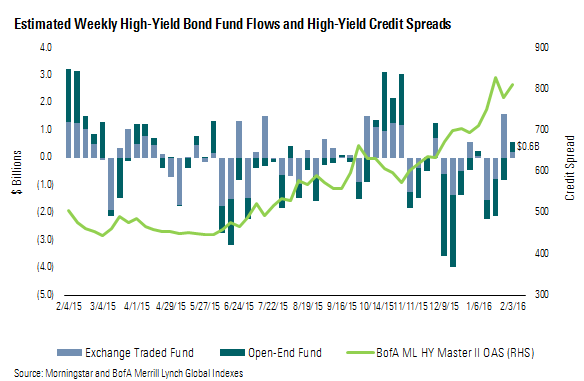
Even though high-yield credit spreads remain near their highest levels since the credit crisis, investors remain wary of chasing the higher yields. Last week, high-yield mutual funds and exchange-traded funds reported only $600 million of inflows into the category.
Economic Conditions Not as Bad as Headlines Appear While the markets have concentrated on the daily price movement of oil and seemingly negative headlines, Robert Johnson, Morningstar's director of economic analysis, points out in his most recent weekly commentary that after stripping out seasonal factors and weather, the U.S. economy has been holding up well. For example, although headline job growth was reported as a disappointing 151,000 increase, well below market expectations, the unemployment rate continued to decline, hourly wage growth rose solidly, and hours worked lengthened. On a year-over-year basis, employment rose about 2%, in line with its trend over the past few years. Even more encouraging, wage growth has risen to a 2.5% year-over-year pace, an increase from the 2.0% pace last January. January auto sales bounced back up to 17.6 million units after declining in December to 17.2 million, which should help stabilize manufacturing. These factors lead Johnson to believe that the U.S. economy is stronger than markets realize.
While economic trends in the emerging markets appear to be deteriorating, Johnson says he has a very hard time envisioning a burgeoning U.S. recession. For greater detail, please see his column this week, "Unmistakable Signs of Strength in January Jobs Report."

 United States