
Shaking Off Brexit-Induced Volatility; Corporate Credit Spreads Tighten in Third Quarter
The amount that credit spreads have tightened has offset the amount that interest rates have risen.

The fixed-income markets performed exceptionally well in the first half of 2016 as the combination of declining interest rates and tightening credit spreads lifted bond prices and generated returns well in excess of the amount of yield carry that bonds would have otherwise generated. Returns in the third quarter, however, have been suppressed (and in some cases resulted in declines) as interest rates on U.S. Treasury bonds have risen off their lows. For example, the yield on 2-year, 10-year, and 30-year Treasury bonds have risen by 18, 12, and 3 basis points, respectively. Among the Morningstar fixed-income indexes that are tied to U.S. Treasury bonds, the rise in interest rates has pushed bond prices down enough to result in a small loss.
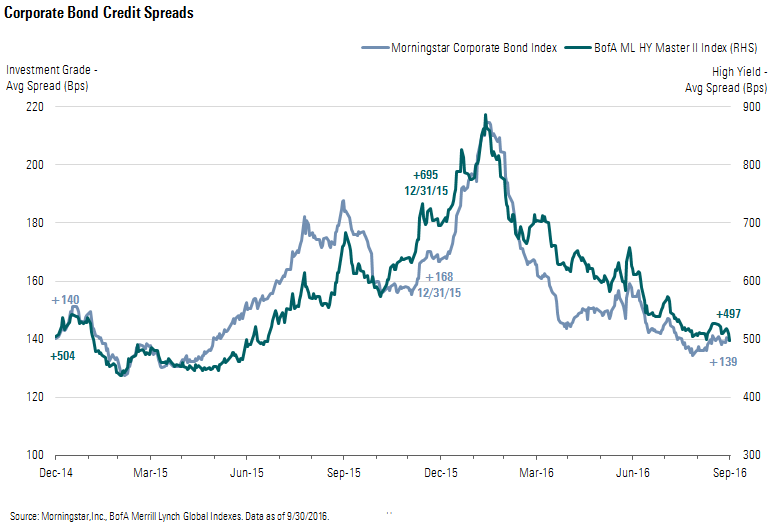
Those fixed-income sectors that trade at a spread over the underlying Treasury bond market have been able to overcome rising interest rates during the third quarter and have generated gains as the amount that credit spreads have tightened has more than offset the amount that interest rates have risen. For example, within the corporate credit markets, the average credit spread of the Morningstar Corporate Bond Index has tightened 16 basis points to +139 and in the high yield sector, the average credit spread in the Bank of America Merrill Lynch High Yield Master Index has tightened 124 basis points to +497. Since the end of last year, the average spread in the investment-grade market has tightened a total of 29 basis points and in the high yield market, the average spread has tightened 198 basis points.
Within the Morningstar Corporate Bond Index, during the third quarter the greatest amount of credit spread tightening occurred within the gas pipelines, basic industries, and telecom sectors, which tightened 48, 30, and 24 basis points, respectively. The sectors that have lagged the market in the third quarter are technology, finance, and manufacturing. The average spread in the technology sector tightened 1 basis point, and within the finance and manufacturing sectors, credit spreads tightened only 4 and 8 basis points, respectively, trailing the overall market which tightened 15 basis points.
Year to date, the greatest amount of credit spread tightening has occurred within the basic industries, gas pipelines, and energy sectors which tightened 138, 105, and 47 basis points, respectively. The sectors that lagged the market in the third quarter are the bank, insurance, and healthcare sectors, which widened 17 basis points, widened 13 basis points, and tightened 4 basis points, respectively.
Despite a brief widening in corporate credit spreads following the U.K. vote to exit the European Union near the end of the second quarter, corporate credit spreads resumed their tightening trend over the third quarter as the market shook off this anxiety. Demand for corporate bonds has also been spurred by international investors who are attracted to the higher all-in yield provided by bonds denominated in the U.S. dollar compared with less lucrative yields elsewhere. Currently, the average credit spread of the Morningstar Corporate Bond Index is 29 basis points tighter than its long-term average and the average spread of the Bank of America High Yield Master Index is 88 basis points tighter than its long-term average.
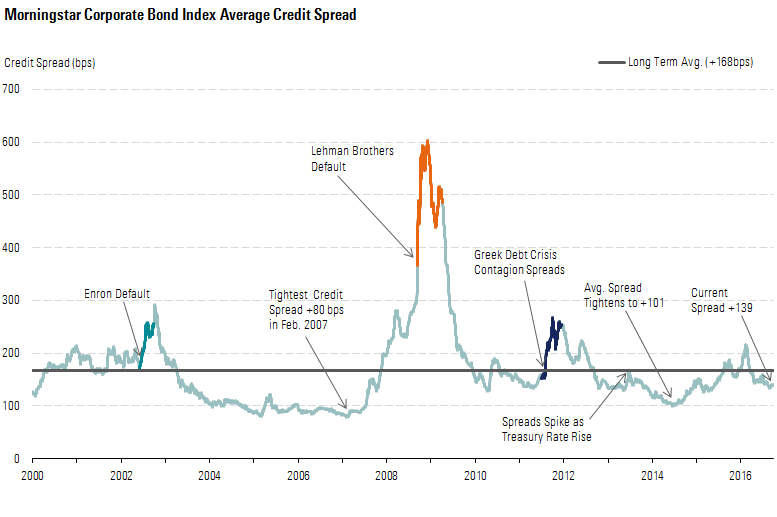
With corporate bonds trading at credit spreads that are tighter than their long-term averages, market appetite at these levels may be tested as corporations begin to release their third-quarter earnings reports over the next few weeks. According to a report published by Factset, the estimated earnings for the S&P 500 is forecast to decline by 2.3%. If this comes to fruition, that would mark six consecutive quarters of year-over-year earnings declines. Factset further reported that would be the longest-running consecutive decline in earnings since it began tracking the data in the third quarter of 2008.
Investors will also be focused on any changes to monetary policy by the major global central banks. The Federal Reserve held its monetary policy steady following its September meeting, but made changes to its meeting statement that seemed to telegraph that it is edging closer to raising the federal funds rate. Similarly, the European Central Bank held its monetary policy steady whereas the Fed is moving closer to tightening monetary policy. The ECB reinforced its commitment to provide more stimulus if the European economy does not improve to the degree it expects. The Bank of Japan held the size of its asset purchase program steady for now, but announced that it was changing the focus of its monetary policy. Moving forward, the BOJ will concentrate on managing the shape of the yield curve and lessen the reliance upon the size of its asset purchase program.

 United States