
Secondary Trading Activity Surges as Higher Interest Rates Lure Buyers
But high-yield buyers were unwilling to chase credit spreads.

Spurred by heightened demand for U.S. dollar-denominated corporate bonds, trading volume in the secondary corporate bond market has reached near-record levels. In the investment-grade market, buyers helped push the average corporate credit spread of the Morningstar Corporate Bond Index tighter by 2 basis points last week to +136. In the high-yield market, buyers were unwilling to chase credit spreads and the Bank of America Merrill Lynch High Yield Master Index was unchanged at +464.
The yield curve for U.S. Treasury bonds continued to steepen last week, even though the interest rate futures market is pricing in with near certainty that the Federal Reserve will increase the federal funds rate next week. Interest rates on short-term bonds declined slightly, and the yield on longer-term bonds rose. The interest rate on 2-year and 5-year Treasury bonds declined 2 and 1 basis points, respectively; in the longer end of the curve, the yield on 10-year and 30-year bonds rose 3 and 6 bps. Since the U.S. presidential election, the yield curve between 2-year and 10-year Treasury bonds has steepened 29 bps.
After Thanksgiving, the corporate bond markets have been very active in the primary and secondary markets. As we approach the end of the year, volume in the primary market has been driven by the dwindling time that the window to the new issue market will remain open before the holiday season. Volume in the secondary market has been driven by renewed demand from insurance companies and pension funds, which have been sitting on cash waiting for interest rates to rise. Now that rates have risen, these investors are putting that cash to work. In addition, there remains a strong demand from overseas investors, including European and Asian buyers. With the recent backup in interest rates in the United States, the all-in yield provided by U.S. dollar-denominated corporate bonds has risen even higher than that of euro-denominated corporate bonds. For example, the yield of the Morningstar Corporate Bond Index is 3.36%, while the Morningstar Corporate Eurobond Index yields only 0.81%.
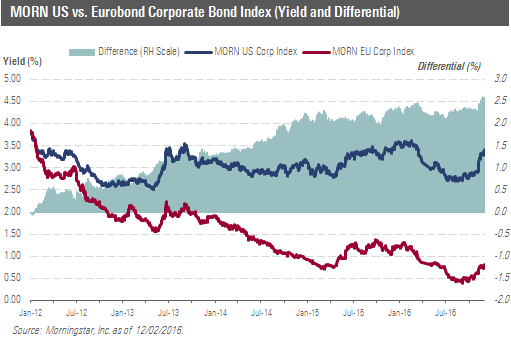
The rise in interest rates has been driven by the expectation for renewed economic activity and resulting resurgence in inflation. According to the Federal Reserve Bank of St. Louis, the 5-year, 5-year forward inflation expectation rate has risen 24 basis points since the U.S. presidential election to almost 2%, its highest level since August 2015. Similarly, the market-implied probability that the Fed will increase the federal funds rate after the December Federal Open Market Committee meeting rose to over 92% at the end of last Friday.
With interest rates surging, fixed-income indexes have given back much of their year-to-date gains over the past two months. For example, quarter to date the Morningstar US Treasury Bond Index has lost 3.94% and is now only up 0.97% year to date. In the corporate bond sectors, credit spreads tightened, which helped to offset some of the impact of rising rates. Quarter to date, the Morningstar Corporate Bond Index has declined 3.59% and is now only up 5.09% year to date. With its lower correlation to interest rates and high-yield carry, the high-yield market has performed better, but even the Bank of America Merrill Lynch High Yield Master Index has essentially broken even and year to date is up 15.31%.
Morningstar Credit Ratings, LLC is a credit rating agency registered with the Securities and Exchange Commission as a nationally recognized statistical rating organization ("NRSRO"). Under its NRSRO registration, Morningstar Credit Ratings issues credit ratings on financial institutions (e.g., banks), corporate issuers, and asset-backed securities. While Morningstar Credit Ratings issues credit ratings on insurance companies, those ratings are not issued under its NRSRO registration. All Morningstar credit ratings and related analysis contained herein are solely statements of opinion and not statements of fact or recommendations to purchase, hold, or sell any securities or make any other investment decisions. Morningstar credit ratings and related analysis should not be considered without an understanding and review of our methodologies, disclaimers, disclosures, and other important information found at https://ratingagency.morningstar.com.

 United States