
Risk-On Rally Impervious to European Events
Meanwhile, risk-free markets have suffered.

Risk assets continued to perform well last week, as none of the European events that occurred were able to shake investor confidence. Neither the news that the European Central Bank will lower the amount of its monthly asset purchase program to EUR 60 billion from EUR 80 billion nor the vote against the referendum on a constitutional reform bill in Italy was enough to derail the markets. Short-term disruptions resulted in the European markets, but they were extremely short-lived and did not disrupt other global markets. Many prognosticators said these events could instigate the beginning of a downturn, but the initial losses were quickly recouped and both events appear to be considered nonevents by the markets.
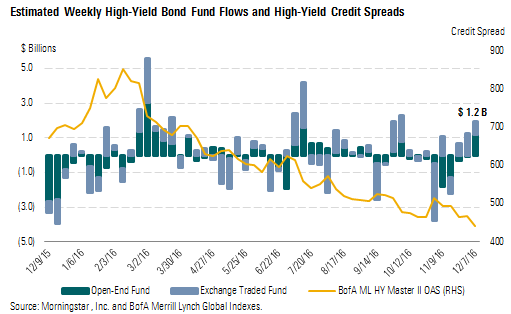
In the investment-grade corporate bond market, the average corporate credit spread of the Morningstar Corporate Bond Index tightened 3 basis points last week to +133. High-yield bonds performed especially well as the average credit spread of the Bank of America Merrill Lynch High Yield Master Index tightened 36 basis points to +428. The S&P 500 rose 3.08% over the course of the week. Industrial commodity prices held their recent gains as economically sensitive commodities such as oil and copper remain at prices near their highest levels since mid-2015. While investment-grade credit spreads have tightened only 6 basis points since the election, high-yield credit spreads have tightened 70 basis points, the S&P 500 has risen 5.61%, oil has increased 13.84%, and copper has increased 7.72%.
As the “risk-on” trade has pushed up asset prices, risk-free markets have suffered. Prices for U.S. Treasury bonds continued to fall, and the yield curve continued to steepen. Even though the interest rate futures market is pricing in with almost near certainty that the Federal Reserve will increase the federal funds rate this week, the yield on the 2-year Treasury rose only 4 basis points to 1.14%. However, the yield on longer-dated bonds widened 8 to 11 basis points from 5-year to 30-year maturities. As interest rates on long-dated bonds have risen further and faster than short-dated bonds, the yield curve has been steepening. Since the election, the spread between 2-year and 10-year bonds has widened 34 basis points to +135.
Portfolio managers were busy last week as they looked to complete positioning their portfolios for year-end. Trading volume in the secondary corporate bond market remained high, but by the end of the week, it had begun to slow from near record-high levels. As expected, volume in the new issue market remained stable as issuers look to tap the capital markets before the new issue window closes as we near the holiday season.
The Federal Reserve is expected to hike the federal funds rate by 25 basis points after the Federal Open Market Committee meeting Dec. 14. For the past two weeks, the federal funds futures market has been pricing in over a 97% probability of a rate hike. Following this rate hike, the markets are not expecting another rate hike until mid-2017. The probability of a rate hike doesn’t increase over 50% until June 2017. The market appears to expect only one increase next year, as there is only a 33% probability that the Fed would conduct a second rate hike in 2017. If the Fed, in the FOMC statement or during questioning at the press conference afterward, were to indicate that the subsequent rate hikes might come sooner than later, the Treasury bond market could experience some short-term disruption as investors would have to readjust to a different rate hike scenario.
Fund flows into high-yield open-end mutual funds and exchange-traded funds continued last week as $1.2 billion of inflows were recorded. The amount was nearly evenly split between open-end funds and ETFs, signaling that both retail and institutional investors were both comfortable increasing allocations to the asset class.
Morningstar Credit Ratings, LLC is a credit rating agency registered with the Securities and Exchange Commission as a nationally recognized statistical rating organization (“NRSRO”). Under its NRSRO registration, Morningstar Credit Ratings issues credit ratings on financial institutions (e.g., banks), corporate issuers, and asset-backed securities. While Morningstar Credit Ratings issues credit ratings on insurance companies, those ratings are not issued under its NRSRO registration. All Morningstar credit ratings and related analysis contained herein are solely statements of opinion and not statements of fact or recommendations to purchase, hold, or sell any securities or make any other investment decisions. Morningstar credit ratings and related analysis should not be considered without an understanding and review of our methodologies, disclaimers, disclosures, and other important information found at https://ratingagency.morningstar.com.

 United States