
Rising Interest Rates Reduce 2016 Fixed-Income Performance
Negative interest rates take their toll.

Long-term global interest rates bottomed out in July 2016 and continued on an upward trend throughout the fourth quarter. In fact, the yield curve in the United States has risen to levels higher than where the markets began last year. In the U.S., the rate of increase in interest rates picked up substantially following the presidential election. The impetus for rising rates has been the market’s expectation that the economy is entering a reflationary environment based on renewed economic activity, which will be spurred by fiscal stimulus and tax reductions. In addition, oil prices and industrial commodities have not only stabilized but are also trending upward.
As investors bid up prices of risk assets and ratcheted up their expectations for economic activity and inflation to rebound, the desire for safe-haven assets such as U.S. Treasury bonds has dwindled. Since the election, Treasury yields have increased across the yield curve anywhere from 35 to 60 basis points, depending upon the maturity date. Further pressuring interest rates, the Federal Reserve increased the federal funds rate by 25 basis points early in December. The rate hike had already been priced into the federal funds futures market; what did surprise the markets was the Fed’s summary of economic projections, which showed that the Fed forecasts three more rate hikes by the end of 2017.
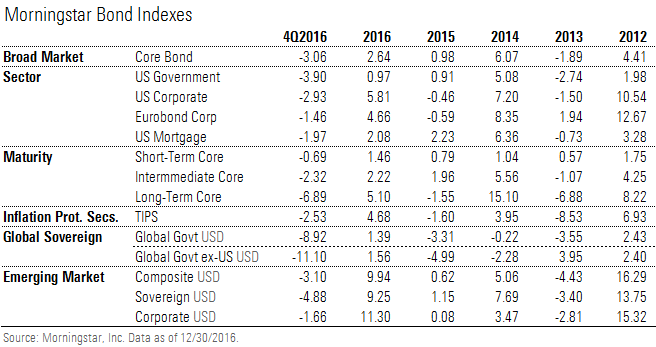
With interest rates surging, fixed-income sectors that are highly correlated to U.S. Treasury prices gave back much of their earlier gains during the fourth quarter. For example, the Morningstar US Government Bond Index fell 3.90% in the fourth quarter, paring back gains generated earlier in the year and ending the year only up 0.97%.
The Morningstar Core Bond Index, our broadest measure of the fixed-income universe, which includes fixed-income securities that trade with a spread over underlying Treasuries, lost less in the fourth quarter, declining 3.06%, and generated a 2.64% increase for the year. As expected in a rising rate environment, long-duration assets fared the worst as indicated by the Morningstar Long Term US Core Bond Index, which dropped 6.89%, lowering the total return for the year to 5.10%. The Short Term Core Index and Intermediate Core Index declined 0.69% and 2.32%, respectively, in the fourth quarter, but registered gains of 1.46% and 2.22% for the year.
As investors price in expectations for enhanced economic growth, investors have flocked to economically sensitive assets, with those assets that have the greatest sensitivity to economic growth performing the best. For example, over the course of the quarter, the average spread of the Morningstar Corporate Bond Index tightened 11 basis points to +128. While the tightening credit spread helped to offset some of the impact of rising rates, it wasn’t enough to overcome the downward pressure on bond prices from rising interest rates. As such, the Morningstar Corporate Bond Index lost 2.93% last quarter and ended the year with a 5.81% gain.
During the fourth quarter, commodity prices generally rose, spurring inflation expectations, as measured by the 5-year, 5-year forward inflation expectation rate, to over 2%, the highest level since mid-2015. The Morningstar TIPS Index declined 2.53% last quarter and ended the year with a 4.68% gain. Among the other U.S.-denominated fixed-income indexes, the Morningstar Mortgage Bond Index fell 1.97% in the fourth quarter and posted a 2.08% return for the year.
International Fixed-Income Performance While interest rates have not risen as quickly in the other developed markets as in the U.S., after reaching unprecedented negative yields in other countries, long-term interest rates in Europe and Asia have at least risen back into positive, albeit still abysmally low, territory. For example, the yield on the 10-year German bund bottomed out at negative 0.19% in July and has since risen to positive 0.27%. As rates rose, the Morningstar Global Government Bond Index fell 8.92% during the fourth quarter, and after excluding U.S. government bonds, the Morningstar Global ex-US Government Bond Index dropped 11.10%. The annual return for these two indexes remained positive at 1.39% and 1.56%, respectively.
After performing very well earlier in the year, the credit spread of euro-denominated corporate bonds widened out in the fourth quarter. Credit spreads widened in response to the European Central Bank’s announcement that it would lower the amount of its monthly asset-purchase program, as well as the heightened uncertainty brought about after Italy voted against a referendum on a constitutional reform bill. The average credit spread of the Morningstar Eurobond Corporate Index widened 13 basis points to end the year at +110. Between rising rates and widening credit spreads, the Morningstar Eurobond Corporate Index fell 1.46% last quarter, reducing the full-year gain to 4.66%.
Although emerging markets typically perform well when investors are looking to increase risk in their portfolios, they were not able to escape the negative impacts from rising rates and were further pressured by the rapidly escalating value of the U.S. dollar. During the fourth quarter, the Morningstar Emerging Market Composite Bond Index declined 3.10%, although it remained up 9.94% for the year. Underlying the composite, the Morningstar Emerging Market Sovereign Bond Index fell 4.88% last quarter and ended the year with a 9.25% gain. The Morningstar Emerging Market Corporate Bond Index fared better in the fourth quarter, declining only 1.66%, and posted an 11.30% return for the year.
Negative Interest Rates Take Their Toll Among countries whose central banks have adopted a negative interest rate policy to stoke inflation and spur economic growth, a slight increase in interest rates to a less negative yield led to losses in the fourth quarter. For example, the Morningstar Japan Government Bond Index sank 1.67%. The loss was generated by an increase in interest rates and the negative carry generated by the underlying bonds. For example, Japan's 10-year bond rose 6 bps to a yield of 0.05% at the end of the fourth quarter. In Switzerland, the Morningstar Switzerland Government Bond Index declined 4.41% due to the underlying negative yield across its yield curve and a slight increase in interest rates. In addition, returns were negatively affected by rising rates as the Swiss 10-year bond rose 36 bps to a negative 0.12% yield.

 United States