
Rising Energy Prices Help Corporate Bonds Hold Value Relative to Treasuries

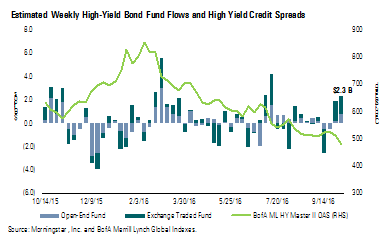
Interest rates rose across the developed markets last week as unconfirmed media reports speculated that the European Central Bank may soon decide to begin to taper its asset purchase program. In the U.S., the entire interest rate curve shifted upward as the yield on the 2-year Treasury bond rose 7 basis points to 0.83%, the 5-year Treasury rose 11 basis points to 1.26% and the yield on both the 10- and 30-year Treasuries rose 13 basis points to 1.72% and 2.45%, respectively. While prices of corporate bonds slipped as well, relative to Treasury bonds, prices did not fall as much, as corporate credit spreads tightened. In the investment-grade market, the average spread of the Morningstar Corporate Bond Index tightened 6 basis points to +134 and in the high-yield market, the average spread of Bank of America Merrill Lynch High Yield Index tightened 21 basis points to +476. These levels represent the tightest that both indexes have registered since June 2015.
A substantial amount that the indexes tightened was generated by the energy sector as oil and natural gas prices surged higher. Within our investment grade index, the average spread of the energy sector tightened 18 basis points and within the high yield index, the average spread of the energy sector tightened 44 basis points. In addition, credit spreads tightened as investors that had cash they needed to put to work had to bid up prices in order to tempt current holders to sell. The amount of volume in the new-issue market has slowed recently as many companies enter their quiet period prior to releasing third-quarter earnings over the next few weeks; yet, even though the new-issue market was waning, volume traded in secondary market swelled higher, highlighting the ongoing demand for corporate bonds over other types of fixed-income securities.
Global Central Bank Monetary Policy Review
Following the September meeting of the Federal Open Market Committee, the U.S. Federal Reserve announced that it held its policy steady and did not make any changes to either the federal funds rate or its reinvestment program. However, based on changes to its meeting statement the Fed seemed to telegraph that it is edging closer to raising interest rates in the near term, although it's highly unlikely the Fed would raise rates at the November meeting given the proximity to the U.S. presidential election. In addition, the November meeting does not include an update to the Federal Reserve's economic projections or a press conference to explain any potential change in policy. Looking past the November meeting, the Fed did make several revisions to its last meeting statement that suggest it is much closer to contemplating a rate hike. In addition, three members of the FOMC voted against the policy action as it preferred to raise the federal funds target rate at the September meeting, as opposed to waiting. Within the press release, the FOMC revised the statement to reflect that "the labor market continued to strengthen and growth of economic activity has picked up from the modest pace seen in the first half of this year." The statement also included new language: "The Committee judges that the case for an increase in the federal funds rate has strengthened but decided, for the time being, to wait for further evidence of continued progress towards its objectives."
While the Fed appears to be conveying a higher probability of a rate hike, the market-implied probability that the Fed will hike the federal funds rate in December has fully priced in such a move. According to the CME Group 30-Day Fed Fund futures prices, the market is only pricing in a 65% probability that the Fed will hike its federal funds rate after the December meeting. Prior to the last FOMC meeting, the market-implied probability of a December rate hike was 55%. The U.S. futures market is also pricing in a high probability that the current ultra-loose monetary policy will remain in place over the next year. According to the futures market, there is only an approximately 11% probability the Fed will hike rates to over 1% in September 2017. This marks a significant departure from the Fed's most current Summary of Economic Projections, in which the FOMC participants forecast the federal funds rate to rise to 1.30% by the end of 2017.
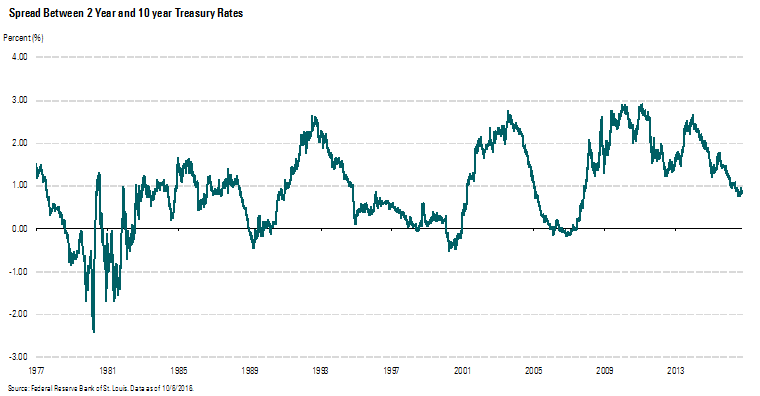
In reaction to the more hawkish stance, short-term rates have risen as the market has priced in higher probabilities of a rate hike. Yet, with the U.S. economy plodding along at a relatively slow growth rate and technical factors driven by international investors providing support to the long end of the curve, long-term rates have held relatively steady, leading to a further flattening of the yield curve.
The Fed has had a difficult time convincing the market over the past few years that it will be successful in pushing inflation higher over the long term. For example, the five-year five-year-forward inflation expectation rate has been on a steady downward trend since 2013. While inflation has remained near 1% on a year-over-year basis for the rolling three-month average since February, it may begin to pick up the pace. Morningstar, Inc. Director of Economic Analysis Robert Johnson, CFA, sees inflation trending up toward 2% within the next six to 12 months. Specifically, Johnson highlights that energy deflation will recede and that inflation in the services category has been accelerating.
European Central Bank The ECB announced on Sept. 8 that it was holding its monetary policy steady, as opposed to loosening it further as expected by the market. The price of many European sovereign bonds quickly fell, pushing yields for some bonds back into positive territory for the first time since mid-June. The price on Germany's 10-year bond fell enough to propel its yield up out of the negative yielding territory to 0.02% after trading as low as negative 0.19% in mid-July.
With interest rates at negative yields out through the 10-year part of the curve and corporate credit spreads at levels that are tighter than the historical average, the yield on the Morningstar Eurobond Corporate Index is lower than the average credit spread of the index. Currently, the yield of our Eurobond Corporate Index is 0.53% and the credit spread is +96 basis points. As a result, financing costs for European companies are at extremely low levels. With interest rates at negative yields and credit spreads tighter than the historical average, this combination has led to distortions in the European corporate bond new issue market. For example,
Given that debt financing is now at an almost negligible cost to corporations, not surprisingly, there has been an uptick in mergers and acquisitions of European companies purchasing U.S. assets. For example, in July, we placed our rating for
More recently, we placed our credit ratings of
Even though the volume of mergers and acquisitions has reached new record highs in recent years, it appears this wave of the big getting even bigger may continue given the historically unprecedented financing environment that exists. We expect that European companies will continue to evaluate acquiring U.S. companies as European companies can finance the debt at minimal cost, acquire a company in a growing economy (as opposed to the moribund European economy), and acquire assets that are denominated in the appreciating U.S. dollar.
In addition, the ultra-low cost of debt will likely lead to even more debt-funded share buyback programs. With interest rates this low, and credit spreads at reasonable levels, there is an arbitrage for dividend-paying companies to repurchase stock to reduce the dividend payments with bonds whose interest rates are lower (even on a pretax basis) than the dividend yield being paid. Even at the risk of suffering credit rating downgrades, we expect that this temptation will be greater than many companies can resist.
Bank of Japan The Bank of Japan announced it was revising the emphasis of its monetary policy to focus on managing the shape of the yield curve and lessen the reliance upon the size of its asset purchase program. Nonetheless, the BOJ held the size of its asset purchase program steady at JPY 80 trillion (approximately $781 billion), for now, but will modify its purchases to target the yield on its 10-year bond at zero percent as opposed to the negative yield the bond has been trading at over much of this year. The intent of this program is to steepen the yield curve in order to minimize the impact that the flat and negative yield curve has had on financial institutions and pension funds. In addition, the BOJ is looking to influence forward inflation expectations as it revised its goal to overshoot its 2% inflation target.

 United States