
Poor Payrolls Pressure Corporate Bonds

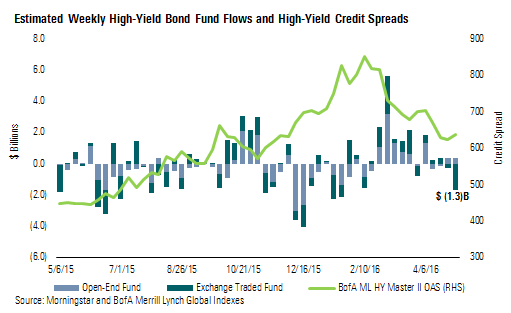
Corporate credit spreads held in relatively well for most of the week. However, after the April nonfarm payroll report was released Friday morning, sentiment turned negative and corporate credit spreads sold off. While the average spread of the Morningstar Corporate Bond Index widened only 1 basis point to an average spread of +147 last week, the high-yield market did not fare quite as well as credit spreads in the Bank of America Merrill Lynch High Yield Index rose 24 basis points on average to +648.
April nonfarm payrolls increased by only 160,000. Not only did this significantly miss the consensus estimate, but it also came in well below the lowest estimate of the range. The unemployment rate held steady at 5.0%, but only due to a decline in the labor force and reduction in the participation rate. Treasury bonds immediately traded up after the release as investors reduced their expectations that the Federal Reserve may raise short-term rates in June. In fact, based on interest rate futures, the market is not pricing in a greater that 50% probability of a rate hike until January 2107.
With earnings season coming to a close, we expect that the new issue calendar will pick up steam. Numerous large acquisitions need to be funded, and the combination of low interest rates and tight credit spreads will probably tempt issuers to lock in cheap financing to conduct share-buyback programs.
While the corporate bond markets have rebounded sharply off their February lows, we are concerned that the technical backdrop of the market has become tenuous over the past few weeks. If too much new issue supply is brought to market too quickly, the market could experience some indigestion. One factor that will help reduce the impact of any oversupply will be the European Central Bank's corporate bond purchase program. With the ECB absorbing supply in the European corporate bond market, a greater amount of these deals may be funded in the European market as opposed to the U.S. market.
Probability of Interest Rate Increases Pushed Further Into the Future Last week, we noted that the April Federal Open Market Committee statement appeared to be purposely vague as to what and when the Fed's next move might be. Based on international developments (such as Britain's vote whether or not to exit the European Union) and domestic events (evolving economic outlook and the upcoming presidential election), we outlined a case that if the Fed does not raise rates at the June meeting, there appears to be a significant chance that it may not act until December.
We noted that until this payroll report, job growth had been encouraging, but inflation has remained below the Fed's target level, and economic activity has been slowing. The sequential annualized growth rate of U.S. GDP has declined for the past three quarters. U.S. economic growth has declined from 3.9% in the second quarter of 2015 to 2.0% in the third quarter of 2015, 1.4% in the fourth quarter of 2015, and 0.5% in the first quarter of 2016. In addition to the slowdown in economic activity, inflation appears to be slipping. For example, the year-over-year increase in the headline personal consumption expenditure index (the Fed's preferred measure of inflation) decelerated to 0.8% from 1.0% last month, and the year-over-year increase in core PCE slipped to 1.6% from 1.7%.
In addition to digesting the regular economic data that will be released before the June meeting and its impact on the Fed's economic outlook, the Fed's action at the June meeting may be further complicated by international factors. On June 23, the week following the FOMC meeting, Britain will hold a vote to decide if it should remain part of the European Union. If Britain decides to exit, many believe that could lead to significant economic disruption in the EU.
The next meeting will be held in July, but that one does not have a scheduled press conference and updated economic projections. Considering the significance of raising rates, most believe it's highly unlikely that the Fed would raise rates without also releasing updated economic projections and holding a press conference to relay its reasoning. The Sept. 20-21 meeting does have a press conference and economic projections, but that meeting will be held less than two months before the presidential election. The Fed may not wish to raise rates so close to an election, as it would not want its moves to been interpreted as being politically influenced. There is another meeting Nov. 1-2, but it is even more unlikely that the FOMC would raise rates the week before an election. That leaves the Dec. 13-14 meeting, which does have a press conference and updated economic projections.
Investors Dump High-Yield Exchange-Traded Funds Investors dumped almost $1.7 billion of high-yield ETFs last week as oil prices retreated from their recent rebound. The outflow in ETFs was partially offset by inflows of $0.4 billion in open-end high-yield mutual funds

 United States