
Plunging Chinese Markets and Rising Global Tensions Test Markets
Credit spreads and volatility to remain elevated.

Plunging Chinese markets, North Korea's nuclear weapons test, and rising tensions in the Middle East resulted in a substantial wave of risk-off sentiment across the global markets. Equity and commodity prices tumbled and credit spreads widened back out to their recent highs.
Over the first week of the year, the average spread of the Morningstar Corporate Bond Index (our proxy for the investment-grade corporate bond market) widened 2.5 basis points to +170 and the spread of the Bank of America High Yield Master II Index widened 28 basis points to +723. Indicative of the risk aversion in the equity markets, the S&P 500 fell 6%. In the commodity space, oil fell to almost $32 per barrel intraweek, its lowest price since 2003, and copper fell below $2 per pound, its lowest price since the credit crisis.
In a flight to safety, investors flocked to U.S. Treasury bonds, bidding their prices up and sending the entire yield curve down. The yield on the 5-year declined 18 basis points to 1.58%, the 10-year fell 14 basis points to 2.13%, and the 30-year dropped 10 basis points to 2.92%. As a result, the Morningstar US Government Bond Index rose 0.78%. Lower interest rates more than offset the wider credit spreads in the investment-grade corporate bond market, and the Morningstar Corporate Bond Index rose 0.75%. High-yield bonds did not fare as well. Junk bond credit spreads widened out almost the same amount as interest rates fell, and the Bank of America High Yield Index recognized a loss of 0.3%.
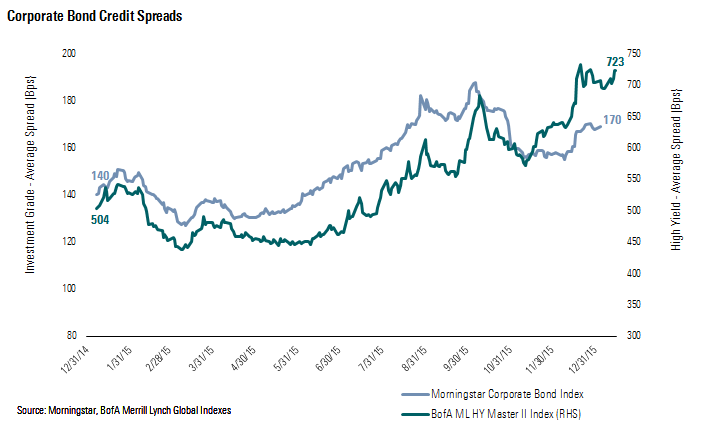
Credit Spreads and Volatility to Remain Elevated Escalating global political discord, ongoing weak commodity prices, tightening domestic monetary policy, and pending mergers and acquisitions will probably keep corporate credit spreads and volatility near their currently elevated levels throughout the first quarter.
Given the underlying fundamentals in the energy and metals and mining sectors, our credit analysts expect commodity price levels will remain under pressure in the near term. This will lead to higher default and bankruptcy rates in those sectors later this year. Low commodity prices have adversely affected near-term economic conditions, but over the longer term, lower prices will help to support consumer spending. As the beneficial impact from lower commodity prices works its way through the economy, we expect defaults will remain low elsewhere this year.
Economic growth in China appears to be dwindling rapidly, and considering it is the second-largest economy in the world, its impact will slow the overall global economic growth rate. This slowdown will continue to pressure top-line growth and operating margins for global corporations, but we expect the direct impact on the U.S. economy should be modest. Robert Johnson, Morningstar's director of economic analysis, highlights in his recent weekly economic commentary that direct exports to China account for only 1% of U.S. GDP. The trading partners that account for a substantial amount of U.S. exports are Mexico, Canada, and Europe. Further, a significant portion of U.S. exports are agricultural goods, Boeing aircraft, and energy-related products. We expect moderate domestic economic growth will continue in the United States this year.
Technical conditions in the investment-grade bond market will remain challenging early this year. There is a significant overhang of new issuance waiting to be brought to market. In addition to the normal amount of refinancing that needs to occur, there are numerous multi-billion-dollar acquisitions outstanding that to be financed. On days that volatility subsides, the new issue market will be flooded, and this deluge of additional supply will constrain the amount that credit spreads would otherwise be able to normalize.

 United States