
Oil Producers Fail to Reach Production Freeze Accord
Investors run out of enthusiasm for high yield.

Oil prices slid Sunday night after the major oil-producing nations failed to reach an accord to freeze oil production at current levels. Sixteen nations, representing more than half of the world's oil production, met in Doha, the capital of Qatar, to try to reach an agreement to halt production levels at current rates. The aim of this meeting was to bolster the price of oil by restricting new supply; however, Iran did not attend the meeting, and the other nations were unable to reach an agreement.
Oil prices had been steadily rising since mid-February, when Russia first signaled its intent to bring the oil-producing nations together to reach an agreement. As oil prices rose, high-yield credit spreads tightened significantly as the rising prices lowered default probabilities across the sector and bolstered recovery values. Oil prices initially slid more than 5% Sunday night after the failure to reach an accord was announced. If oil prices continue to wane, we expect credit spreads in the energy sector will once again begin to rise and take the entire high-yield index wider with them.
In our second-quarter corporate bond outlook, we predicted that oil prices and high-yield credit spreads would remain tightly correlated in the near term. While oil prices have rebounded sharply off their mid-February lows, Morningstar's corporate credit analyst for the energy sector, Andy O'Conor, cautioned that near-term crude oil concerns remain. He highlighted:
- high global inventories of oil, with U.S. commercial crude inventories at a more than 80-year high
- heightened OPEC production as Saudi Arabia and other key members in the cartel continue to pursue market share protection, despite the negative impact to oil prices
- reacceleration of Iranian production and exports since economic sanctions were lifted in January, partly offsetting production cuts underway elsewhere
- tepid economic growth in China, the world's largest oil importer
While we see further upside by the middle of the oil cycle, we think oil prices will remain volatile in the near term until nonprofitable producers make meaningful reductions in production. For the second quarter, many of the same dynamics that affected the first quarter are still in place, and we think investors should brace for another bout of corporate credit spread volatility. In such a volatile environment, investors should look to use sell-offs to increase exposure in those sectors whose underlying credit risk dynamics are unaffected by the downturn in commodity prices but in which credit spreads widen in sympathy with overall market movements.
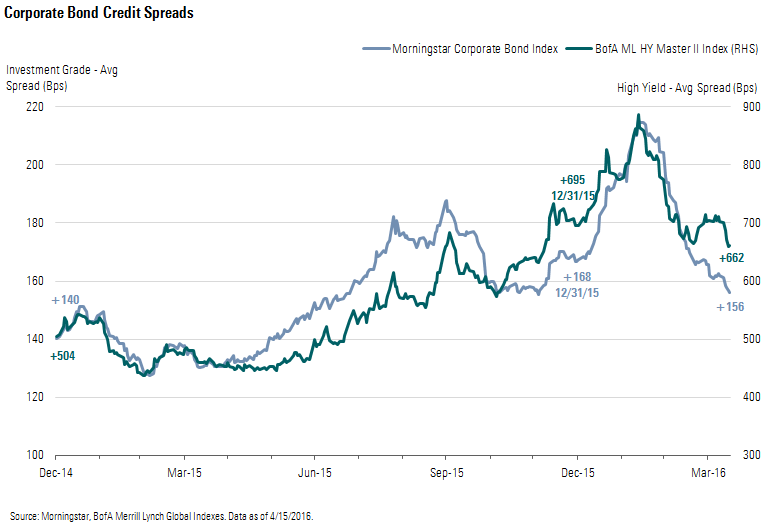
The average credit spread of the Morningstar Corporate Bond Index tightened 6 basis points to +156 last week, reaching its tightest level since November 2015. High yield also performed well, as the spread of the Bank of America Merrill Lynch High Yield Index tightened 41 basis points to +662. The S&P 500 rose 1.60%, and oil rose almost a dollar a barrel to a little over $40.
First-Quarter Bank Earnings Takeaway The big four U.S. banks--JPMorgan Chase JPM (rating: A-, narrow moat), Wells Fargo WFC (rating: A, wide moat), Bank of America BAC (rating: BBB, narrow moat), and Citigroup C (rating: A-, narrow moat)--were first in the banking sector to report first-quarter results last week. Across the board, results were lower than in the year-earlier period but better than many market participants had feared. Net income fell, ranging from a 6.9% decrease at Wells Fargo to 29.1% at Citigroup. Results were negatively affected by lower revenue in investment banking and trading. Traditional consumer banking was generally supportive of results, with Wells and Citi reporting modest decreases in consumer income and JPMorgan and BofA reporting higher income. Another common thread detracting from results was higher credit costs from energy loans. Provisions for energy loans increased sharply relative to the year-earlier period and included reserve builds at most companies. However, overall credit quality remains at healthy levels as improvements in consumer loan portfolios partially offset deterioration in energy-related commercial loans. Although modestly higher than the prior quarter, nonperforming loans finished the first quarter below year-earlier levels at around 1% of total loans. Other than Wells Fargo, which increased its asset base considerably by acquiring $30.8 billion in commercial loans from GE Capital during the quarter, the banks improved their capital buffers. Both tangible and regulatory capital finished the quarter roughly 100 basis points higher than year-earlier levels, providing us further comfort in the banks' ability to manage the consequences of a prolonged slump in energy prices. Contributed by Chris Baker, CFA
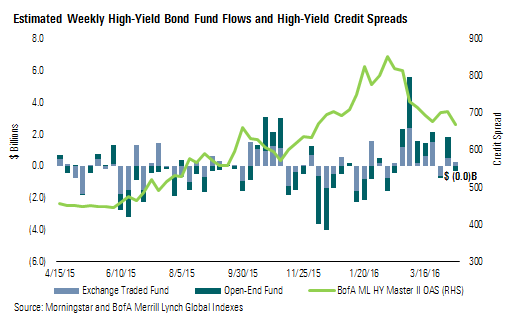
Investors Run Out of Enthusiasm for High Yield Fund flows into high-yield open-end mutual funds and exchange-traded funds ran out of steam last week, as outflows from ETFs matched inflows into open-end mutual funds.

 United States