
Markets Rally on Surging Oil Price, but Not Enough to Recoup Week's Losses
Bonds lead, equities confirm.

Markets rallied sharply Friday, but the rebound was not enough to recoup all of the losses that occurred earlier in the week. The rally was spurred by rumors late in the week that OPEC was planning on cutting production. Oil prices had fallen as low as $26 per barrel earlier in the week, then surged almost 12% on Friday, one of the greatest one-day swings in history. Oil prices continued to move higher Monday, rising another dollar to approximately $30.
On a week-over-week basis, the average spread of the Morningstar Corporate Bond Index (our proxy for the investment-grade corporate bond market) widened 10 basis points, rising to +215. This represents the widest level our index has registered since June 2012, when the markets were recovering from the European banking and sovereign debt crisis. The spread of the Bank of America Merrill Lynch High Yield Master II Index widened 54 basis points to +864, its widest level since October 2011. In the equity markets, the S&P 500 dropped 0.8% to its lowest level since March 2014.
The flight to safety drove prices for Treasury bonds higher and sent the yields on the bonds down to their lowest levels in years. The yield on the 5-year Treasury declined 5 basis points to 1.20%, the 10-year bond fell 10 basis points to 1.75%, and the 30-year decreased 7 basis points to 2.61%. Treasury bonds have been one of the best-performing assets thus far this year. Year to date, the Morningstar US Government Bond Index has risen 3.08%. The decline in Treasury bond yields has been enough to offset the amount that investment-grade corporate bonds widened this year with the result that the Morningstar Corporate Bond Index is essentially flat, only having returned 0.15%. While investment-grade bonds are essentially unchanged on the year, high-yield bonds have continued to fall. High-yield credit spreads have widened considerably more than underlying interest rates have declined, leading to a 4.61% loss in the Bank of America Merrill Lynch High Yield Master II Index. Equities have fared the worst this year, as the S&P 500 has fallen 8.77%. Assets outside the United States have not fared much better. The Morningstar Eurobond Corporate Index has risen 0.46%, but the Morningstar Emerging Market Composite Bond Index has fallen 0.37% and the Morningstar Emerging Market High Yield Corporate Bond Index has fallen 1.76%.
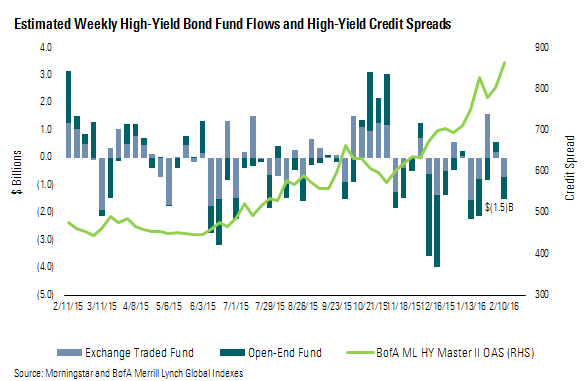
As asset prices fell and investors looked to reduce risk exposure, the new issue market for corporate bonds came to a near standstill. Among the corporate bond issuers that we cover, none issued new debt in the public capital markets last week. If the markets are able to hold their recent gains and stabilize this week, we expect the window to the new issue market will reopen. Indicative of the risk-off sentiment last week, fund flows turned negative as high-yield mutual funds and exchange-traded funds reported an outflow of $1.5 billion.
Bonds Lead, Equities Confirm At times of major market reversals, there is an adage that bonds lead and equities confirm. This implies that oftentimes movements in the bond markets presage key turning points. However, the bond market is not infallible, and investors often joke about how the bond market has called seven of the past four recessions: The bond market also has a history of indicating major turning points when no turn actually occurs.
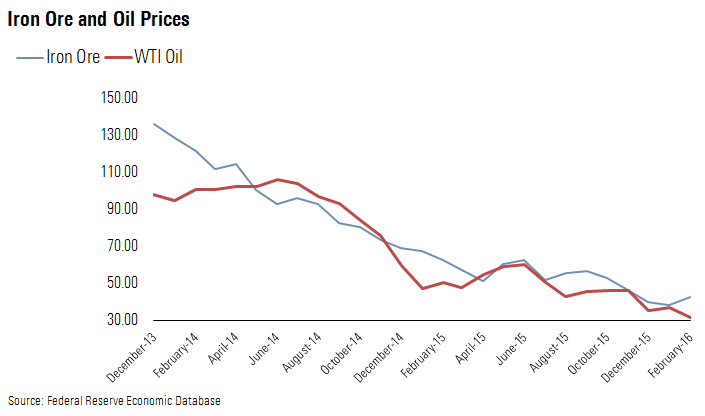
In June 2014, corporate credit spreads reached their tightest level since before the credit crisis. Since then, oil and commodity prices have steadily declined and credit spreads in the energy and basic materials sectors widened out to account for the increasing credit risk. As these sectors weakened, it pulled the overall corporate bond market wider as well.
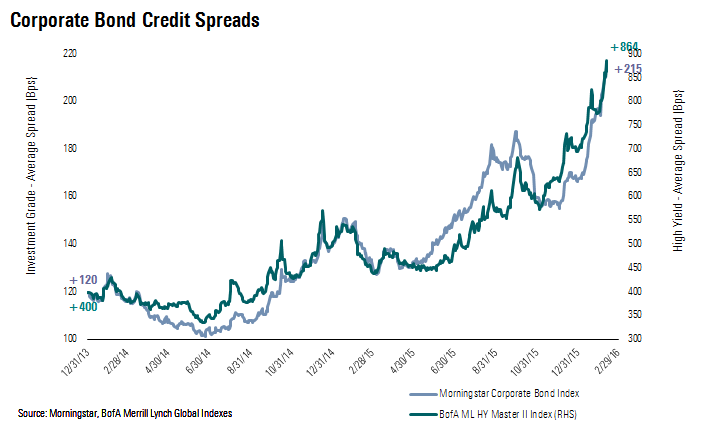
Initially, the weakness was generally contained to those two sectors; however, more recently, this weakness has spread and accelerated. For example, since reaching its tightest spread level, the Morningstar Corporate Bond index has widened 115 basis points, with half of that widening occurring in just the past three months. The equity market corrected last fall, rebounded, and has now corrected again, having fallen almost 13% from its highs.
The current conundrum is to determine whether this movement is indicative of a major turning point that has further to run, or just a correction from overvalued levels as a reaction to the decline in energy and commodity prices. On the economic front in the U.S., many recent metrics, such as the January payrolls report, indicate a deceleration in economic growth. However, once adjusted for weather and seasonal factors, Robert Johnson, Morningstar's director of economic analysis, believes economic growth is in better shape than generally believed. In fact, after making those adjustments and taking into consideration strong wage growth, Johnson said he has a very hard time envisioning a near-term recession. From a credit market perspective, there will be an increase in default rates as energy companies whose costs are too high go under. However, considering that the prices of bonds in the energy sector have fallen to distressed levels, the market has already priced in the heightened default rate.
When contemplating a further significant downturn from here, it is most likely exogenous factors internationally that could cause the recent correction to extend into a major downturn. Indicators to watch include a greater deterioration in commodity prices, a hard landing in China, or significant credit spread widening of European banks.
If commodity prices fall further, then the price of bonds in the energy and basic materials sectors will fall as the recovery value of those companies that file bankruptcy will decline. Lower commodity prices may also indicate weaker demand due to a general global economic slowdown, as opposed to just an oversupply issue. If China, the second-largest economy in the world, experiences a hard economic landing, this will reverberate across economies tied to the Chinese economy. In addition, the Chinese banking system would incur significant losses, and the yuan could be significantly devalued, leading to global economic disruption. The last indicator to watch is the credit spread levels for major European banks. Recently, Deutsche Bank and Credit Suisse have reported large losses. If this weakness extends to the banks in the peripheral eurozone countries, such as Italy and Spain, and solvency of those banks is called into question, then we could see a reprise of the 2011 European banking and sovereign debt crisis.

 United States