
Markets Pressure Central Banks for Further Easing
European Central Bank intimates additional easing ahead.

Weak global economic performance and significant market declines have renewed investor pressure for global central banks to further ease monetary policy. Early last week, China released a report outlining its fourth-quarter and full-year 2015 gross domestic product. The annualized GDP growth rate in the fourth quarter registered 6.8%, the slowest since the 2008-09 global credit crisis. The markets reacted positively to the news as investors are betting that China will ease its monetary policy further in an attempt to stimulate economic activity.
The People's Bank of China last cut each of its benchmark lending and deposit rates by 25 basis points in October 2015, following the release of third-quarter GDP. At that time, the PBOC also reduced its reserve requirement ratio (the amount of capital that banks need to reserve against loans) by 50 basis points. These actions piled on top of the other easing steps the PBOC has taken over the past year. The reductions were the sixth time since November 2014 that the PBOC has lowered its benchmark lending rate and the fourth time it has lowered the reserve requirement ratio. Yet despite these actions, the sequential growth rate of China's economy has consistently slowed.
Midweek, the European Central Bank announced that it would hold its key short-term rates unchanged. Currently, the main refinancing rate (the short-term rate the ECB charges to member banks) is 0.05%, the marginal lending facility is 0.30%, and the deposit facility (the amount that the ECB pays to member banks on excess funds) is negative 0.30%. The negative deposit rate effectively means that the ECB is charging a fee to banks that leave funds on deposit with the central bank. While the ECB held its policy steady this month, investors were encouraged by ECB President Mario Draghi's comments during the press conference, which strongly intimated that the central bank would conduct additional monetary policy easing measures at its March meeting.
In early December 2015, the ECB lowered its deposit rate to negative 0.30% from negative 0.20% and announced that it would extend its EUR 60 billion-per-month asset-purchase program by six months to March 2017. The intent of the greater negative rate is to spur banks into lending excess reserves as opposed to paying the ECB to leave those reserves on deposit. The hope is that the additional lending will in turn will stimulate economic activity. The extension of the asset-purchase program will create an additional EUR 360 billion worth of new currency on top of the program's original EUR 1.1 trillion target. The goal of raising the money supply is to increase spending and lending. The ECB's monetary policy began easing with interest rate cuts in November 2011, and the asset-purchase program began in March 2015.
The average spread of the Morningstar Corporate Bond Index (our proxy for the investment-grade corporate bond market) widened 9 basis points to +192 last week and the spread of the Bank of America Merrill Lynch High Yield Master II Index was almost unchanged, as it only tightened 2 basis points to +787. The S&P 500 rose 1.4%, paring back some of its year-to-date loss, but still remains down 6.7% for the year. Commodities staged a late-week comeback as oil rose swiftly on Thursday and Friday, ending the week at $32.25 a barrel after hitting a low of $26.25 on Tuesday. Copper bounced back up and ended at $2 per pound on Friday. As the panic from the prior weeks subsided, the need for the safety of Treasury bonds lessened. Last week, the yield on the 5-year rose 3 basis points to 1.48%, the 10-year increased 2 basis points to 2.05%, and the 30-year rose 1 basis point to 2.82%.
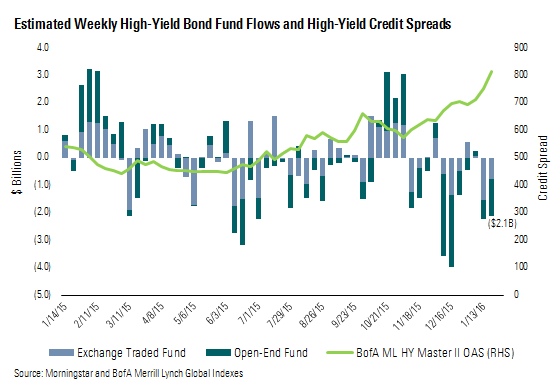
Investors remained wary that high yield hasn't bottomed out yet and withdrew more assets from the sector. Last week, a little over $2.1 billion was pulled out of the high-yield asset class, following the redemption of $2.2 billion the prior week. Over the past two months, almost $15.5 billion has been withdrawn from high-yield mutual funds and exchange-traded funds. Even after accounting for the inflows early last year and over the summer, on a 52-week rolling basis, more than $5.5 billion has been taken out of the high-yield asset class.

 United States