
Market Melt-Up Continues
High-yield fund flows bounce back.

Asset markets continued to melt up as the newly created liquidity from the European Central Bank, Bank of Japan, Bank of England, and other smaller central banks flowed through the global markets. The U.S. equity markets hit all-time highs, Treasury bonds rose, and corporate credit spreads tightened. The average spread of the Morningstar Corporate Bond Index tightened 4 basis points to +141, and the average spread of the Bank of America Merrill Lynch High Yield Master Index tightened 12 basis points to +534. These are the tightest levels the corporate bond indexes have traded at over the past year.
Typically, new issue volume plummets in the corporate bond market during August as the buy side and sell side take vacation time and trading desks are thinly staffed. However, to satisfy the raging demand from investors looking to put cash to work, issuers brought an unusually large volume of new bonds to market for a typically slow week in August. Among the issuers we cover, 12 companies priced almost $20 billion of new bonds last week. These bond deals were well received in the market and generally traded higher in the secondary markets. While demand from domestic investors remains solid, we continue to hear anecdotal evidence that foreign investors are increasing their asset allocations to U.S. dollar-denominated corporate bonds. Foreign investors see significant value in dollar-denominated fixed-income securities. With interest rates negative in the European Union and Japan and rates on U.K. bonds hitting new lows, the U.S. dollar is likely to continue to appreciate against other developed-market currencies. As global interest rates remain near their lowest historical levels, corporate bonds have become increasingly more attractive on a relative value basis. With underlying interest rates as low as they are, the extra return provided by the credit spread on corporate bonds above the underlying benchmark bond has become an increasingly larger portion of total return.
While the Federal Reserve made its first foray into normalizing monetary policy by raising the federal funds rate a quarter point in December 2015, the ultra-easy monetary policies that exist among global central banks are unabated. In fact, based on recent reports, the ECB and BOJ are considering loosening their already historically easy monetary policy by increasing their asset-purchase programs and/or lowering interest rates even further into negative territory. In the United States, investors will be focused on the Federal Reserve’s annual confab at Jackson Hole during August 25-27 in hopes of gaining a better understanding of what data the Fed is focused and gaming when the Fed may raise interest rates next. Fed watchers will be especially focused on Fed Chair Janet Yellen, who is scheduled to speak Aug. 26. In our quarterly outlooks, we have made our case on why we don’t foresee the fed funds rate rising anytime in the near future. The market-implied probability of a hike in interest rates at the September meeting is only 12%, and for the December meeting, it remains under 50%. The probability of an increase in short-term rates does not rise to over 50% until March 2017. Even after that, the probability of a rate hike does not increase very quickly. In July 2017, the probability that the Fed will not have increased the federal funds rate is still 40%.
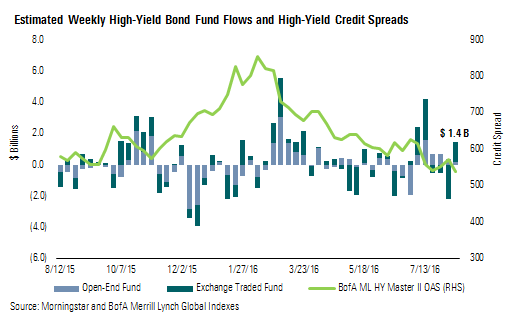
High-Yield Fund Flows Bounce Back Fund flows into the high-yield asset class bounced back last week as exchange-traded funds and open-end mutual funds reported an inflow of $1.4 billion. The preponderance of inflows occurred among ETFs, which are the preferred vehicle for fast-money accounts to quickly shift allocations among different asset classes. With oil prices continuing to trade near break-even levels for many high-yield oil producers, over the past year there has been a high correlation between asset flows into and out of the high-yield market as default risk in the energy sector appears to increase significantly when oil prices sink below $40 per barrel.

 United States