
It's Not Thanksgiving Yet, but Everyone's Talking Turkey
With the lira plunging, it becomes more difficult for Turkey to support and repay its sovereign debt.

Tailwinds from strong economic growth and robust second-quarter earnings reports helped drive corporate credit spreads tighter during the first half of last week. However, credit spreads reversed course and gave up those gains and more by the end of the week.
Over the past few months, investors have become increasingly concerned about Turkey's economic strength, stability, and progressively tense relations with the United States. Those concerns turned into a full-scale currency crisis Friday after President Donald Trump announced that he would double the tariffs paid on Turkish steel and aluminum imports. The Turkish lira plunged approximately 18% against the dollar on Friday before clawing its way back to a 13% loss for the day. This rout adds to the loss of confidence that the lira has suffered this year. Year to date, the lira has declined 40% against the dollar.
With the value of the lira plunging, it will become increasingly difficult for Turkey to support and repay its sovereign debt, especially notes denominated in dollars. As a result, the yield on Turkey's 10-year bond soared to close at 8.50% on Friday from 5.30% at the beginning of the year. The crisis continued early Monday morning as the price on the Turkish bond continued to drop, with the resulting yield rising to 9.31%, a spread of +634 basis points over U.S. Treasuries.
As the lira plummets and yields skyrocket on Turkish sovereign bonds, investors are concerned that many Turkish corporations with dollar- or euro-denominated debt may find access to international capital markets constrained, potentially leading to financial distress from illiquidity or insolvency. While the direct impact on the global economy from a decline in economic output from Turkey would be very limited, contagion from this currency and debt crisis has begun to spread to other emerging markets, especially those that rely heavily on foreign investment. In addition, the equity of European banks with significant direct exposure to Turkey, as well as Turkish corporations, slid at the end of last week.
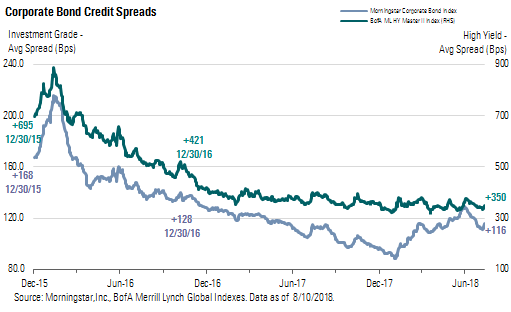
The average spread of the Morningstar Corporate Bond Index (our proxy for the investment-grade market) widened 4 basis points to +116 last week. In the high-yield market, the BofA Merrill Lynch High Yield Master Index widened 7 basis points to +350. While risk assets were under pressure at the end of the week, heightened volatility in the emerging markets drove investors to the safety of U.S. Treasuries. By the end of the week, the yield on the 2-year Treasury had tightened 4 basis points to 2.60%, the 5-year Treasury note tightened 7 basis points to 2.74%, the 10-year declined 8 basis points to 2.87%, and the 30-year dropped 6 basis points to 3.03%.
Although the corporate bond market experienced a slight pullback last week, quarter to date, risk assets have continued to perform well, as strong economic growth and robust corporate earnings have buoyed investor sentiment. Over the past few weeks, among the economically sensitive companies that Morningstar Credit Ratings rates, we have published numerous credit notes highlighting the double-digit increases in top-line growth this past quarter and the resulting surge in earnings. Even after accounting for last week's pullback, since the end of June, the investment-grade index is 12 basis points tighter and the high-yield index is 21 basis points tighter.
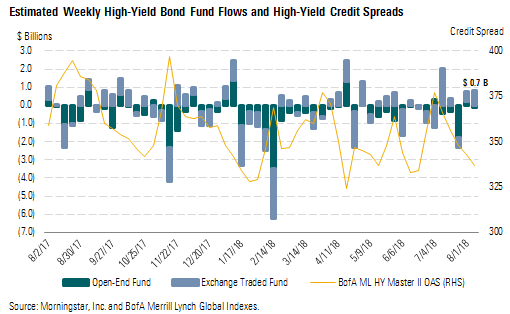
Weekly High-Yield Fund Flows Although open-end high-yield mutual funds experienced an outflow of $0.1 billion last week, the $0.8 billion of net new unit creation among high-yield exchange-traded funds overwhelmed the slight outflows. Total high-yield fund flows for the week were a net inflow of $0.8 billion. Year to date, fund flows have registered a total outflow of $15.2 billion, consisting of $3.1 billion of net unit redemptions across ETFs and $12.1 billion of redemptions among open-end funds.
Morningstar Credit Ratings, LLC is a credit rating agency registered with the Securities and Exchange Commission as a nationally recognized statistical rating organization ("NRSRO"). Under its NRSRO registration, Morningstar Credit Ratings issues credit ratings on financial institutions (e.g., banks), corporate issuers, and asset-backed securities. While Morningstar Credit Ratings issues credit ratings on insurance companies, those ratings are not issued under its NRSRO registration. All Morningstar credit ratings and related analysis contained herein are solely statements of opinion and not statements of fact or recommendations to purchase, hold, or sell any securities or make any other investment decisions. Morningstar credit ratings and related analysis should not be considered without an understanding and review of our methodologies, disclaimers, disclosures, and other important information found at https://ratingagency.morningstar.com.

 United States