
Investors Flee High-Yield ETFs
Risk assets took it on the chin last week as corporate credit spreads widened out, stocks fell, and commodity prices declined.

Risk assets took it on the chin last week as corporate credit spreads widened out, stocks fell, and commodity prices declined. The average spread of the Morningstar Corporate Bond Index widened out 4 basis points to +140 and the Bank of America Merrill Lynch High Yield Master Index widened 44 basis points to +520. Among the equity indexes, the S&P 500 dropped 1.94% to its lowest level since June and among the major commodities, oil prices fell $4.50 per barrel to $44.10.
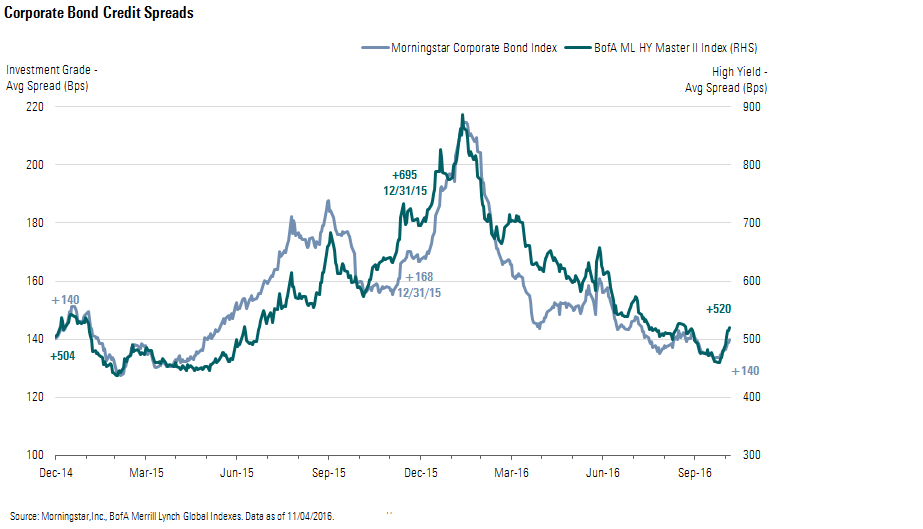
In the prior Corporate Credit Weekly Highlights, we pointed out that the combined new issue calendar and a slew of merger and acquisition announcements had been keeping bond traders especially busy. We further pointed out that the unusually high trading volume in the secondary market was also attributed to early year-end window dressing by many institutional investors that invest with a total return mandate. Considering investment-grade and high-yield bonds have risen substantially this year, these investors are looking to lock in gains and have been switching to a more defensive posture to ride out the rest of the year. Even though new issue supply dwindled last week and the pace of M&A receded, trading volume remained robust last week. While the window dressing among institutional portfolio managers drove some of the volume, withdrawals from fixed-income ETFs spurred a significant amount of trading.
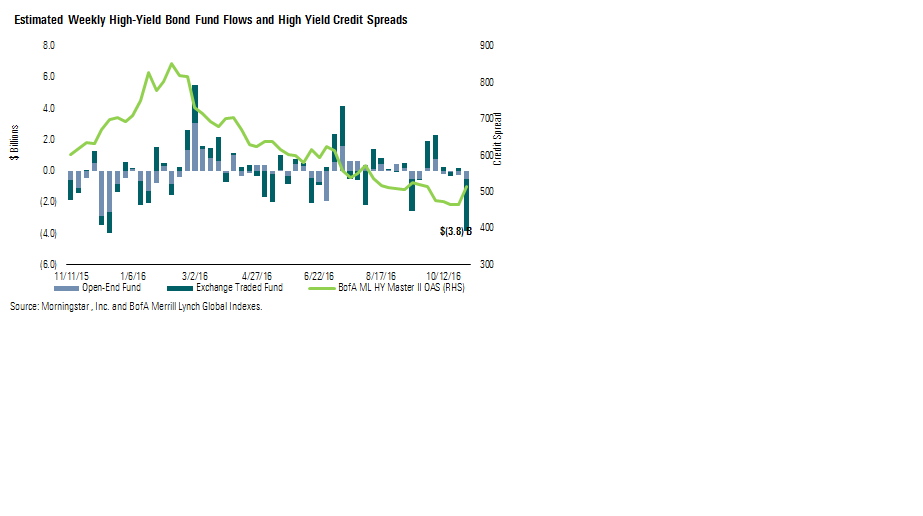
For example, in the high-yield market, approximately $3.8 billion of funds were withdrawn from high- yield open-end mutual funds and exchange traded funds. This represents the second greatest weekly outflow over the past 52 weeks. The single greatest outflow was $3.9 billion in mid-December after oil prices broke below $40 per barrel. Of the withdrawals, approximately $3.3 billion were pulled from the high-yield ETF products, which was the single largest weekly outflow incurred by the high-yield ETFs over the past year.
Prior to last week, we noted that the market had been taking a wait and see attitude before making any investment decisions to either committing additional funds or withdrawing funds from the high-yield space. Several reason were postulated as to the reason that investors fled high-yield ETFs.
- First, many investors may have looked to exit the asset class prior to this week's presidential election. With the polls showing the race running near even, investors may have decided to take money off the table until the uncertainty surrounding the outcome
- Second, even though the headline GDP report revealed that the economy expanded at a 2.9% annualized pace in the third quarter, many believe the underlying dynamics that drove the growth rate will not be sustainable in the fourth quarter. For example, exports and inventory accumulation drove approximately half of the growth rate. Specifically, the exports of soybeans were pulled forward from their typical fourth quarter export pattern and represented 0.9% of the growth rate. This will provide a headwind in the fourth quarter GDP growth rate as the effect will be reversed in the coming months.
- Third, the Fed appears to be poised to raise the federal funds rate after the December FOMC meeting. After having been cut to zero percent seven years ago in response to the 2008–09 credit crisis, the federal funds rate is still only in a range of 0.25%–0.50%, which remains lower than any other time in history prior to the credit crisis. With GDP running at a low single digit growth rate, unemployment below 5%, and the consumer price index rising 1.5% over the past 12 months, it appears that the Fed will have little reason not to raise the federal funds rate at its December meeting.
- Fourth, the third-quarter earnings season is close to wrapping up and while earnings have generally beaten lowered expectations, guidance for the fourth quarter has generally been lackluster. With high yield credit spreads bottoming out in the mid-400s toward the end of October and oil prices weakening, further upside potential appeared to many investors to be limited and those investors decided to lock in gains generated early this year.
Morningstar Credit Ratings, LLC is a credit rating agency registered with the Securities and Exchange Commission as a nationally recognized statistical rating organizations ("NRSRO"). Under its NRSRO registration, Morningstar Credit Ratings issues credit ratings on financial institutions (e.g., banks), corporate issuers and asset-backed securities. While Morningstar Credit Ratings issues credit ratings on insurance companies, those ratings are not issued under its NRSRO registration. All Morningstar credit ratings and related analysis contained herein are solely statements of opinion and not statements of fact or recommendations to purchase, hold, or sell any securities or make any other investment decisions. Morningstar credit ratings and related analysis should not be considered without an understanding and review of our methodologies, disclaimers, disclosures and other important information found at https://ratingagency.morningstar.com.

 United States