
Investor Demand for U.S. Corporate Bond Remains Insatiable
Even in earnings season, trading volume remains high.

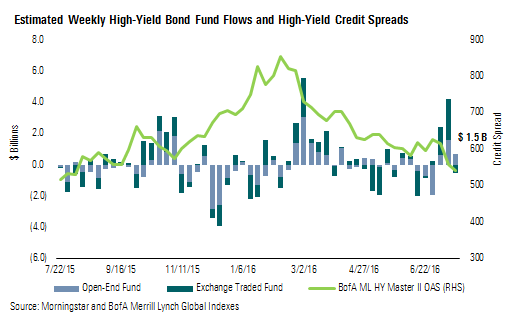
The seemingly insatiable investor demand for U.S. dollar-denominated corporate bonds was unabated last week. As earnings season heats up, investor attention in the corporate bond market often turns away from bond trading and toward analyzing corporate results; however, trading volume has remained high as institutional investors are swamped with inflows that need to be invested.
An example of this voracious demand for corporate bonds is evident in Teva Pharmaceutical Industries’ TEVA (rating: BBB-, narrow moat) new issue. Teva issued $15 billion in a multitranche offering to help fund its acquisition of Allergan’s AGN (rating: BBB-, wide moat) generic assets. We rate the company at the lowest investment-grade rating. Initial price talk on the 10-year notes started at a spread of +190 basis points over Treasuries. As investors clamored to participate in the new issue, the final spread on the notes tightened to +160. Typically, new issues are priced with a small concession to where the firm’s existing bonds are trading in the secondary market, but in this case the new issue spread was actually tighter. The bonds traded up even further in the secondary market, with the credit spread dropping to inside +150, resulting in a yield of 3.00%.
While current trading levels look expensive to us on a credit spread basis, the all-in yield for foreign investors remains attractive. Following the dollar-denominated new issue, Teva also issued bonds in euros and Swiss francs. As an example of how negative sovereign interest rates are distorting the market, the coupon on the 9-year Swiss franc-denominated bonds is 1%, below the credit spread at which the bonds were sold. The bonds are currently trading above par, resulting in a yield below 1%.
With most of the world’s central banks conducting extremely easy monetary policies, demand for fixed-income securities denominated in the U.S. dollar remains high. Last week, the European Central Bank held its policy interest rates at current levels but confirmed its intention to maintain its EUR 80 billion monthly asset-purchase plan until at least March 2017 and perhaps beyond that if deemed necessary. Considering that’s at least another eight months of purchases, there is still another EUR 640 billion of new money that will be created. A significant amount of that new money will probably be reinvested in the fixed-income markets. Not only does this asset-purchase program increase demand for fixed-income securities by creating new money that must be reinvested, but it also reduces the amount of outstanding supply, which exacerbates the market impact.
Considering that U.S. Treasury bonds are some of the last sovereign bonds in the developed markets to trade at a positive yield, foreign investors are finding value in dollar-denominated fixed-income securities. In addition, with deposit rates negative in the European Union, over time the U.S. dollar is likely to continue to appreciate against the euro. As interest rates sink, corporate bonds have become increasingly more attractive on a relative value basis. With underlying interest rates as low as they are, the extra return provided by the credit spread on corporate bonds above the underlying benchmark Treasury bond has become an increasingly larger portion of total return.

 United States