
Investor Demand Pushes Credit Spreads Tighter
Monetary easing will heighten demand for corporate bonds.

The corporate bond market performed well last week. The average spread of the Morningstar Corporate Bond Index, our proxy for the investment-grade market, tightened 12 basis points to +160 bps over Treasuries. In the high-yield market, the average credit spread in the Bank of America Merrill Lynch High Yield Master Index tightened 9 basis points to end the week at +588. Demand from foreign investors helped drive the market tighter as investors in Europe and Asia sought the higher all-in yields that the U.S. fixed-income market provides. Foreign investors also looked to U.S. dollar-denominated investments to protect the purchasing power of their savings as the dollar has been steadily appreciating versus other currencies. Typically, in a strong corporate bond market, high yield will outperform investment grade to the upside; however, the investment-grade bond market outperformed the high-yield market last week. Investors looked to investment-grade bonds as substitutes for sovereign bonds, whereas weak economic metrics in the United States limited credit spread tightening among high-yield bonds, which are more correlated with economic activity.
At a reported growth rate of 1.5%, third-quarter U.S. gross domestic product grew much more slowly than expected. The fourth quarter thus far appears to be showing this same pace of lackluster growth. Several recent economic metrics are indicating that the weak growth rate from the third quarter is carrying into the fourth quarter. For example, the report for durable goods orders excluding transportation fell 0.4% last month and core durable goods orders fell 0.3%. Consumer spending, which accounts for a significant proportion of economic activity, slowed to a 0.1% increase and personal income rose only 0.1%.
While the high-yield market did not perform as well as might be expected, it did continue to attract its share of investors. Last week, high-yield fund flows into open-end mutual funds and exchange-traded funds rose by $2.2 billion. After suffering outflows for much of the year, the asset class registered four consecutive weeks of inflows for the first time since spring.
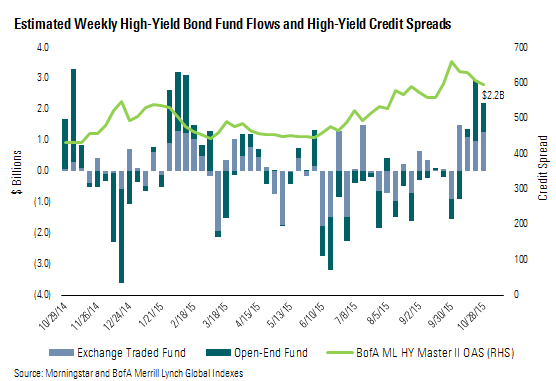
Monetary Easing Will Heighten Demand for Corporate Bonds With interest rates on sovereign bonds in developed markets at such low rates (and in the case of short-term debt, generating negative returns), corporate bonds should perform well on a relative basis. As the European Central Bank purchases sovereign debt and asset-backed securities, the proceeds will need to be reinvested, and the path of least resistance is the corporate bond market. This demand will in turn drive corporate credit spreads tighter. As corporate credit spreads in Europe contract, this will pull credit spreads tighter in the U.S. Investors who can purchase debt in either euros or U.S. dollars will gravitate toward the debt that offers both greater spread and a higher all-in yield; this is currently the dollar-denominated debt.
Not only are interest rates on European fixed-income securities much lower than in the U.S., but through a 5-year maturity, many of the bond prices are so high that investors will suffer losses if the bonds are held to maturity. If the ECB does ratchet up its asset purchases, it not only will inhibit interest rates from rising in the U.S., but may pull U.S. interest rates down further. For example, the yield on the 10-year U.S. Treasury is currently 2.15%, more than 150 basis points higher than the 10-year German bund. U.S. Treasury bonds offer global investors a significant yield pickup over sovereign European debt as well as the safety of being denominated in U.S. dollars. By purchasing dollar-denominated assets, if the exchange rate of euro continues to slide, investors will benefit from the exchange rate differential when they convert their investments back into euros.

 United States