
Investment-Grade Spreads Tighten on Healthy Job Growth and Dovish Commentary
Sliding oil prices send high yield wider.

Healthy job growth and dovish commentary from Federal Reserve Chair Janet Yellen provided the catalyst for investment-grade corporate credit spreads to tighten and stock prices to rise. The average spread of the Morningstar Corporate Bond Index tightened 4 basis points to +162 and the S&P 500 rose 1.81% last week; however, with a high percentage of the high-yield index tied to energy and commodity prices, junk bonds weakened as oil prices fell. Oil fell more than 7% to $36.68 a barrel, and the average spread of the Bank of America Merrill Lynch High Yield Index widened 12 basis points to +705.
Yellen gave a speech at the Economic Club of New York which was widely considered to be more dovish than expected. In her speech, she waffled on the pace of future interest rate increases and made several statements emphasizing that the Fed's guidance is only a forecast and should not be considered a specific plan as to rate increases. She then expounded upon all of the factors that could dissuade the Fed from raising rates any further in the near term.
The labor market continued to improve last month as nonfarm payrolls rose by 215,000 in March, surpassing expectations, and the previously released strong February payrolls report was restated even higher. The participation rate also rose to 63.0% from 62.9%. While the headline payrolls growth was greater than expected, the unemployment rate edged up to 5.0% from 4.9%; however, this increase portends well for additional economic expansion as the increase was due to a surge in new entrants and previously unemployed workers who had stopped looking for employment, not from a decline in jobs. As these job seekers gain employment, it will provide greater future economic activity.
First-Quarter Review: Fixed Income Performs in Face of Heightened Volatility Interest rates declined around the world early in the quarter as investors sought the safety of developed-market sovereign bonds as a refuge from plummeting commodity prices. Even after commodities rose higher late in the quarter, sovereign bonds held their gains in response to the European Central Bank's expanded easy monetary policy. In corporate bond markets, plunging oil prices sent credit spreads wider early in the quarter. However, the rebound in oil sent credit spreads back to the same levels at which they opened the quarter. After posting losses as capital fled China, the emerging-markets fixed-income indexes recuperated and surged higher.
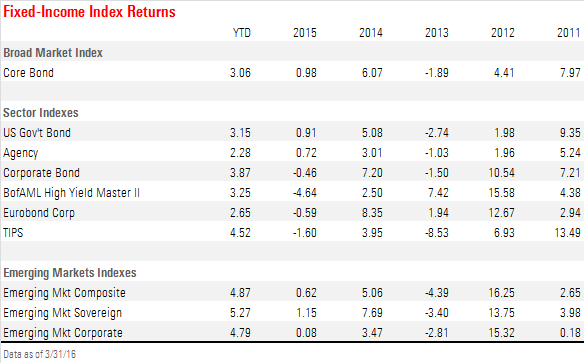
The Morningstar Core Bond Index, our broadest measure of the fixed-income universe, rose 3.06% last quarter. The gain was driven by a rally in sovereign bonds early in the quarter as investors sought the safety of sovereign bonds as a refuge from plummeting oil prices and weakening global economic conditions. Yet even when oil prices staged a late-quarter recovery, sovereign bonds held their gains as the ECB and other central banks eased their monetary policies in an attempt to bolster their respective economies and stoke inflation.
Over the course of the first quarter, the yield on the 2-year U.S. Treasury bond declined 34 basis points to 0.72%, the 5-year Treasury bond fell 54 bps to 1.24%, the 10-year bond decreased 48 bps to 1.79%, and the 30-year bond was cut 40 bps to 2.62%. The Morningstar Short Term Core, Intermediate Core, and Long Term Core indexes rose 1.28%, 2.60%, and 6.20%, respectively, in the first quarter.
While the Morningstar Corporate Bond Index gained 3.87% in the first quarter, it was a rough ride intraquarter as plunging oil prices and lower commodity prices pushed credit spreads significantly wider early in the quarter. However, oil and commodity prices staged a late-quarter recovery with oil prices recuperating almost all of the losses realized since the end of last year. In the first quarter, the average credit spread of the Morningstar Corporate Bond Index (our proxy for the investment-grade corporate bond market) had widened as much as 48 basis points to +216 before tightening back to +166, some 2 basis points tighter than at the end of last year.
As oil prices sank, inflation expectations, as measured by the 5-year, 5-year forward inflation expectation rate, dropped to the lowest level since the financial crisis; however, Treasury Inflation-Protected Securities performed very well in the first quarter as reflected in the Morningstar TIPS Index, which rose 4.52%. With oil prices having rebounded, investors are no longer worried about the deflationary impact of lower energy prices, and after excluding the volatile food and energy segments of the consumer price index, inflation rose at a 2.3% rate year over year in February.
New Buyer to Enter Corporate Bond Market: The ECB In Europe, Morningstar's Eurozone Government Bond Index rose 3.30% in the first quarter as interest rates declined across the board. For example, the yield on 5-year German bonds decreased 28 basis points to an even greater negative yield of (0.33)% and the 10-year dropped 48 basis points to end the quarter near its all-time lows at 0.13%. Even the bonds of lower-rated Italy and Spain rallied as the yield on 10-year Italian bond fell 38 basis points to 1.22% and Spain's 10-year bond fell 33 basis points to 1.44%. Part of the rally was driven by the European Central Bank's expansion of its easy monetary policy.
The ECB cut its main refinancing rate (the short-term rate it charges to member banks) by 5 basis points to 0.00%, lowered the marginal lending facility (overnight rate) 5 basis points to 0.25%, and reduced the deposit facility (the amount it pays to member banks on excess funds) by 10 basis points to an even greater negative rate of (0.40)%. In an attempt to spur lending, the negative deposit rate effectively charges a fee to those banks that leave excess funds on deposit with the central bank. In addition, the ECB announced it would increase the size of its monthly purchase plan by EUR 20 billion to EUR 80 billion (approximately an annualized run rate of EUR 1 trillion) and that it would conduct four targeted longer-term refinancing operations with 4-year maturities. The interest rate on the TLTROs can be as low as the interest rate on the deposit facility, meaning that the banks would pay back the ECB less than borrowed.
While it was no surprise that the ECB once again eased its monetary policy in an attempt to stimulate its moribund economy, the amount and composition of easing was greater than the market expected. The biggest surprise, however, was that ECB announced it would begin to purchase investment-grade corporate bonds issued by nonbank corporations as part of its quantitative easing. The immediate near-term impact of this announcement is to tighten corporate credit spreads in the European market. Unlike conventional buyers of corporate bonds, the ECB will not be as price sensitive. The ECB's purchases are intended to implement an easy monetary policy, as opposed to conventional purchasers, who look to maximize return for a given risk. As such, the ECB's purchases are likely to distort the normal market discounting function and will artificially suppress credit spreads. The Morningstar Eurobond Corporate Index registered an increase of 2.65%, mainly due to the decline in underlying interest rates but also due to tightening credit spreads. The average credit spread of the index tightened 7 bps and ended the quarter at +113 bps over sovereign bonds. We think the ECB's purchase of corporate bonds will have international implications as well. Many issuers have bonds outstanding in other currencies than just euros. For example, for those issuers with both euro- and U.S. dollar-denominated bonds outstanding, as the euro bonds' credit spreads tighten, the credit spread on the dollar-denominated bonds will also tighten. Investors with the ability to purchase either denomination will swap euro bonds for U.S. dollar bonds if the dollar spreads are meaningfully wider.
Among other developed-market sovereign bonds, the Morningstar Switzerland Government Bond Index rose 3.80% as investors sought refuge in the safety of the Swiss franc. Currently, the Swiss 10-year bond yields a negative (0.34)% interest rate (the greatest negative rate among developed-market sovereign bonds), which means investors who hold bonds to maturity are locking in losses for the next 10 years. In addition, the Japanese 10-year bond currently yields a negative (0.06)%. As the yields on Japanese bonds dropped 30 basis points over the course of the past three months, the Morningstar Japan Government Bond Index rose 4.26%. With underlying interest rates at negative yields, in order to realize further gains, the bonds would need to trade at even greater negative yields.
Emerging Markets Soar Higher After Capital Flight Recedes Capital flight out of China and a general "risk off" sentiment initially drove the emerging-markets' fixed-income indexes into negative territory, but once the market began to turn around, emerging markets soared higher. The Morningstar Emerging Market Composite Bond Index rose 4.87%. The Morningstar Emerging Market Sovereign Bond Index rose 5.27%, and the Morningstar Emerging Market Corporate Bond Index rose 4.79%.
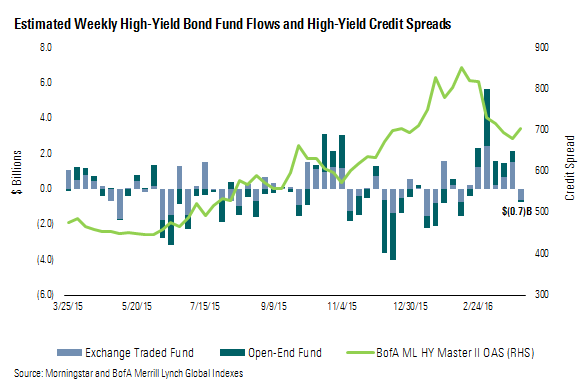
Record-Breaking Pace of Inflows Into High Yield Comes to an End In our prior Credit Research Highlights, we cautioned that the record-breaking pace of inflows into the high-yield asset class would slow after the runup in prices and recent softness in oil prices. Last week, high-yield open-end mutual funds and exchange-traded funds realized an outflow of $727 million. We also highlighted the near-term correlation between oil prices and the performance of the high-yield market. If, as we suspect, oil prices subside further, then we expect that investors may continue to pull some of the recent inflows from the high-yield sector to lock in short-term gains before credit spreads in the high-yield sector experience another bout of volatility.

 United States