
Investment-Grade Market Holds Steady; High-Yield Sinks With Stocks
Federal Reserve holds off yet again on raising the fed funds rate.

A few brave issuers entered the market early last week, but the new issue market quickly faded as investors awaited the Federal Open Market Committee decision. Among the new issues, we think St Jude's STJ (rating: A, wide moat) bonds were attractively priced compared with our view of the credit risk, even though we recently downgraded our rating by two notches. The downgrade reflects the increase in debt leverage used to acquire ventricular assist device company Thoratec. Management intends to maintain a strong investment-grade rating, though, and aims to deleverage to gross debt/EBITDA of around 2.0 times by the end of 2017, or about 1.5 turns of deleveraging in the two years after the planned acquisition, by our estimates. The firm's new 10-year notes were priced at Treasuries plus 175, but we think fair value on the notes is +150.
The average spread of the Morningstar Corporate Bond Index tightened 1 basis point to +174 basis points over Treasuries. However, as stocks sank late in the week, contagion of the risk-off sentiment spread to the high-yield bond market, and the average credit spread of the Bank of America Merrill Lynch High Yield Master Index widened 18 basis points to end the week at +580.
The two sectors that have disproportionately caused spreads to widen this year are basic industries and media. The basic industries sector within the Morningstar Corporate Bond Index has widened 66 basis points this year, well more than double the overall index. The media sector has widened 62 basis points. Among the basic industries sectors, plunging commodity prices have led to rapid fundamental credit deterioration across the entire sector, whereas in the media sector, myriad causes including weak results, debt-leveraging acquisitions, and heightened share-buyback programs have led to weakening credit metrics. While most would have thought that the energy sector would have been one of the main culprits this year, most of the spread widening in the investment-grade market in that sector occurred in late 2014. However, at an average spread of +255 for the sector, it is the second-widest sector among the entire investment-grade index, reflecting its high credit risk (the basic industries sector garners the notorious spot of being the widest at +259). The financial sector, specifically the banks, continues to be the best-performing sector as regulators have sustained their pressure to improve capital levels across the industry and kept a tight lid on programs to reward shareholders.
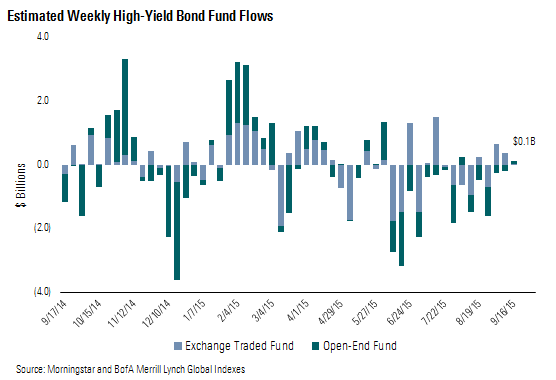
In the high-yield index, the metals and mining sector has widened 344 basis points this year to +1,189. Whereas credit spreads in the investment-grade energy sector have stabilized this year, in the high-yield market, jump-to-default risk has pushed the energy sector wider by 225 basis points to +981. In addition to heightened default risk in the metals and mining and energy sectors due to low commodity and oil prices, from a technical perspective, the high-yield market has had to contend with significant outflows in the third quarter, which has weighed on credit spreads. Over the past 11 weeks through Sept. 16, $4.2 billion of funds has been withdrawn from high-yield open-end mutual funds and exchange-traded funds. Investors cited the uncertainty surrounding the impact of China's devaluation of the yuan, the decline of commodity prices to multiyear lows, lower-than-expected earnings from global industrial firms, and economic metrics indicating that the Chinese economy is softening at an accelerating rate. Over the past three weeks, outflows appear to have stabilized as price declines in commodities and oil have stabilized and the wider credit spread has begun to attract investors back to the asset class.
Federal Reserve Holds Off Yet Again on Raising the Fed Funds Rate The Federal Open Market Committee decided to hold the federal funds rate steady at its targeted range of 0%-0.25%. If the Fed does not raise rates before December, it will be the seventh anniversary since the zero-interest-rate policy was put in place and a little over eight years since it began the current monetary easing cycle by lowering interest rates. The last time the Fed began a monetary policy tightening cycle was in June 2004, more than 11 years ago, and the last time it raised the fed funds rate was in June 2006. Assuming a person started working in finance right out of college at the age of 22, anyone in the financial community who is younger than 34 has not been employed during the beginning of a monetary policy tightening cycle.
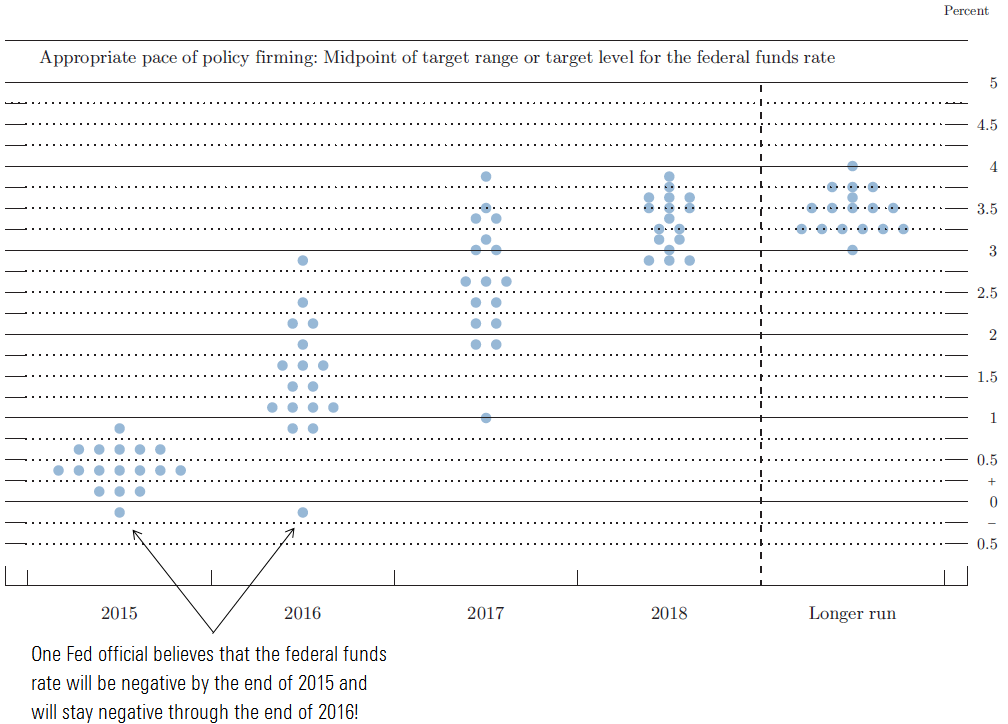
The Fed has long averred that its decision to begin raising interest rates and start normalizing monetary policy is "data dependent." Yet many of its governors have been intimating for much of this year that the Fed was close to the point where it would start to tighten monetary policy. Considering that recent U.S. economic data has been neither strong enough nor weak enough to indicate that the economy is on a strong, consistent expansionary trend, we thought this meeting would be especially contentious. However, only one voting member (Jeffrey Lacker of the Federal Reserve Bank of Richmond) dissented on the action, preferring to have raised the fed funds rate by 25 basis points. Telling of the wide dispersion of economic outlooks among the members, within the dot plots of the economic projections of the Fed's officials, one (our guess is Narayana Kocherlakota of the Minneapolis FRB, who has been particularly dovish) is now projecting that the fed funds rate will be cut to a negative interest rate by the end of this year and held through the end of next year.
The tone of the FOMC's statement was generally positive regarding the economic situation in the United States. The FOMC opined that economic activity is "expanding at a moderate pace," highlighting that "household spending and business fixed investment have been increasing moderately" and "the housing sector has improved further". The Fed even said "labor market indicators show that underutilization of labor resources has diminished." Inflation continues to run below the FOMC's target, but this is due to low energy prices and imports, which should equalize next year. It seems that the main development holding the FOMC back is economic weakness abroad: "Recent global and financial developments may restrain economic activity somewhat and are likely to put further downward pressure on inflation in the near term." In addition, it appears that the data dependency of the FOMC now includes international fluctuations, as it specifically said it is "monitoring developments abroad."
For 2015, the Fed increased its GDP forecast to 2.1% from 1.9%, decreased its unemployment projection to 5.0% from 5.3%, and slightly raised its core personal consumption expenditures inflation outlook to 1.4% from 1.3%. Robert Johnson, Morningstar's director of economic analysis, forecasts that 2015 GDP growth in the U.S. will range between 2.0% and 2.5%, and based on his current expectations, he is confident that GDP will most likely print at the high end of this range. Inflation will remain subdued through the rest of this year but should begin to normalize and rise early in 2016 as the year-over-year comparisons lap when oil prices hit their lows earlier this year. While the core PCE will remain low over the next few months, inflation as measured by the core consumer price index remains at 1.8%, not that far from the Fed's 2% target.
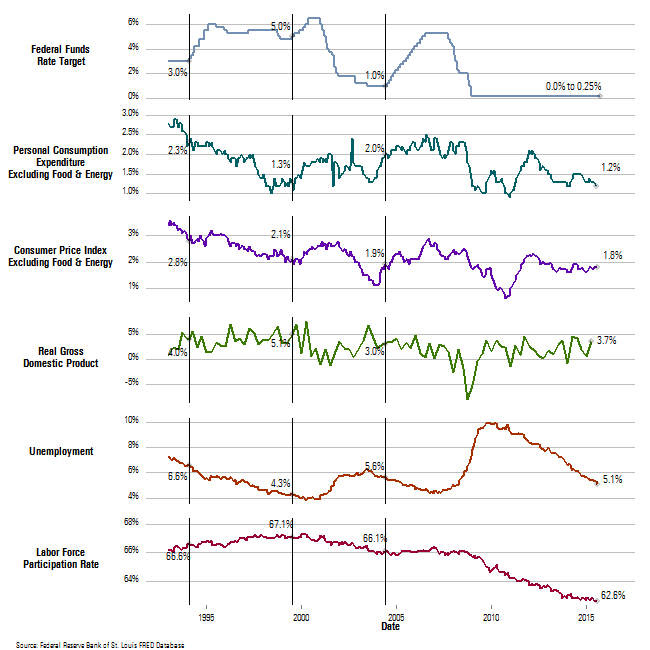
The zero-interest-rate policy was originally intended as an emergency measure to support the entire financial system in December 2008 and pump liquidity into the markets when the economy was in a free fall; it was only to be kept in place during the financial crisis and would normalize soon thereafter. With the credit crisis well behind us, unemployment declining to its long-run central tendency, and positive economic growth ahead, we expect this backdrop will be sufficient to encourage the Fed to begin raising short-term rates in the near term. Long-term interest rates should also move higher as monetary policy starts to normalize. Historically, the yield of the 10-year Treasury bond has averaged more than 200 basis points over inflation. With domestic economic growth expanding, albeit at a low-single-digit pace, the flight to the safety of Treasury bonds should subside.

 United States