
Investment-Grade Corporate Credit Spreads Rise to Widest Level in Three Years
Crude oil prices fall to lowest level since credit crisis.

Corporate credit spreads in the investment-grade bond market widened further last week. Investors looked to reduce risk exposures in light of slumping commodity prices and heightened uncertainty driven by China's devaluation of its currency. The average spread of the Morningstar Corporate Bond Index, our proxy for the investment-grade market, widened 5 basis points to +169 basis points over Treasuries. This is almost 30 basis points wider than where the index closed last year and is the widest level that the index has registered since September 2012, when the markets were recovering from the first incarnation of the Greek debt crisis and resulting European bank solvency concerns. Year to date, our investment-grade bond index's return is negative 0.20%. The decline in bond prices due to the combination of widening credit spreads and slightly higher underlying interest rates has more than offset the amount of underlying yield generated thus far this year.
Last week, China allowed the value of its currency to decline versus the U.S. dollar by about 3%. While the nominal change was not great in absolute terms, it occurred very rapidly, especially for a currency whose trading range is tightly controlled by the Chinese government. The devaluation is most likely a symptom of the rapidly slowing economic growth in the Chinese economy and indicative of significant capital outflows by foreign investors. The devaluation should help stem the decline of Chinese exports as these goods will now be cheaper compared with foreign currencies. In our view, the devaluation probably won't have much of a direct impact on the U.S. economy, as very little of that economy is based on exports, and of those exports, only a small amount is directed to China. In fact, over the medium to long term, the U.S. economy will most likely benefit from the lower commodity prices that have resulted from the slowdown in the Chinese economy. Although the Chinese economy appears to be cooling and the European economy remains stagnant, the U.S. economy continues its positive momentum. Robert Johnson, Morningstar's director of economic analysis, highlighted that economic data, such as retail sales, inventories, and construction data, has been revised upward over the past few weeks. In his opinion, this means that the next revision to the second-quarter GDP report may be an unusually large increase. Economic growth in the second quarter was originally reported at 2.3% and may be revised to 3.0%-3.5%. This positive momentum has carried through to the beginning of the third quarter, as the retail sales and industrial production reports were quite positive.
Other than specific companies with significant exposure to China, the devaluation is likely to have little direct impact on the U.S. corporate bond market. However, the devaluation may exert pressure on the economies of other Asian emerging markets and lead to significant capital flight from these countries. As such, the devaluation will hurt emerging-market fixed-income investments. In our third-quarter outlook published at the end of June, we noted that while emerging-market fixed-income indexes had performed well over the first half of the year, they are notorious for being an extremely volatile fixed-income class in a "risk off" scenario. Month to date, Morningstar's Emerging Markets Composite Bond Index has declined 0.7%, which has lowered the year-to-date return to 1.92%.
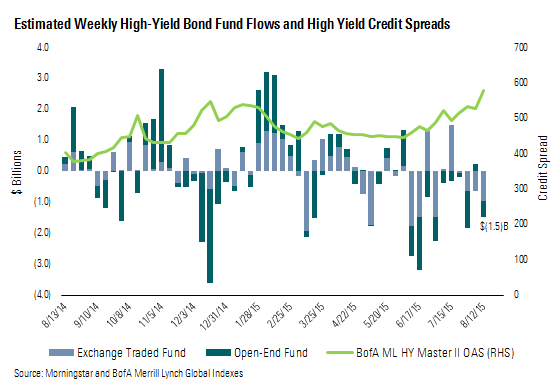
Outflows among high-yield mutual funds and exchange-traded funds marked their fourth consecutive week, as $1.5 billion of assets was pulled from the asset class. Investors appear to be looking to reduce risk exposures as they evaluate the impact of the yuan devaluation and weak commodity prices.
Crude Oil Prices Fall to Lowest Level Since Credit Crisis Crude oil prices fell to $42.13 a barrel last week, the lowest since March 2009. After stabilizing earlier this summer following the precipitous price declines over the winter, prices began to sink again in early July as the market priced in increasing probabilities that economic sanctions impeding Iran's ability to export oil were going to be lifted. Although oil volumes exported from Iran won't rebound immediately, the news was damaging to crude markets that are dealing with one of the toughest supply/demand imbalances over the past 20 years. Even though prices have fallen in the near term, our long-term outlook is unchanged, as we maintain our midcycle oil price forecasts of $75/bbl for Brent oil and $69/bbl for West Texas Intermediate crude. Since the news of a possible Iran deal broke on July 6, spreads among constituents in the energy component of the Morningstar Corporate Bond Index widened 35 basis points to +226 bps over Treasuries.
U.S. offshore rig counts may also be having an impact on credit spreads in the energy sector as the number of rigs has stagnated since the end of June, despite growth in the number of onshore rigs. In the last week alone, average spreads of drilling and oil field services companies with exposure to offshore production have fared the worst, increasing 16 and 11 basis points, respectively. Month to date, weak quarterly earnings reports from the integrated oil companies also caused spreads to widen. Investors are beginning to price in greater credit risk as they doubt management teams' ongoing ability to make meaningful investments in future growth while also returning significant amounts of cash to equityholders through dividends and share repurchases. Since the end of last month, the average spread of integrated oil companies in our index widened 14 bps to +218.

 United States