
Interest Rates Rise Off Historic Lows, but Demand for Corporate Bonds Remains High
Search for yield drives third-greatest amount of weekly inflows into high yield.

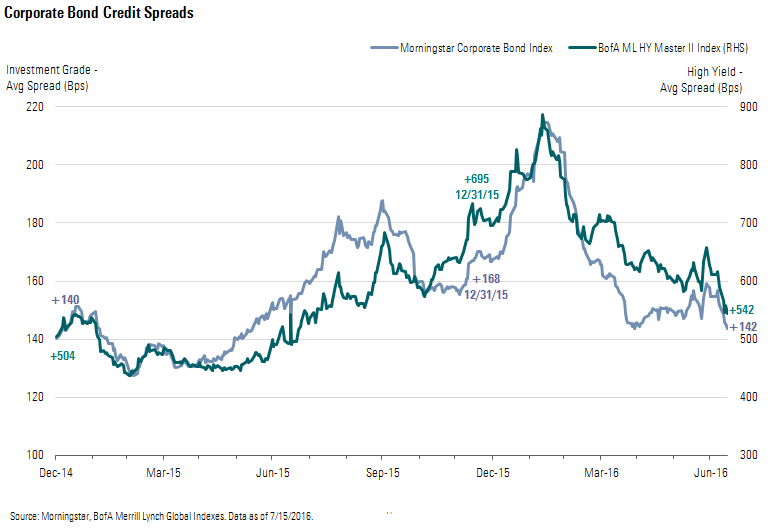
Interest rates rose sharply last week off of the new historical lows of the previous week, but investors continued to find value in corporate bonds. The yield on 5-year, 10-year, and 30-year U.S. Treasury bonds rose 15 basis points, 19 basis points, and 17 basis points, respectively, to 1.10%, 1.55%, and 2.27%. Yet even with the increase in rates, the yields on Treasury bonds remain near all-time lows. While sovereign bonds sold off, the credit spread on corporate bonds continued to tighten, helping offset much of the losses generated by the increase in underlying yields. The average credit spread of the Morningstar Corporate Bond Index tightened 9 basis points to +142, and the average spread of the Bank of America Merrill Lynch High Yield Master II Index tightened 46 basis points to +542. Since the end of last year, the average credit spread of the Morningstar Corporate Bond Index has tightened 26 basis points and the Bank of America High Yield Master II Index has tightened 153 basis points.
Even after accounting for the sell-off in Treasury bonds last week, the combination of lower interest rates and tighter credit spreads has led to much greater than expected returns among fixed-income securities so far this year. Year to date, our investment-grade index, the Morningstar Corporate Bond Index, has gained 8.21%, and in the high-yield market, the Bank of America High Yield Master II Index has risen 10.89%. While the equity market has made great strides over the past few weeks to catch up, it continues to lag the corporate bond market, having only risen 5.76%.
With most of the world’s central banks pursuing ever easier monetary policies, demand for fixed-income securities denominated in the U.S. dollar remains high. Foreign investors are finding value in U.S. Treasury bonds, which are some of the last sovereign bonds in the developed markets that trade at a positive yield. In addition, with deposit rates negative in the European Union, over time the U.S. dollar will likely continue to appreciate compared with the euro. As interest rates sink, corporate bonds have become increasingly more attractive on a relative value basis. With underlying interest rates as low as they are, the extra return provided by the credit spread on corporate bonds above the underlying benchmark Treasury bond has become an increasingly larger portion of total return.
Among other fixed-income asset classes, the Morningstar Core Bond Index, our broadest measure of the fixed-income universe, has increased 5.39%, and the Morningstar US Treasury Index has climbed 4.99%. Among the different durations of fixed income, the Morningstar Short-Term Core Index is up 1.93%, the Intermediate Core Index has increased 3.99%, and the Long-Term Core Index has risen 12.46%. Among the U.S. fixed-income indexes, the Morningstar Long-Term Corporate Bond Index has generated the greatest return of 13.41%.
In the international fixed-income markets, the emerging markets have produced stellar returns. The Morningstar Emerging Markets Composite Bond Index has risen 11.55%. Among the underlying subcomponents of the composite index, the Emerging Market Sovereign Bond Index has risen 12.84%, and the Emerging Market Corporate Bond Index has increased 11.21%. The Morningstar Emerging Markets High Yield Bond Index has jumped 14.22% this year.
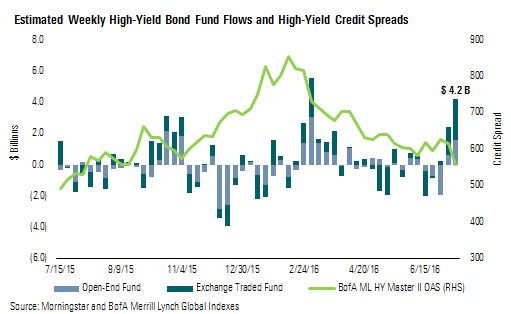
Search for Yield Drives Third-Greatest Amount of Weekly Inflows Into High Yield As an indication of investors' demand for yield, the high-yield sector experienced one of its single greatest weekly inflows since we started tracking the data in June 2009. Last week, almost $4.2 billion of inflows were recorded among the high-yield open-end mutual funds and exchange-traded funds. While this lags the $5.7 billion of inflows that surged into high-yield at the end of February 2016 when oil prices bottomed out, it rivals the second-greatest weekly inflow of $4.3 billion, which occurred in October 2011, shortly after the U.S. Federal Reserve launched Operation Twist and the equity markets were on their way higher.
A significant amount of the inflows are reportedly coming from investors in Europe and Japan. While yields may appear low to U.S. investors, those same yields appear attractive to investors whose sovereign bonds are trading at negative yields. In addition to earning a higher all-in yield, these same investors are also attracted to assets denominated in the U.S. dollar, which they expect to continue to appreciate against the euro and yen so long as those central banks pursue a negative interest-rate policy.
Also, the ultralow cost of debt is likely to lead to even more debt-funded share buyback programs. With interest rates so low and credit spreads at reasonable levels, there is an arbitrage for dividend-paying companies to repurchase stock to reduce the dividend payments with bonds whose interest rates are lower (even on a pretax basis) than the dividend yield being paid. Even at the risk of suffering credit rating downgrades, we expect this temptation to be greater than many companies can resist.

 United States