
As Interest Rates Rise, Investors Prefer Corporate Bonds
Treasury yield curve rises and flattens as probability of December interest rate hike climbs.

The strong demand for corporate bonds continued last week, pushing credit spreads tighter across the investment-grade and high-yield sectors. The average spread of the Morningstar Corporate Bond Index, our proxy for the investment-grade market, tightened 4 basis points to +156 bps over Treasuries. In the high-yield market, the average credit spread in the Bank of America Merrill Lynch High Yield Master Index tightened 6 basis points to end the week at +582 bps.
Until there is some specific catalyst that causes investors to rethink the amount of risk they are willing to undertake, this strong demand for corporate bonds is likely to persist. A confluence of factors has heightened demand for corporates from domestic as well as foreign buyers. Both domestic and foreign buyers are attracted to the credit spread currently offered on corporate bonds. Even though credit spreads have tightened from their recent highs at the end of September, the average credit spreads of investment-grade and high-yield indexes remain higher than their long-term averages.
Among domestic institutional investors, the increase in underlying interest rates on U.S. Treasury bonds has lifted the all-in yields to rates targeted by insurance companies and pension funds. In addition, as yields in the United States have risen, the higher rates have made U.S. fixed-income assets increasingly more attractive to foreign buyers. For example, the yield for many among short-term European sovereign bonds is negative through the 5-year maturity, and for long-term bonds, the yield on the 10-year U.S. Treasury is 164 basis points higher than the 10-year German bond. In addition, the European Central Bank's purchases of sovereign debt have reduced the amount of bonds available to purchase, and European investors have used investment-grade corporate bonds as substitutes for sovereign bonds. Finally, foreign investors also looked to U.S. dollar-denominated investments to protect the purchasing power of their savings, as the dollar has been steadily appreciating versus other currencies.
In the investment-grade market, demand was especially strong in the single A rating category for all maturities. The buying across the 3- to 5-year space was dominated by foreign investors (European and Asian), and purchases among 10- and 30-year bonds was led by institutional buyers, particularly insurance companies and pension funds. Some of the demand began to spread into the BBB rating category, but even in face of the strong demand over the past few weeks, portfolio managers remained disciplined and stuck with the well-known issuers. At this point, we have not seen investors willing to reach for extra yield among issuers whose credit quality is tainted.
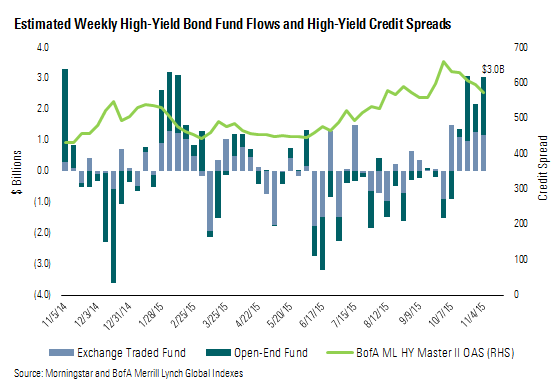
Over the past few weeks, we have noted that the strong demand has been driven by several sources, including foreign investors, institutional investors, and inflows from retail accounts. For example, as indicated by fund flows into the high-yield asset class, inflows into open-end mutual funds and exchange-traded funds rose by $3.0 billion last week. After suffering outflows for much of the year, this is the first time since February that the asset class has registered five consecutive weeks of inflows. While the cumulative amount of inflows over the past few weeks is less than the amount of cumulative inflows registered earlier this year, it remains one of the greatest inflows of funds into the high-yield market over a consecutive five-week period.
Treasury Yield Curve Rises and Flattens as Probability of December Interest Rate Hike Climbs The market-implied probability in the interest rate futures market that the Fed will raise the federal funds rate in December has been rising since Oct. 28, when the Fed released its statement after the Federal Open Market Committee meeting. After the employment report was released last Friday, the probability of a rate increase in December jumped even higher (to over a 75% probability from an approximate 50% probability). As short-term Treasury bonds are more highly correlated to movements in the federal funds rate than long-term rates, the yield curve has been flattening as it has been rising. Thus far this year, the yield on the 2-year Treasury bond has risen 22 basis points to 0.89%, whereas the yield on the 10-year Treasury bond has risen 16 basis points to 2.33%.
Interest rates probably have further to rise as they normalize toward historical averages compared with inflation and inflation expectations. However, the dynamics are different now than in spring 2013, when the taper tantrum sent credit spreads wider. Back then, interest rates on Treasury bonds were coming up from a much lower level. As underlying rates rose rapidly, portfolio managers looked to reduce duration across the entire fixed-income asset class, including selling long-dated corporate bonds, which sent credit spreads wider. While interest rates rose last week, they are rising from a higher level; they probably will not rise as rapidly and don't have as far to rise. For example, during the taper tantrum, the 10-year Treasury bond quickly rose over 100 basis points to 2.70% at the end of June 2013; now, the 10-year Treasury bonds is already trading at 2.33%.

 United States