
High-Yield Rally Loses Steam as Oil Prices Roll Over
Investors continued to invest in high-yield sector; inflows likely to slow in upcoming weeks.

Strategist's Perspective
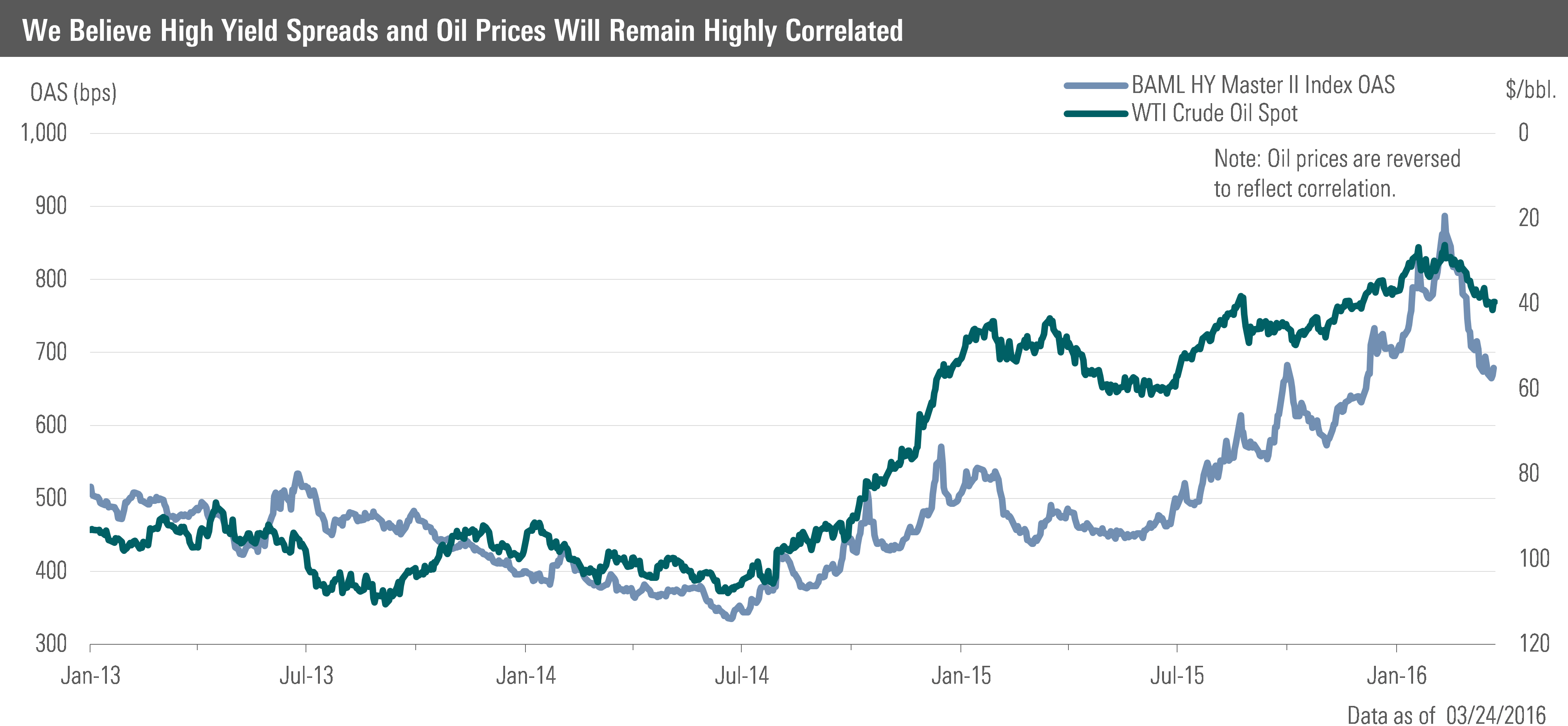
High-Yield Rally Loses Steam as Oil Prices Roll Over It was a relatively quiet, holiday-shortened week in the corporate bond market. A few new issue deals priced early in the week before traders headed home for a long weekend. The average spread of the Morningstar Corporate Bond Index tightened 4 basis points to +166, but the multiweek rally in high yield ran out of steam as the surge in oil prices rolled over. Oil fell 1.5% to $39.60 per barrel, which helped to push the average spread of the Bank of America Merrill Lynch High Yield Master II Index 22 basis points wider to +693. Similarly, the S&P 500 gave up a bit of its recent gains and slid 0.7%.
In our second-quarter corporate bond outlook, we averred that oil prices and high-yield credit spreads would remain tightly correlated in the near term. While oil prices have rebounded sharply off their mid-February lows, Morningstar's corporate credit analyst for the energy sector, Andy O'Conor, cautions that near-term crude oil concerns remain. Specifically, O'Conor has highlighted:
- High global inventories of oil, with U.S. commercial crude inventories at a more-than 80-year high
- Heightened OPEC production, as Saudi Arabia and other key members within the cartel continue to pursue market share protection, despite the negative impact to oil price
- Reacceleration of Iranian production and exports since economic sanctions were lifted in January, partly offsetting production cuts under way elsewhere
- Tepid Chinese economic growth, the world's largest oil importer. While we see further upside in oil prices by the middle of the oil cycle, we think that oil prices will remain volatile in the near term until nonprofitable producers make meaningful reductions in production.
Disappointing Durable Goods Orders Pressure Consensus GDP Estimates, but We Remain Steady
The Fed held off from raising rates at its March meeting in response to market volatility and weaker global economic activity. However, last week several Federal Reserve officials (St. Louis Fed President James Bullard and Atlanta Federal Reserve President Dennis Lockhart) stated that additional interest rate hikes may not be far off if economic data remains stable. They indicated that the Fed could raise the federal funds rate again as soon as its April 26–27 meetings; however, it's unlikely that the Fed would raise rates during a meeting that does not also have a scheduled press conference and updated economic projections. The next meeting with associated press conference and updated economic projections isn't until the June 14–15 meeting.
U.S. durable goods orders excluding the transportation sector were down 1.0% in February as compared with January. This was lower than consensus estimates, but investors should not be overly concerned as the January durable goods orders were a 1.8% increase. Also on a positive note, the rate of decline on a year-over-year basis for durable goods orders continued to show improvement as the rate of decline has been slowing. Morningstar's Director of Economic Analysis Robert Johnson forecasts that order rate to turn positive by June. Because the monthly durable goods data is a factor utilized in calculating the GDP report, the Atlanta Fed lowered its GDPNow GDP forecast for the first quarter to 1.4% from 1.6%; however, Johnson is maintaining his first-quarter GDP estimate of 2.0%.
Second-Quarter 2016 Corporate Bond Outlook In first-quarter 2016, the average spread of our investment-grade index ranged between +168 and +216 and in high yield, credit spreads ranged between +671 and +887. For second-quarter 2016, we think investors should be braced for another bout of corporate credit spread volatility. In such a volatile environment, investors should look to utilize selloffs to increase exposures in those sectors whose underlying credit risk dynamics are unaffected by the downturn in commodity prices, but in which credit spreads widen in sympathy with overall market movement.
We expect the volatility to be bounded between by swings in expectations for a relatively stable economic environment in the United States as opposed to global economic recessionary fears in conjunction with downward pressures in the commodity sector. From an overall economic outlook, Johnson expects real GDP growth in the U.S. to average between 2.0% and 2.5% in 2016, inflation as measured by the Consumer Price Index will average 2.5% and the unemployment rate will drop toward 4.6%–4.8%. Based on these assumptions, he expects the yield on the 10-year Treasury should increase towards 3.00%. Yet, while the U.S. economy should hold its course, we expect economic growth in China to continue to wane. Even though a very small percentage of U.S. exports are directly tied to China, as the second-largest economy in the world, a slowdown in Chinese economic activity will have ripple effects throughout the world. In addition, credit spread volatility will continue to emanate from the commodity sector, and more specifically, oil prices.
O'Conor believes that ongoing over-production in the oil sector could lead oil prices to tumble once more.
The recent recovery in commodity prices has likely run most of its course over the past few weeks, so prices are poised either to stabilize or to reverse from current levels. Even at the current price levels, default rates in the energy and basic materials sectors will continue to climb over the course of the year. This will increase the overall default rate; however, continued moderate economic expansion in the United States will continue to keep default rates in check among other sectors.
In addition to the economic outlook and volatility in commodity prices, there is a new exogenous variable that will have an impact on the U.S. corporate credit markets. Not only has the ECB continued to expand its easy monetary policy by cutting financing rates further and increasing the negative yield on its deposit facility, but it has also increased the size of its monthly asset purchase program to EUR 80 billion from EUR 60 billion. As part of its quantitative easing program, the ECB has announced that it will begin purchasing nonbank investment-grade corporate bonds by the end of second quarter. In our view, the ECB will not be a price sensitive buyer of corporate credit risk as its main goal it to further expand its easy monetary policy in an attempt to bolster economic growth and stoke inflation, opposed to traditional investors which look to maximize their return for a given level of risk. Toward the end of the second quarter, once the ECB begins this aspect of its purchase program, we expect credit spreads to tighten (or at least restrict the amount credit spreads would widen if global economic fundamentals are deteriorating), as supply is removed from the corporate bond market and those investors that sold their bonds will need to reinvest the proceeds. As such, the ECB's purchases are likely to distort the normal market discounting function and will artificially suppress credit spreads. The abnormally low interest rates due to the negative interest rate policy not only have an impact on fixed-income investors, but now investors' compensation for accepting corporate credit risk will be reduced as well.
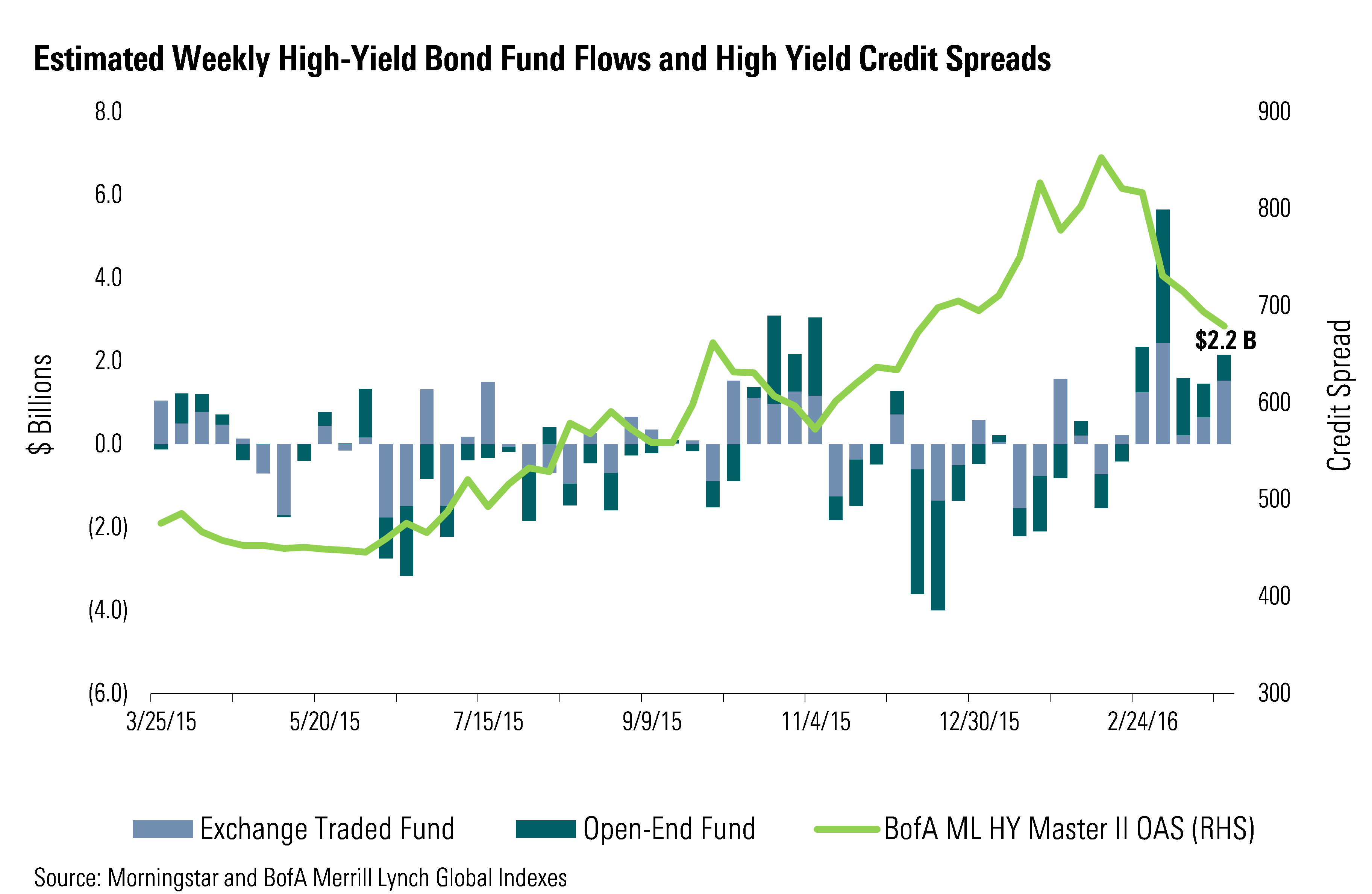
Investors Continued to Invest in High-Yield Sector; Inflows Likely to Slow in Upcoming Weeks Inflows into high-yield open-end mutual funds and ETFs totaled $2.2 billion last week; however, after setting a new record for the amount of inflows over a four-week consecutive period, we expect the amount of assets flowing into the high-yield sector to slow.

 United States