
High-Yield Credit Spreads Snap Tighter
Investors tiptoe back into high yield.

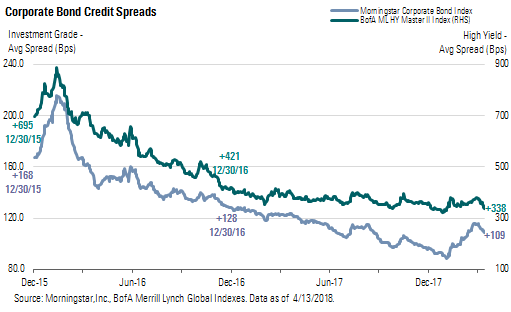
Corporate credit spreads in the high-yield market tightened 23 basis points last week as the average spread of the BofA Merrill Lynch High Yield Master Index dropped to +338 basis points. This is near the low end of the 90-basis-point range that the high-yield market has traded in since the beginning of 2017. In the investment-grade market, the average spread of the Morningstar Corporate Bond Index tightened 3 basis points last week to +109. While credit spreads in the high-yield market are nearing the lows they hit in January, credit spreads in the investment-grade market remain well wide of the levels they hit earlier this year.
Yields on U.S. Treasuries marched higher last week, with short-term interest rates hitting renewed highs. Interest rates have been pushed and pulled in different directions over the past few weeks. Short-term rates have surged higher in conjunction with mounting inflation pressures, while trading levels on long-term interest rates have vacillated depending on the volatility amid risk-on and risk-off sentiments as geopolitical risks ebb and flow. This past week, the Bureau of Labor Statistics released its March report on the Consumer Price Index, which showed that headline inflation rose to a 2.4% annual rate on a year-over-year basis. Even excluding the more volatile components of the index, core CPI inflation increased to 2.1% in March, an increase from 1.8% last month and the highest reading over the past 13 months. With inflation running at the Federal Reserve's preferred rate, investors are pricing in another 25-basis-point hike in the federal-funds rate, to 175-200 basis points, as a near certainty. In addition, investors are bracing for further rate hikes this fall. According to the CME FedWatch Tool, the interest-rate futures market is pricing in an 84% probability that the fed-funds rate will end the year over 200 basis points.
The yield on the U.S. 2-year Treasury bond increased 9 basis points, ending the week at 2.36%, the highest it has traded since August 2008. The yield on the 5-year Treasury bond rose 8 basis points to 2.67%, near the highest it has traded over the past eight years. The yield on the 10-year rose 8 basis points to 2.83%, placing it in the top of the range that it has traded over the past five years. Along the longest end of the curve, the 30-year bond only rose 1 basis point to 3.03%.
Among other asset classes, although the S&P 500 traded off on Friday afternoon, it rose 0.83% for the week and is near the top of its trading range over the past three weeks. Oil jumped over $5 per barrel to $67.33, its highest price since November 2014. Oil prices have been steadily rising as production cuts by OPEC and Russia have led to decreasing global oil inventories. In addition, Saudi Arabia has been hinting at being comfortable with $80 per barrel.
Depending on how multiple different near-term catalysts play out over the next few weeks, the corporate bond markets could trade sharply higher or lower. The markets appear to be assuming that the military action in Syria over the weekend will be constrained to this limited engagement. Further military actions would probably inflame the already heightened tensions between the United States and Russia and lead to a risk-off sentiment across the market. In addition, after a few early-round jabs, the U.S. and China continue to circle one another like two boxers at the beginning of a fight, evaluating one another's strengths and weaknesses. Investors' initial concern following the opening gambits has subsided, but there will be many more rounds to go before any semblance of resolution for trade issues. Market volatility will depend on whether the trade negotiations are conducted on an orderly basis or played out in the headlines. Lastly, earnings season ramps up in earnest this week, and depending on results and updated expectations for the remainder of the year, this could affect investor sentiment.
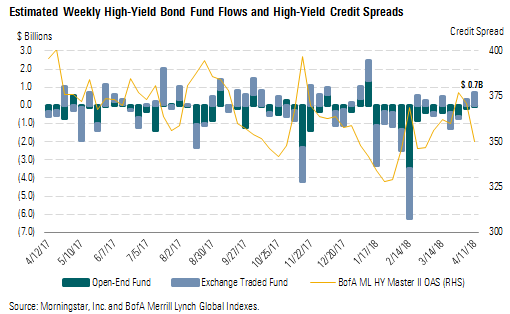
Investors Tiptoe Back Into High Yield Following a record-breaking streak of weekly outflows earlier this year, investors finally began to tiptoe back into the high-yield market. Net inflows into high-yield open-end mutual funds and exchange-traded funds totaled $0.7 billion last week. Inflows were driven entirely by $0.7 billion of net unit creation among the ETFs as open-end funds were essentially unchanged. This represents the greatest amount of net weekly inflows since the beginning of January 2018. Historically, ETFs have been considered a proxy for institutional investor demand, whereas open-end funds are considered a proxy for individual investors. Year to date, there has been a total of $12.7 billion of outflows across the high-yield sector, consisting of $8.0 billion of outflows among open-end high-yield mutual funds and $4.7 billion of net unit redemptions among high-yield ETFs.
Morningstar Credit Ratings, LLC is a credit rating agency registered with the Securities and Exchange Commission as a nationally recognized statistical rating organization ("NRSRO"). Under its NRSRO registration, Morningstar Credit Ratings issues credit ratings on financial institutions (e.g., banks), corporate issuers, and asset-backed securities. While Morningstar Credit Ratings issues credit ratings on insurance companies, those ratings are not issued under its NRSRO registration. All Morningstar credit ratings and related analysis contained herein are solely statements of opinion and not statements of fact or recommendations to purchase, hold, or sell any securities or make any other investment decisions. Morningstar credit ratings and related analysis should not be considered without an understanding and review of our methodologies, disclaimers, disclosures, and other important information found at https://ratingagency.morningstar.com.

 United States