
High Returns Prompt Early Year-End Window Dressing
Market Data and Insights

Interest rates rose substantially last week as investors are becoming increasingly more concerned that inflation rates are rising and that the Fed will lift the federal funds rate at its December meeting. The yield on the 5-year Treasury rose 8 basis points to 1.32%, the yield on the 10-year increased 12 basis points to 1.85%, and 30-year increased 14 basis points to 2.62%. These levels represent the highest rates that Treasury bonds have traded at since May.
Among economic indicators released last week, third-quarter real GDP was reported to have increased at a 2.9% annualized pace. This growth rate is the second consecutive increase in the growth rate from 1.4% in the second quarter and 0.8% in the first quarter and is the fastest rate of growth since second- quarter 2015. However, it should be noted that factors that are unlikely to be repeated in the fourth quarter drove a substantial amount of the growth. For example, exports and inventory accumulation drove approximately half of the growth rate. Specifically, the exports of soybeans were pulled forward from their typical fourth-quarter export pattern and represented 0.9% of the growth rate. This will provide a headwind in the fourth-quarter GDP growth rate as the effect will be reversed in the coming months. While the headline GDP result was encouraging, several of the underlying factors were below expectations. For example, consumption growth only rose at a 2.1% pace and capital expenditures posted its fourth consecutive quarterly contraction.
Although the drivers within the third-quarter GDP report may not be as robust as hoped for, with third- quarter economic growth rising at a 2.9% pace, unemployment down to 5.0%, and the Consumer Price Index rising 1.5% over the past 12 months, it appears that the Fed will have little reason not to raise the federal funds rate at its December meeting. After having been cut to zero percent seven years ago in response to the 2008–09 credit crisis, the federal funds rate is still only in a range of 0.25%–0.50%, which remains lower than any other time in history prior to the credit crisis.
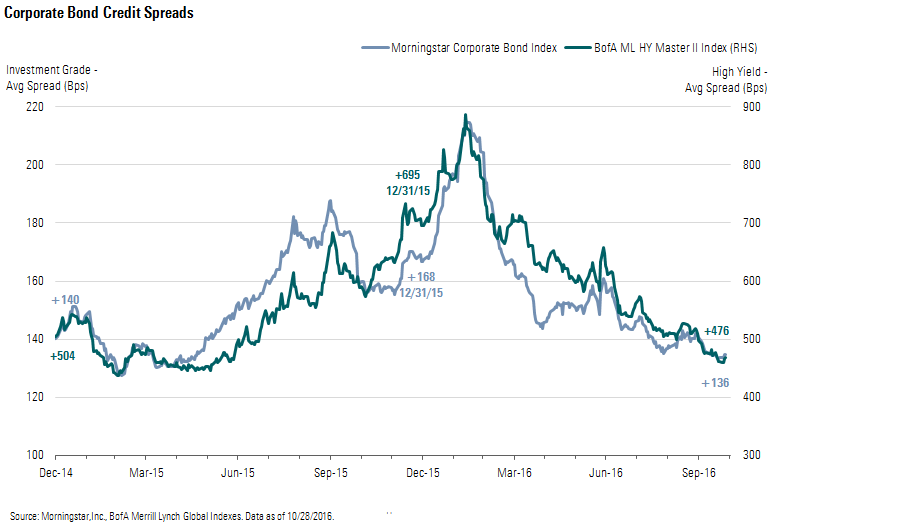
In the fixed-income markets, corporate credit spreads traded in a relatively tight range last week as investors were unwilling to pay up for corporate bonds in a rising rate environment; yet, the demand for corporate bonds remains strong enough to keep credit spreads from widening out. Year to date, corporate credit spreads have fully recovered from the panic that gripped the corporate bond markets in early 2016 when oil and commodity prices were hitting multiyear lows. Both the average spread of the Morningstar Corporate Bond Index and the Bank of America Merrill Lynch High Yield Master Index have tightened to multiyear lows, touching the tightest levels that credit spreads have traded at since mid-2015. The average spread of the Morningstar Corporate Bond Index ended last week at +136 basis points and the Bank of America Merrill Lynch High Yield Master Index closed at +476 basis points.
Between a strong new issue calendar and a slew of recent merger and acquisition announcements, bond traders were kept especially busy last week as a significant amount of volume traded hands in the secondary market. As corporations have begun to release their earnings reports and exit their quiet periods, many management teams have looked to capitalize on the combination of low interest rates and tight credit spreads. With the U.S. presidential election closing in fast, many CFOs may look to lock up funding before any heightened uncertainty may have an impact on the new issue window to the market. In addition, there remains several large announced acquisitions that need to be financed and will require a substantial amount of funding in the debt capital markets. For a list of those issuers that we believe may look to tap the debt capital markets in the near term, please refer to our publication Potential New Issue Supply, dated Oct. 20.
After a brief lull this summer, the number of recently announced M&As has soared. We placed our corporate credit ratings of
The unusually high trading volume in the secondary market was also attributed to early year-end window dressing by many institutional investors that invest with a total return mandate. Considering our investment-grade index is up almost 8% year to date and the Bank America Merrill Lynch High Yield Master Index has risen 16%, these investors are looking to lock in gains and have been switching to a more defensive posture to ride out the rest of the year. Considering that the yield at the beginning of the year on investment-grade bonds averaged 3.50% and high-yield bonds averaged 8.75%, these returns generated year-to-date are substantially greater than expected.
While these investors have not been selling corporate risk en masse, they have been looking to shift their portfolios to a more defensive posture. Bond traders have reported that these investors are scouring their portfolios for any issuers that have any downside risk. Specifically, they are trying to identify any issuers that may be at risk of trading down in response to further merger & acquisition activity. In addition, they are locking in gains on bonds in the energy sector that they purchased earlier this year during the rout in the oil market as these bonds have risen further and faster than expected in such a short time frame.
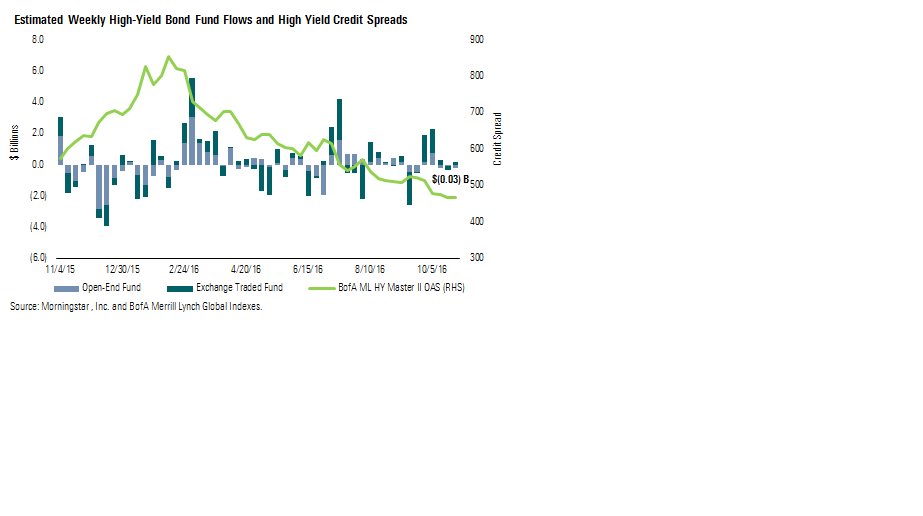
High-yield fund inflows were essentially unchanged last week as the amount of inflows into exchange- traded funds was slightly more than offset by the amount pulled from open-end mutual funds. Considering the weekly amount of fund flows over the past three weeks has been effectively been zero, it appears that the market is taking a wait-and-see attitude regarding the remainder of third-quarter earnings. In addition, before making any investment decisions prior to either committing additional funds or withdrawing funds from this asset class, investors are waiting to hear from management teams as to the outlook for the fourth quarter.
Morningstar Credit Ratings, LLC is a credit rating agency registered with the Securities and Exchange Commission as a nationally recognized statistical rating organizations (“NRSRO”). Under its NRSRO registration, Morningstar Credit Ratings issues credit ratings on financial institutions (e.g., banks), corporate issuers and asset-backed securities. While Morningstar Credit Ratings issues credit ratings on insurance companies, those ratings are not issued under its NRSRO registration. All Morningstar credit ratings and related analysis contained herein are solely statements of opinion and not statements of fact or recommendations to purchase, hold, or sell any securities or make any other investment decisions. Morningstar credit ratings and related analysis should not be considered without an understanding and review of our methodologies, disclaimers, disclosures and other important information found at https://ratingagency.morningstar.com.

 United States